Mobile County School Board Approves Armed Deputies in All 12 High Schools
The Mobile County School Board approved a three-year pilot program to place armed deputies in all 12 high schools, funded entirely through the school.
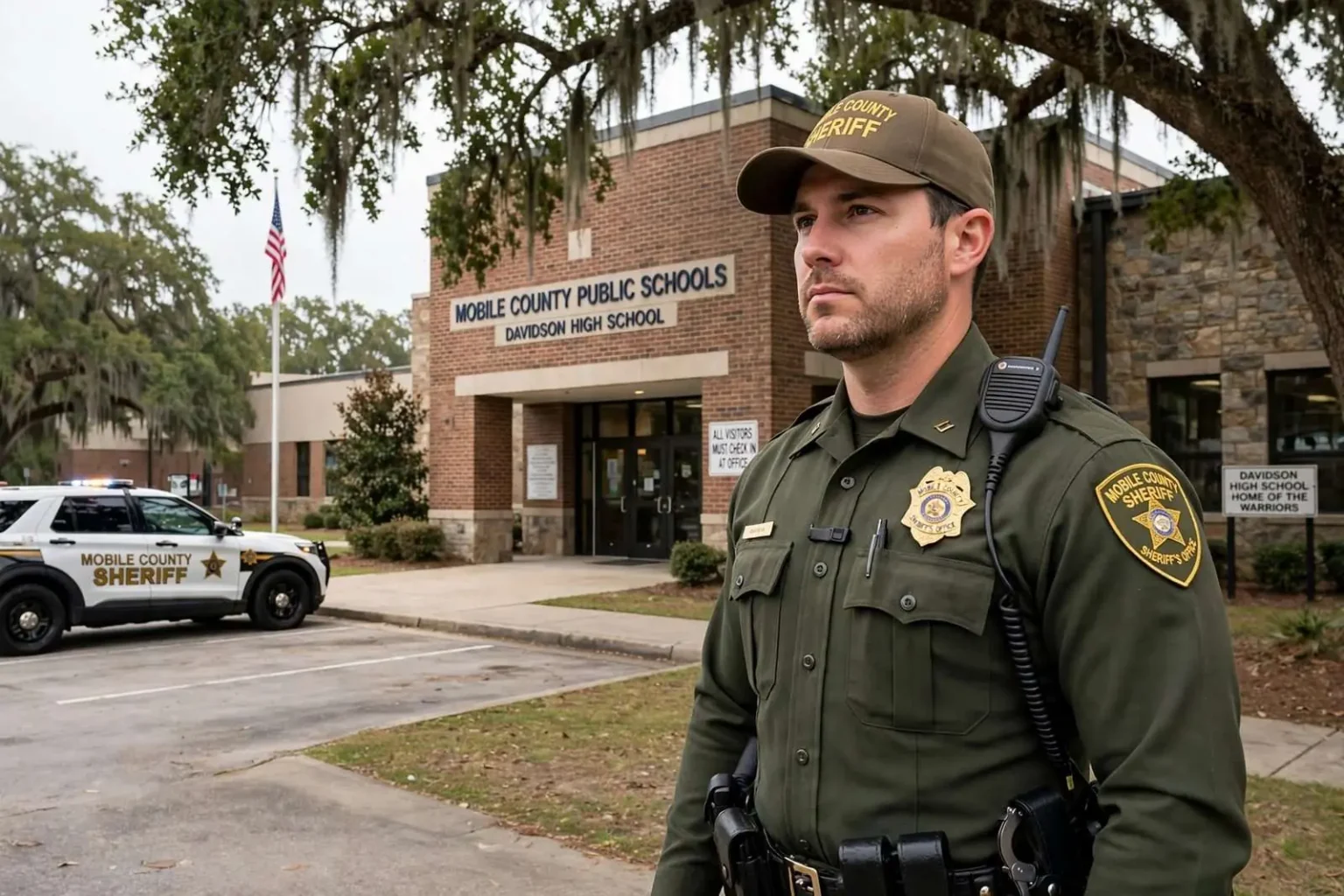
MOBILE, Ala. — The Mobile County School Board has approved a plan to place armed deputies in all 12 Mobile County high schools, marking a significant shift in campus security policy for the largest school system in Alabama. The board voted Monday to move forward with a three-year pilot program developed in collaboration with the Mobile County Sheriff’s Office and the Mobile County Commission, an arrangement that puts sheriff’s deputies — rather than the district’s existing security staff — inside high schools across the county.
The initiative will be fully funded through the school system, an unusual structure for partnerships of this kind and one that signals how seriously district leaders treat the security question. By paying for the program itself, the district keeps control over the positions while drawing sworn, trained personnel from the sheriff’s office.
The Cost of the Program
The program is expected to cost nearly $1.8 million in its first year, covering salaries, overtime, benefits, equipment and vehicles for the newly hired deputies. Costs in the second and third years are projected at approximately $1.3 million annually, a step down that reflects the difference between startup expenses and steady-state operations.
For a district that stretches from the city of Mobile out to communities along the Mississippi line, the investment ranks among the largest single security expenditures in its history. Board members weighed that price against the realities of modern campus safety, and the vote signals a consensus that the current model had reached its limits.
“This is a move forward into being proactive, not reactive,” Board Commissioner Johnny Hatcher said, framing the program as a change in philosophy as much as a change in staffing. The distinction — prevention before response — captures the argument supporters made during deliberations: an armed deputy stationed on campus can act in seconds, where a 911 call brings help in minutes.
The Gaps in Current Coverage
Mobile County schools currently employ resource officers, but those officers are unarmed and face limitations in responding to emergencies. The existing officers handle day-to-day matters — truancy, disputes, campus incidents — but a serious armed threat falls into a category their training and equipment were not designed to address.
The district’s geography compounds the challenge. With 90 campuses spread across the county, the school system has long struggled to maintain adequate security coverage, and campuses outside the city limits can be far from the nearest municipal police force.
“With 90 campuses like I said, over half of our campuses are in the City of Mobile,” MCPSS Safety and Security Director Andy Gatewood said. “So you can imagine if we have things that happen at several campuses at one time, it really stretches the Mobile Police Department and other agencies really thin. So it’s going to be great to have one deputy in for each high school that we can call.”
How the Pilot Will Work
Under the three-year pilot, each of the county’s 12 high schools will have an armed deputy assigned to the campus, drawn from the Mobile County Sheriff’s Office and funded by the district. The deputies will be primarily stationed at the high schools but will make occasional rounds to middle and elementary campuses to familiarize themselves with the broader school community — a feature designed to put a known, uniformed face on campuses that do not have a daily deputy presence.
No firm start date has been set, but officials say the program will begin soon, with hiring and assignment logistics to be worked out between the district and the sheriff’s office. The pilot structure gives the board a built-in evaluation window: three years of data on cost, incidents and campus climate before any long-term commitment.
Community Reaction
Mobile resident Tom Wait, who has had grandchildren in the Mobile County school system, said the plan is a good start but believes more should be done. “I think it should be more than the high schools,” Wait said. “It should be the grade schools too because we got some real kooks running around here.”
His reaction mirrors a debate that follows school security programs everywhere: whether protection aimed at the oldest students should extend down the grade levels, where the youngest children spend their days. Supporters of the phased approach argue that starting with high schools — where campuses are larger and the student population older — is the sensible first step.
Looking Beyond the High Schools
Board members said that if the high school program runs smoothly, they plan to expand armed deputy coverage to middle and elementary schools. The pilot’s design makes that expansion a deliberate decision point rather than an assumption, with the district able to assess the first three years before widening the program.
“Guns don’t necessarily fix everything, but it is good in the event that requires some type of higher-level security,” Gatewood said. His framing reflects the program’s stated purpose: the deputies are a backstop for the emergencies that exceed the capabilities of existing staff, not a replacement for the day-to-day work of campus resource officers.
Board member Douglas Harwell said the deputies represent another layer of security, but his long-term hope is that the presence builds trust between students and law enforcement. “So hopefully what we are going to see after they are leaving the school systems is that they can trust these guys,” Harwell said. “They have seen these guys in uniform and that they are good people. They are here to help us.”
A District Defined by Its Scale
The Mobile County Public School System is the largest school district in Alabama, covering not only the city of Mobile but also communities such as Prichard, Chickasaw, Saraland, Satsuma, Citronelle, Tillman’s Corner and the unincorporated stretches of the county. Its 90 campuses range from dense urban schools to rural schools where the nearest sheriff’s substation may be a long drive away, and that geography has shaped every security decision the board has made.
The scale also explains the cost structure of the deputy program. Twelve high schools means twelve deputies, each with a vehicle, equipment and benefits, and the district’s decision to absorb the full cost reflects both the sheriff’s office’s own budget constraints and the board’s desire for a program it controls directly.
The Sheriff’s Office Partnership
The Mobile County Sheriff’s Office patrols the unincorporated parts of the county and provides law enforcement services to communities without their own police forces, making it the natural partner for a school security program that spans the entire county. Deputies assigned to schools remain sworn officers of that office, with the training and arrest authority that come with the badge — a significant escalation from the unarmed resource officer model.
Partnerships between school districts and sheriff’s offices have become a common answer to campus security questions across Alabama, with the specific structure — who pays, who supervises, who responds — varying from county to county. Mobile County’s fully district-funded arrangement gives the board a direct line of accountability for the program’s performance during the pilot period.
What Parents and Students Should Expect
For families, the most visible change will be a marked deputy’s vehicle at each high school and a uniformed armed presence on campus during school hours. Administrators typically pair such arrivals with communication to parents explaining the officer’s role, the difference between a deputy and a disciplinarian, and the procedures for situations that require a law enforcement response.
The occasional visits to middle and elementary campuses are intended to build the familiarity that board member Harwell described — students who have seen the same deputy in their school gym or car line are more likely to see a uniform as a source of help rather than a symbol of trouble. That relationship-building, repeated over a three-year pilot and across a student body that cycles through the system every few years, is the part of the program whose results will be hardest to measure but may matter most.
The Road Ahead for the Pilot
The board’s vote closes the deliberation phase and opens an implementation one: hiring, assignments, radios, vehicles and the protocols that govern when a deputy is called and how a campus responds. District officials say the program will begin soon, and the first year’s $1.8 million price tag will buy the county its first sustained look at what armed, dedicated coverage looks like in its high schools.
If the pilot performs as its supporters expect, the 12 high schools will be the first chapter of a broader security plan — one that could eventually reach the middle and elementary campuses that residents like Tom Wait say need protecting too. For now, the largest school system in Alabama has made its decision: proactive rather than reactive, funded rather than promised, and soon to be visible in every high school parking lot in Mobile County.
How the Money Breaks Down
The difference between the first year’s nearly $1.8 million and the following years’ roughly $1.3 million comes down to startup versus ongoing costs. First-year budgets for programs like this one typically absorb vehicle purchases, radios, duty equipment and initial training on top of salaries and benefits, while later years carry the recurring payroll and maintenance that a standing program requires.
Board members will have that full cost picture in hand as the pilot progresses, along with whatever incident data the sheriff’s office and district administrators collect. The three-year window was chosen, in part, to spread that evaluation across enough time for patterns to emerge — a single school year can be shaped by one unusual incident, while three years reveal how the program performs in ordinary times.
Security in Context: The County’s Other Coverage
The deputy program does not operate in a vacuum. High schools across the county already open their doors each morning to the unarmed resource officers the district employs, and municipal police departments in Mobile, Prichard, Saraland and the county’s other cities respond to campuses within their limits. What the pilot adds is a dedicated armed presence whose first responsibility is a single school building rather than a patrol zone covering miles of city streets.
That distinction is what district leaders say stretches existing agencies thin during multi-campus emergencies, and it is the gap the program is designed to close. A deputy who is already in the building when an incident begins changes the response time from minutes to seconds — the difference Hatcher’s “proactive, not reactive” framing is meant to capture.