Mobile County School Board Member Johnny Hatcher Subject of Police Complaint After Verbal Threat Allegation
Mobile County school board member Johnny Hatcher is the subject of a police complaint after allegedly verbally threatening a man at a personnel hearing.
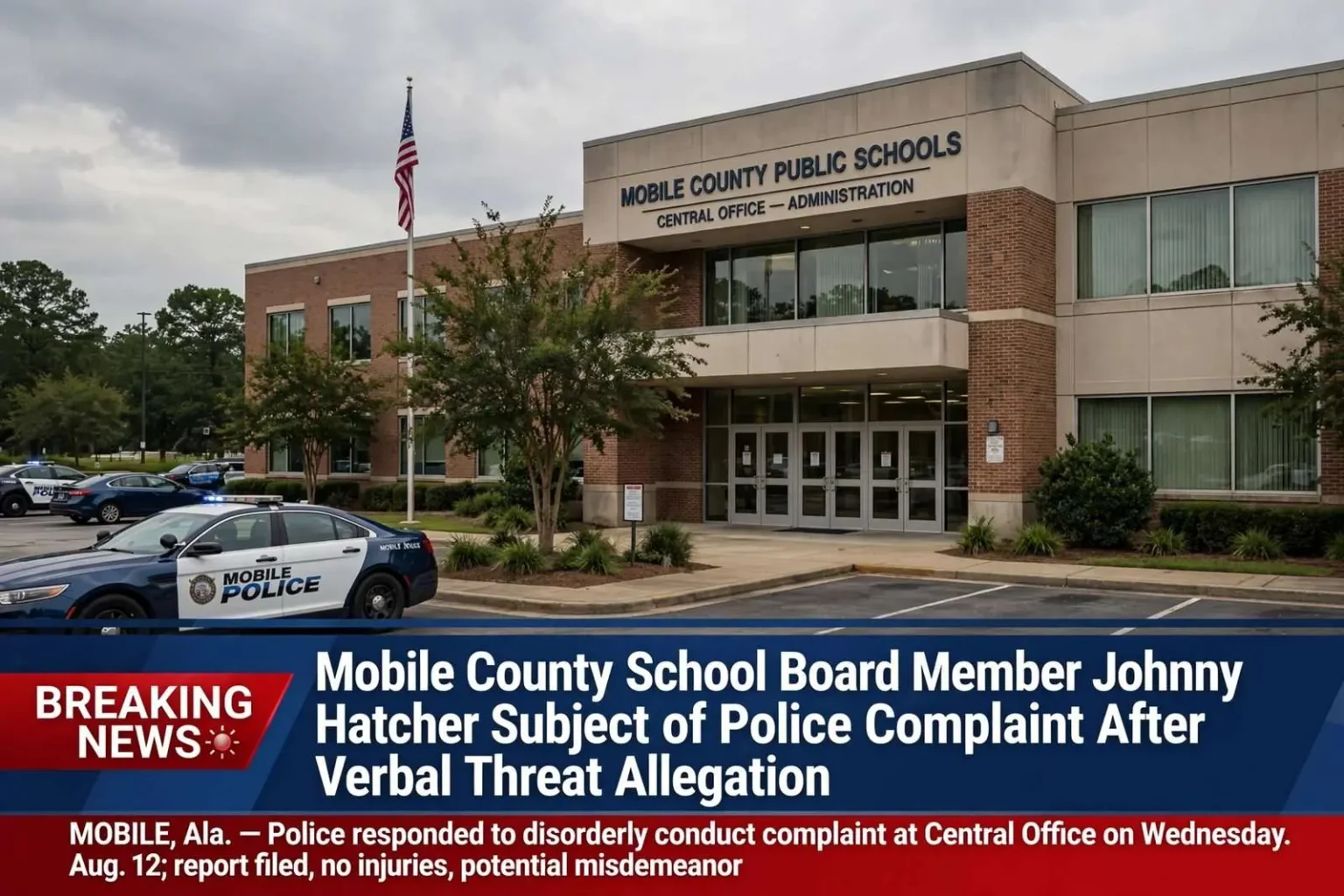
MOBILE, Ala. — A Mobile County school board member is the subject of a police complaint following an incident at a personnel board hearing at the Mobile County Public Schools Central Office, according to police records of the response.
Mobile police responded to a disorderly conduct complaint at the central office on Wednesday, Aug. 12. According to police, officers determined that board member Johnny Hatcher verbally threatened another man who attended the hearing. No injuries were reported, and police said the incident was strictly verbal.
A police report was filed in connection with the incident, and authorities said any potential charge would be a misdemeanor. Efforts are underway to confirm the identity of the person who reported being threatened, and no additional information has been released by police or by the school system.
The incident unfolded at the district’s Central Office, the administrative headquarters of the Mobile County Public School System, where the county personnel board holds hearings on employment matters involving school system employees. Those hearings — typically held during business hours in administrative meeting rooms — bring employees, their representatives, and district officials into the same rooms to dispute discipline, dismissals, and other personnel decisions.
The setting: a personnel board hearing
The Mobile County Personnel Board is the administrative body that hears employment disputes within the school system, one of the largest employers in southwest Alabama. Its hearings are formal but administrative — less adversarial than court proceedings, but structured enough that both sides present evidence and argument — and they are the stage on which much of the school system’s employment conflict plays out away from public view.
A verbal confrontation during such a hearing is unusual precisely because of the setting. Hearing rooms are supervised spaces, attended by board staff and sometimes attorneys, and the disputes inside them are supposed to be channeled through procedure. When police are called to a hearing at the Central Office, it means a dispute has exceeded what those in the room could manage on their own.
Mobile police responded to the Aug. 12 complaint and, according to the department’s account, determined that Hatcher — an elected member of the Mobile County Board of School Commissioners — had verbally threatened another man attending the hearing. The determination that the incident was “strictly verbal” and that no injuries were reported defined the scope of the police response: a documented complaint, a filed report, and a potential misdemeanor.
What disorderly conduct means under Alabama law
Disorderly conduct in Alabama is defined broadly enough to cover verbal behavior: a person commits the misdemeanor offense by engaging in fighting or violent tumultuous conduct, or by making an unreasonable amount of noise or offensive utterance in a public place, among other provisions. A verbal threat made in a government office can fall within that statute’s reach, which is why authorities said any potential charge in this incident would be a misdemeanor.
The misdemeanor classification matters for what happens next. Misdemeanor charges in Alabama are typically initiated by warrant or, in some cases, a sworn complaint, and prosecuted in district court — a process that can take months and that, for an elected official, carries consequences beyond the legal system itself. A conviction on a misdemeanor can carry fines and up to a year in jail, though most first-offense verbal incidents resolve through lesser outcomes.
Police said a report was filed in connection with the Aug. 12 incident, which is the first formal step in that process. Whether a warrant is ultimately sought, and whether the District Attorney’s Office accepts the case for prosecution, are decisions that come later and that were not made public in the immediate aftermath.
A board member’s role, and the limits of it
The Mobile County Board of School Commissioners is the elected governing body of the state’s largest school district, responsible for hiring and evaluating the superintendent, adopting budgets and policies, and setting the district’s direction for tens of thousands of students across Mobile County. Board members are elected by district and hold policy authority — not administrative authority over individual employees or hearings.
That distinction is relevant to the incident’s setting. A personnel board hearing at the Central Office is an administrative function of the school system, not a meeting of the elected board, and a board member’s presence there places an elected official inside a process he has no formal role in operating. What occurred there on Aug. 12, according to police, was a verbal threat directed at another attendee — a personal altercation, by the department’s account, in a professional setting.
School board members in Alabama are subject to the state’s ethics laws and, where conduct raises questions about fitness for office, to removal mechanisms that are rare and require formal action. A police complaint and a potential misdemeanor charge do not, by themselves, unseat a board member; they generate a public record that voters and colleagues respond to. The school system released no additional information, and the board took no public action in connection with the report.
An investigation with open questions
Several threads of the incident remained open when the report was filed. Police were working to confirm the identity of the man who reported being threatened — a step that determines who the complaining party is in any subsequent charge. The department released no transcript or account of what was said, and the personnel board’s own records of the hearing were not made public.
The uncertainty is typical of the earliest stage of a misdemeanor matter. A complaint at the scene, a responding officer’s determination, and a filed report establish that police were called and what officers found; they do not establish what, if anything, will be charged. Prosecutors review the report before any warrant is sought, and defense of any charge would raise questions about context, intent, and the statements of those in the hearing room.
For the school system, the incident landed awkwardly by its nature: an elected overseer of the district at the center of a police response inside the district’s own headquarters, during a hearing about the district’s employees. No injuries were reported; the exchange was strictly verbal; and the potential charge, if any comes, is a misdemeanor. Those facts bounded the incident even as questions about it remained.
What the record shows
The verified account is limited, and this report preserves those limits: Mobile police responded to the Mobile County Public Schools Central Office on Wednesday, Aug. 12, after a disorderly conduct complaint during a personnel board hearing. Officers determined that board member Johnny Hatcher verbally threatened a man attending the hearing. No injuries were reported. A police report was filed. Any potential charge would be a misdemeanor. Police were working to confirm the identity of the person who reported the threat, and no additional information has been released.
Nothing in that record establishes guilt, and nothing here presumes it. What it documents is a confrontation at the administrative heart of Alabama’s largest school system — serious enough for police to be called and to file a report, minor enough that no one was hurt — with the legal process now holding the questions the police response left open.
Why such incidents matter to a school district
Incidents involving elected school board members draw scrutiny beyond their legal weight because of the trust the position carries. Board members set policy for a district serving tens of thousands of Mobile County students and employ thousands of teachers, aides, and staff — the people whose disputes pass through the very personnel board hearings that a board member would attend. Conduct at the Central Office, of all places, lands on that audience directly.
Districts typically handle such matters through public silence unless charges are filed, deferring to the police investigation while the elected board’s own procedures address anything that touches governance. The absence of additional information from the school system in this case fits that pattern, as does the police department’s practice of releasing only the outline of a misdemeanor-level response.
The Aug. 12 response also illustrates how Alabama’s administrative machinery processes a complaint like this one: a municipal police department takes the report, the potential charge is a misdemeanor under state law, the District Attorney’s Office would review any warrant request, and district court would hold any prosecution. Each step is public, slow, and documented — which means the incident’s full account, whatever it turns out to be, will eventually exist in open court records rather than in rumor.
Until then, the record stands as police filed it: a verbal threat determined at a personnel board hearing, a report, no injuries, and a potential misdemeanor — with the man who reported the threat still being identified and the rest left to the process.