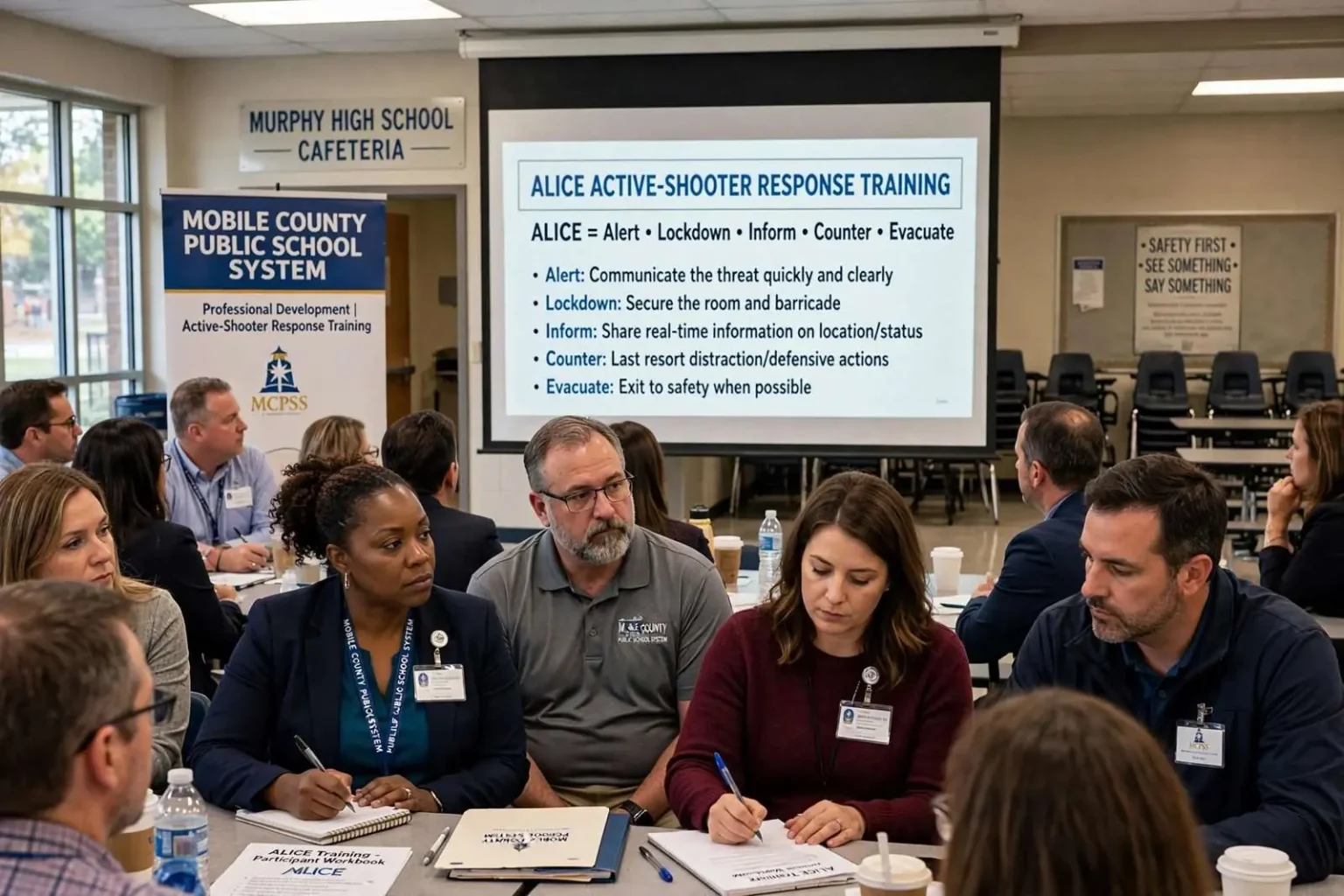
About 100 administrators, counselors and other leaders from the Mobile County Public School System gathered at Murphy High School recently to complete ALICE training, a nationally recognized program designed to prepare school staff for active-shooter and violent-intruder situations.
ALICE, which stands for Alert, Lockdown, Inform, Counter and Evacuate, moves beyond the traditional lockdown-only approach that many schools have relied on for decades. Instead of instructing students and staff to simply shelter in place and wait, the program teaches a range of options that can be adapted to the specific circumstances of an emergency, giving people inside a building more ways to protect themselves if a threat gets close.
The training combined online assessments, video presentations and hands-on demonstrations, walking participants through what each step of the ALICE framework looks like in practice. Alerting others quickly, locking down a room effectively, sharing real-time information, countering a threat as a last resort, and evacuating safely when possible are all treated as tools that can be used in whatever order or combination best fits a given situation.
District leaders who took part in the session are expected to carry the training back to their individual schools, where it will eventually be passed down to teachers and students through age-appropriate drills and instruction. That cascading approach is central to how ALICE is meant to work: rather than a single districtwide briefing, the goal is for every campus to have staff members who deeply understand the protocol and can teach it to others.
“School should be a safe haven, a place to learn, but we realize in society there are a lot of people that don’t make the best choices. So we need to be cognizant and mindful of all the cues and the signs and things we can do to make sure our students are safe,” said Apryle Williams, a guidance counselor at Scarborough Middle School who attended the training.
School safety has remained a top priority for administrators and parents across Mobile County in recent years, as districts nationwide have worked to update emergency plans in response to violent incidents at schools elsewhere in the country. Programs like ALICE, which was developed in the aftermath of the Columbine High School shooting and has since been adopted by thousands of school districts and other organizations across the country, are part of a broader shift toward giving occupants more agency during an emergency rather than relying on a single, rigid response.
Murphy High School served as the training site for this session, drawing leaders from schools throughout the Mobile County Public School System. District officials have not announced a timeline for when the training will be extended to additional staff and students, though the program’s design anticipates that trained leaders will begin incorporating its principles into their own campuses’ safety planning in the coming months.
Local government in the Mobile area operates through a combination of mayor-council or commission structures at the municipal level and a county commission in Mobile County, with elected officials handling budgets, public safety, infrastructure, and zoning. Baldwin County has its own commission and a collection of incorporated municipalities.
Education in South Alabama spans public school systems in Mobile and Baldwin counties, a network of private and parochial schools, and institutions of higher learning including the University of South Alabama, Spring Hill College, and community colleges. Public-school governance rests with locally elected boards.
Mobile is the county seat of Mobile County in southwest Alabama and the state’s only saltwater port. Situated where the Mobile River meets Mobile Bay near the northern Gulf of Mexico, the city has long served as a commercial and cultural gateway between Alabama and the wider Gulf Coast. Founded in 1702 as Fort Louis de la Louisiane and ruled in turn by France, Britain, and Spain before joining the United States in 1813, Mobile carries a layered heritage distinct from the rest of the state.
The economy of the Mobile region is diversified across shipping and logistics, aerospace and shipbuilding, healthcare, tourism, and manufacturing. The Port of Mobile is one of the nation’s busiest seaports and a cornerstone of the local and state economy.
The natural environment is central to life on the Gulf Coast, where barrier islands, bays, rivers, and wetlands support fisheries, recreation, and storm protection. Coastal Alabama faces challenges common to low-lying regions, including hurricane exposure, erosion, and the management of fragile ecosystems.
The history of South Alabama is shaped by its position at the crossroads of cultures and waters. Indigenous peoples, including the Muscogee (Creek) and Choctaw, lived in the region for centuries before European colonization by French, British, and Spanish powers.
Healthcare in the Mobile area is anchored by several hospital systems and provider networks that serve patients across southwest Alabama, the Gulf Coast, and into parts of Mississippi and Florida. Large employers in the sector include regional health systems operating hospitals, clinics, and specialty centers, alongside university-affiliated providers.
Local journalism serves as the connective tissue of communities like those across South Alabama, informing residents about government, schools, public safety, and the events that shape daily life. Outlets covering Mobile and Baldwin County help hold institutions accountable and give voice to neighborhood concerns larger media may overlook.
Local law enforcement across South Alabama is carried out by municipal police departments, county sheriff’s offices, and state agencies that together cover a mix of urban, suburban, and rural territory. City departments handle policing within municipal limits, while sheriff’s offices provide courthouse security, jail operations, and patrol in unincorporated areas.
Charitable and nonprofit organizations form a vital safety net across South Alabama, addressing needs from hunger and homelessness to disaster relief and holiday assistance. Groups such as The Salvation Army operate local corps that provide shelter, food, and seasonal programs funded largely by community donations.
The Federal Bureau of Investigation is the principal investigative arm of the United States Department of Justice, tasked with protecting the country against terrorist threats, foreign intelligence operations, cyber attacks, and major criminal activity. Established in 1908, the bureau operates a network of field offices across the country, each responsible for federal law-enforcement matters within its region.
Probate courts in Alabama handle matters distinct from the trial courts that hear criminal and civil cases, including wills, estates, guardianships, and involuntary commitments for mental-health treatment. In Mobile County the probate judge is an elected official with broad administrative and judicial duties.
Behavioral-health care on the Gulf Coast is provided by a mix of community mental-health organizations, hospital systems, and private practitioners. Community centers play an especially important role in serving patients who might otherwise lack access to care, often coordinating with courts, jails, and social services.
Mobile lays claim to a long tradition of outdoor festivals and public celebration, most famously its Carnival or Mardi Gras season, which predates the better-known celebrations of New Orleans. Throughout the year the region hosts music festivals, food and arts events, and waterfront gatherings that draw visitors from across the Gulf Coast.
Collegiate athletics are a major part of life in southern Alabama, where the University of South Alabama in Mobile fields the Jaguars across a range of sports. The university’s football program, which began competition in the 2000s, has become a rallying point for students, alumni, and residents and a source of regional pride.
Baldwin County sits directly east of Mobile County across Mobile Bay and is the largest county in Alabama by land area. It encompasses the Eastern Shore communities of Daphne, Fairhope, Spanish Fort, and Foley and stretches south to the beaches of Gulf Shores and Orange Beach along the Gulf of Mexico.
The Gulf of Mexico borders Alabama’s southern edge and defines much of the state’s coastal identity. Alabama’s Gulf coastline, centered on Dauphin Island, Gulf Shores, and Orange Beach, supports a tourism industry built around beaches, charter fishing, and marine recreation, while offshore waters host shipping lanes and energy interests.
Alabama is a state in the southeastern United States bordered by Tennessee, Georgia, Florida, the Gulf of Mexico, and Mississippi. Often called the Heart of Dixie, it spans Appalachian foothills in the north and flat coastal plains in the south. Its largest cities include Birmingham, Montgomery, Huntsville, and Mobile.
Mobile Bay is a shallow estuary in southern Alabama where freshwater from the Mobile, Tensaw, and other rivers mixes with saltwater from the Gulf of Mexico. It is among the largest estuarine systems in the United States and supports commercial and recreational fishing, shipping through the Port of Mobile, and wetlands that buffer the coastline from storms.
Decisions made in council chambers and commission meetings affect roads, school funding, economic development, and quality of life, which is why coverage of local government is a staple of regional journalism. The interplay between city, county, and state authorities often determines how effectively the area can address shared challenges.
Boards oversee budgets, curricula, and facilities, often amid debates over funding equity and student achievement. The region’s colleges contribute not only to the workforce pipeline but also to healthcare, research, and cultural life, and education policy set in Montgomery frequently shapes what local districts can do.