Mobile County Schools Add New First Class Pre-K Classroom as State Expansion Continues
Mobile County schools are adding a new First Class Pre-K classroom at Elsie Collier Elementary this fall as part of a 122-classroom statewide expansion, though thousands of local families remain on waiting lists for the free program.
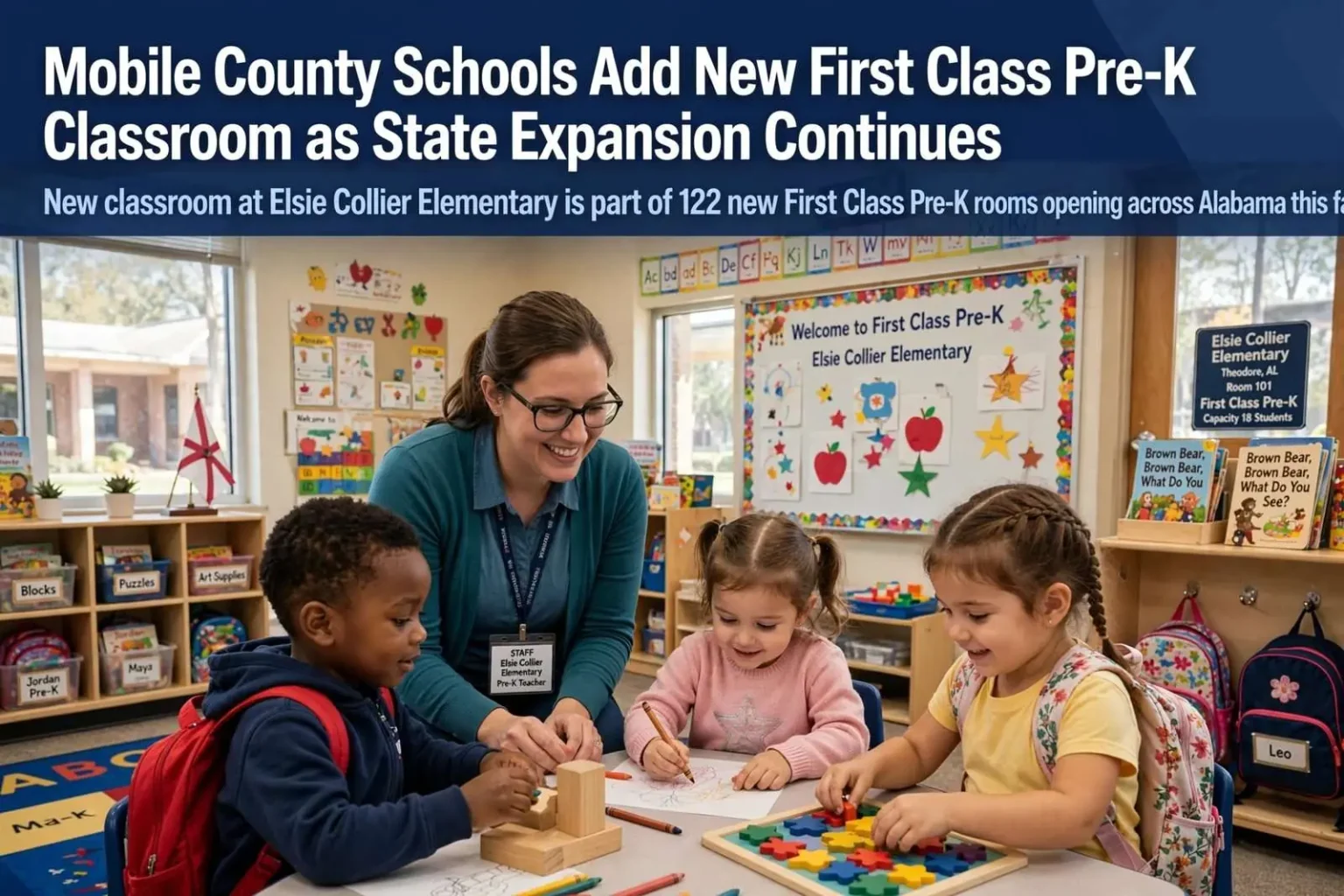
Mobile County families will have another option for free, high-quality prekindergarten this fall as the Mobile County Public School System prepares to open a new First Class Pre-K classroom at Elsie Collier Elementary School.
The addition is part of a statewide expansion that will bring 122 new First Class classrooms to Alabama by August, including five spread across Mobile and Baldwin counties. First Class Pre-K is Alabama’s voluntary, state-funded prekindergarten program for 4-year-olds, financed through grants appropriated from the state’s Education Trust Fund and administered by the Alabama Department of Early Childhood Education, an agency organized under the governor’s office.
Classrooms can be housed in public or private schools, as well as in child care centers, faith-based programs and Head Start facilities across the state. To earn the First Class designation, a classroom must meet quality standards recognized by the National Institute for Early Education Research, including a cap of 18 students per class and a staff-to-child ratio of 1 to 9, which requires both a lead teacher and an assistant in every room.
Quality Standards and Teacher Requirements
Lead teachers must hold a bachelor’s degree, while assistants are required to have at least a Child Development Associate credential or an equivalent certification. The program has enjoyed bipartisan support in Montgomery for more than a decade. Former Gov. Robert Bentley pushed for substantial funding increases during his time in office, and Gov. Kay Ivey has continued that trend, recently signing off on grant funding for the new round of 122 classrooms statewide.
The expansion comes after the National Institute for Early Education Research’s 2016 State of Preschool Yearbook ranked First Class among the top state-funded pre-K programs in the country for the 11th consecutive year. State lawmakers have steadily increased pre-K funding since 2005, when the Education Trust Fund allocated just $4 million to the effort.
This year’s budget includes a significant increase that will bring total First Class funding to over $120 million, serving more than 21,000 children across the state. The program’s growth reflects a consensus among Alabama policymakers that early childhood investment yields long-term returns in educational attainment, workforce readiness, and reduced social costs.
First Class meets all ten of NIEER’s quality benchmarks — a distinction held by only a handful of state programs nationwide. These benchmarks include comprehensive early learning standards, teacher degree requirements, specialized training, assistant teacher credentials, professional development, maximum class size of 20, staff-child ratio of 1:10 or better, vision and hearing screenings, and a continuous quality improvement system.
Elsie Collier Elementary and the Mobile County Context
Elsie Collier Elementary, located in the Theodore area of west Mobile County, serves a diverse student population with a significant percentage of economically disadvantaged families. The school’s principal and district administrators identified the need for additional pre-K capacity after tracking kindergarten readiness data showing that children without preschool experience entered school with measurable gaps in language, literacy, and social-emotional skills.
The new classroom at Elsie Collier will serve 18 students selected through a random lottery process, as required by First Class guidelines when demand exceeds capacity. Mobile County typically receives applications for two to three times the available slots, and the lottery system is designed to ensure equitable access regardless of family background or connections.
Mobile County Public School System, the state’s largest district with over 53,000 students, has been expanding its pre-K footprint steadily. The district currently operates First Class classrooms at more than 30 elementary schools, with a long-term goal of offering at least one classroom in every elementary attendance zone.
The district’s pre-K expansion has been supported by a combination of state grants, federal Title I funds, and local allocations. Mobile County has also partnered with community organizations — including the United Way of Southwest Alabama, the Mobile Area Education Foundation, and local Head Start grantees — to coordinate outreach, transportation, and wraparound services for pre-K families.
Baldwin County Expansion and Regional Growth
In Baldwin County, the state’s fastest-growing county, the five new classrooms will be distributed across the county’s three school systems — Baldwin County Public Schools, Gulf Shores City Schools, and Orange Beach City Schools — reflecting the enrollment pressures that come with rapid population growth. Baldwin County’s pre-K waiting lists have consistently been among the longest in the state.
The Alabama Department of Early Childhood Education uses a needs-based formula to allocate new classrooms, weighing factors including poverty rates, existing pre-K access, kindergarten readiness scores, and population growth projections. The formula is designed to direct resources to communities where the gap between need and availability is greatest.
First Class Pre-K’s quality standards are rigorous by design. Classrooms are evaluated annually through the Alabama Quality STARS rating system, which assesses learning environment, teacher-child interactions, curriculum implementation, family engagement, and program administration. Classrooms must maintain a minimum rating to continue receiving funding.
The curriculum framework emphasizes play-based learning aligned with the Alabama Developmental Standards for Preschool Children. Teachers use the Teaching Strategies GOLD assessment system to document each child’s progress across developmental domains — social-emotional, physical, language, cognitive, literacy, and mathematics — throughout the year.
Long-Term Outcomes and Research Base
Longitudinal studies of Alabama’s First Class graduates have shown sustained benefits through elementary school. Children who attended First Class Pre-K scored higher on state reading and math assessments in third and fourth grade compared to demographically similar peers who did not attend. They also had lower rates of grade retention and special education placement.
Researchers at the University of Alabama and the Public Affairs Research Council of Alabama have tracked multiple cohorts, finding that the program’s effects are most pronounced for children from low-income families — the same population most likely to lack access to high-quality private preschool.
The program’s cost per child, approximately $5,700 per year, is significantly lower than the per-pupil cost of K-12 education, making it a relatively efficient investment. Economic analyses by the Federal Reserve Bank of Minneapolis and other institutions have estimated returns of $7 to $10 for every dollar invested in high-quality pre-K, measured in reduced remedial education costs, higher lifetime earnings, lower crime rates, and better health outcomes.
A 2022 study by the Alabama Department of Early Childhood Education and the University of Alabama’s Education Policy Center found that First Class alumni were 1.5 times more likely to be proficient in reading by third grade — a critical milestone that predicts high school graduation rates. The study controlled for family income, race, and home language, isolating the program effect.
Application Process and Family Engagement
Families interested in the new Elsie Collier classroom or any First Class site can apply through the state’s centralized online portal, which opens each spring for the following school year. The application requires basic demographic information and proof of Alabama residency; there is no income requirement, though priority is given to children who are at risk for school readiness gaps.
First Class also mandates family engagement components, including home visits, parent-teacher conferences, and volunteer opportunities. The program views parents as partners in their children’s education, and research indicates that this engagement carries forward into elementary school involvement.
The home visit, conducted before the school year begins, allows teachers to meet families in their own environment, understand each child’s interests and routines, and establish a relationship that supports communication throughout the year. This practice, adapted from the Head Start model, has been shown to reduce chronic absenteeism and increase parent participation in school activities.
Workforce Development and Economic Impact
Beyond child outcomes, First Class Pre-K functions as a workforce support for Alabama parents. The program’s full-day schedule — typically 7:30 a.m. to 2:30 p.m., with many sites offering extended care — enables parents to work or attend training programs. A 2021 survey of First Class parents found that 68 percent said the program allowed them to maintain or increase employment hours.
The program also creates jobs directly: each classroom employs a lead teacher and an assistant, and the expansion of 122 classrooms statewide adds 244 education positions. These are credentialed, benefited positions that contribute to the state’s early childhood workforce pipeline.
Alabama’s community college system has responded by expanding early childhood education degree and certificate programs, creating articulation pathways from Child Development Associate credentials to associate and bachelor’s degrees. This pipeline addresses a longstanding shortage of qualified early childhood educators, particularly in rural counties.
Transportation remains a challenge for some families. While Mobile County provides bus service for pre-K students at most sites, the Elsie Collier location is still finalizing its route schedule. The district has committed to having transportation available by the first day of classes.
For Mobile County families, the Elsie Collier addition represents both a concrete opportunity and a signal of the district’s commitment to early learning. As Superintendent Chresal Threadgill noted at a recent board meeting, “Every child who walks into kindergarten ready to learn changes the trajectory of a classroom, a school, and ultimately a community.”