Mobile County Schools Open the Year From Home as MCPSS Holds Its First Virtual Day
Mobile County Public School System opened the 2020-21 year remotely. Inside the first virtual day, WiFi buses, Schoology access and plans for returning.
The largest school system in Alabama started its school year without a single student walking through its doors. On Tuesday, September 1, the Mobile County Public School System launched its first day of classes in an all-virtual format, leaving hallways and classrooms quiet while lessons moved onto screens at home. For a system that educates thousands of students across Mobile County every day — the largest district in the state — the quiet first day marked one of the most unusual openings in its history, and the start of a school year no one had planned for six months earlier.
District officials had planned for students to learn online for at least the first nine weeks of the year, with any return to campuses dependent on the course of COVID-19 cases across the county. The nine-week framework gave families a defined horizon — roughly the first quarter of the school year — while preserving the district’s flexibility to hold the line longer if the pandemic’s trajectory worsened, or to begin phased returns if conditions allowed. Every decision flowed from the same county-level data that health officials were tracking daily: case counts, positivity rates, hospital capacity.
The all-virtual opening placed Mobile County among the large districts nationally that chose remote learning for the start of the pandemic school year, a decision weighted differently in a county where students ranged from households with high-speed internet and a laptop for every child to homes with neither. Managing that digital divide — and the anxiety of thousands of parents navigating a school year that looked nothing like any before it — became the district’s defining challenge of the fall.
Inside a virtual classroom
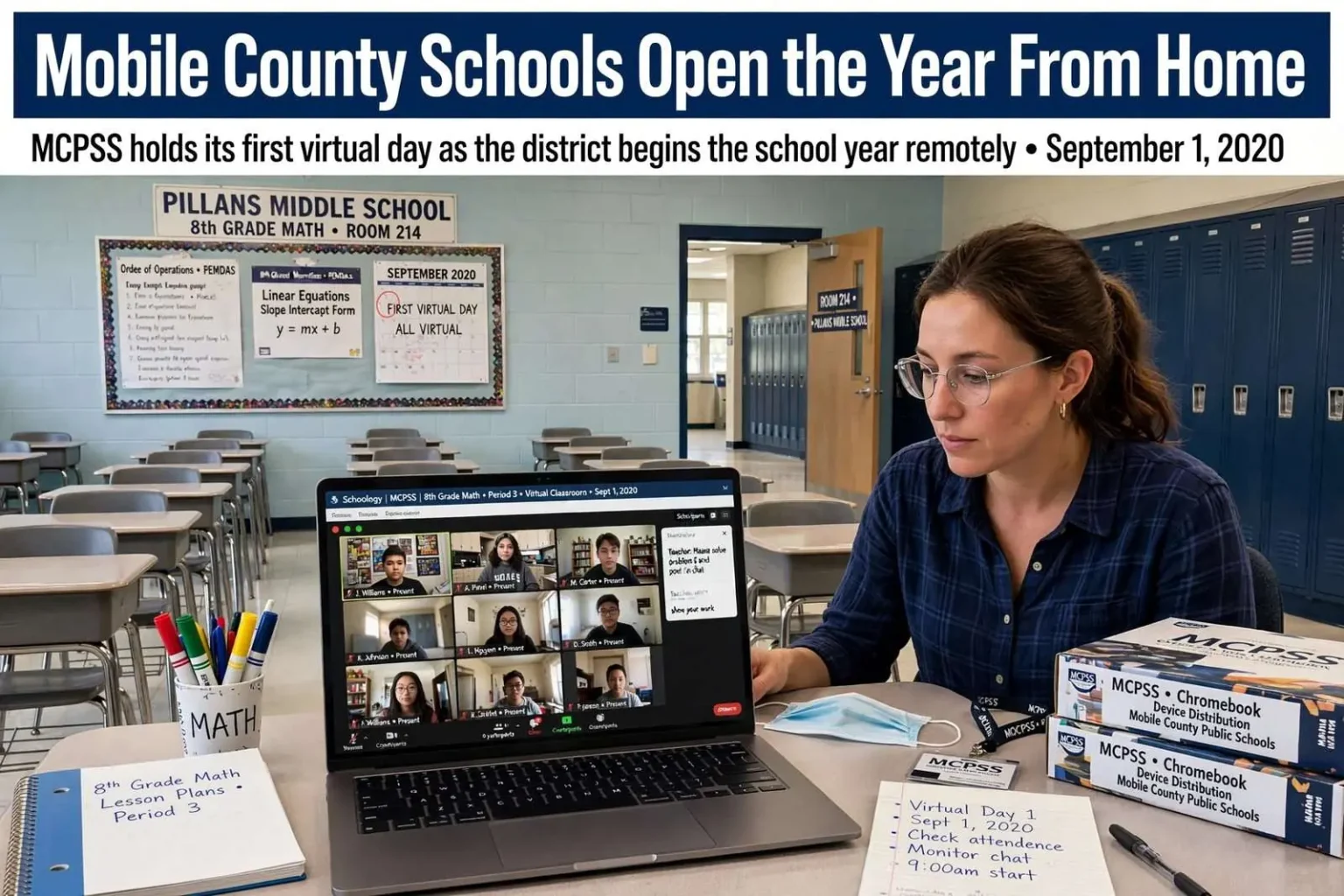
At Pillans Middle School, eighth grade math teacher Pamela Haines described the strange feeling of teaching to a grid of faces she could not see in person. She said she imagines her students sitting in the classroom with her even while they tune in from home. The image captures the odd doubleness of pandemic teaching: the teacher performing to a room she knows well, while the room itself is empty and the students are scattered across the county in bedrooms and kitchens, visible only as thumbnail squares if they appear at all.
Math, arguably more than any other subject, depends on the immediate feedback loop of the classroom — the quick check for understanding, the worked example at the board, the raised hand that signals confusion before it hardens into a gap. Teachers like Haines had to rebuild those loops virtually, using screen sharing, digital whiteboards and chat-based questions. The adaptation happened in real time, school by school and teacher by teacher, as Mobile County’s educators discovered which of their in-person habits translated to the screen and which had to be reinvented.
For students, the first day meant logging in to schedules they may never have seen in a printed version, meeting teachers they had never shaken hands with, and learning the etiquette of a new kind of school: cameras on or off, chat windows, breakout groups, attendance taken through a login. For parents, it meant becoming, overnight, the on-site support staff for the largest school system in Alabama.
Solving the technology hurdles
Principal Jacinda Hollins said her staff was working family by family to iron out device and connectivity problems during the opening days. She pointed out that families who had not yet received a Chromebook were not locked out: Schoology, the district’s learning platform, runs in a web browser and works on phones, tablets, iPads and laptops alike. That flexibility mattered enormously in the opening week, when device distribution was still catching up with demand and some students were starting the year on a parent’s phone rather than a district-issued laptop.
Schoology served as the connective tissue of the district’s virtual year — the single platform where assignments appeared, lessons were posted, submissions were collected and grades were recorded. For a district the size of Mobile County’s, standardizing on one platform was itself a significant undertaking, and the first days of September were spent teaching not just math and reading but the platform itself: how to log in, where to find the day’s work, how to reach a teacher.
To reach households with unreliable internet, the district stationed WiFi buses at points across the county so students could get online near their neighborhoods. The buses — a strategy adopted by large districts across the country during pandemic closures — parked at designated spots, broadcasting district networks that students within range could connect to from a car, a porch or a nearby step. In a county as geographically sprawling as Mobile County, which stretches from the urban core of Mobile to rural communities near the Mississippi line, no single solution could reach every doorstep, and the bus network was the district’s answer to the pockets where home internet simply did not reach.
The connectivity gap was never merely an inconvenience. For students in households without reliable service, virtual school threatened to become no school at all, and districts that failed to close the gap risked widening the very achievement divides that schools exist to narrow. Mobile County’s combination of distributed devices, browser-based platforms and parked WiFi buses represented the practical toolkit available to a district of its size in the fall of 2020 — imperfect, improvised, and continuously adjusted as staff learned where the gaps actually were.
Planning for the return
MCPSS leaders said they would keep monitoring coronavirus figures and give parents the choice between returning to campus or staying virtual once in-person classes resume. That commitment to parent choice became one of the year’s structural features: even when buildings reopened, virtual learning remained an option for families who preferred it, whether for health concerns, household vulnerability or the simple fact that a routine had taken shape at home. Managing two parallel modes of instruction — students in seats and students on screens simultaneously — would become one of the defining logistical puzzles of the pandemic school year.
When that day comes, Hollins said teachers — not students — will rotate between classrooms to keep hallway traffic down and allow social distancing. The inversion of the middle school model was one of the more consequential planning decisions of the return: instead of hundreds of students changing classes every period, crowding corridors and touching the same surfaces, the teachers would move while the students stayed put. Homerooms would become fixed cohorts, reducing the web of contacts each student carries through the day and making any necessary quarantine narrower and more targeted.
The plan acknowledged the realities of middle school architecture and epidemiology at once. Rotating teachers protects instructional time — the specialized math or science teacher still delivers the lesson, just in a different room — while the fixed cohort contains risk. For students used to the freedom of changing classes, the adjusted model would feel strange; for administrators charged with keeping schools open once they reopened, it was the difference between a manageable exposure and a building-wide shutdown.
September 1, then, was less a first day than the opening move of a year-long improvisation. The district’s largest-in-the-state scale meant every decision — nine weeks virtual, WiFi buses, rotating teachers, parent choice — was made with tens of thousands of students on the other end of it. The hallways of Pillans Middle School and every other MCPSS campus stood quiet that Tuesday, but the school year, in a form no one would have recognized a year earlier, was underway.
What the first days revealed
The opening week served as a live stress test of the district’s preparation. District staff had spent the summer distributing Chromebooks, publishing how-to guides for parents, training teachers on virtual instruction and mapping the county for connectivity dead zones, but no amount of rehearsal could fully anticipate tens of thousands of simultaneous logins on day one. The family-by-family troubleshooting that Hollins described — staff working phones and home visits to solve individual device and internet problems — was the unglamorous work that made the model function, school by school.
Teachers, meanwhile, were improvising pedagogy in real time. Attendance, participation, cheating prevention, grading, and the simple mechanics of holding attention through a screen all required new systems. Veteran educators found that some instincts transferred directly — clear structure, warm rapport, high expectations — while others, like circulating the room or reading body language across a classroom, had no obvious equivalent. Professional learning communities within schools traded what worked: shorter direct instruction, more checks for understanding, recorded lessons students could replay.
The human weight of the arrangement fell unevenly. Families where a parent could stay home managed the model differently from those where essential workers could not, and students with special needs or limited English proficiency faced steeper barriers at a distance. District leaders acknowledged that no virtual plan could replicate everything a school building provides, from meals to counseling to the social development that happens between classes — all of which hung on the same question everyone was watching: what the county’s coronavirus numbers would do next, and when the quiet hallways might fill again.