Mobile County Students Gain Career Experience Through Summer Internships and Camps
More than 300 Mobile County students took part in summer internships, STEM camps and job shadowing this year, with more than 100 area businesses partnering with the school district on career readiness.
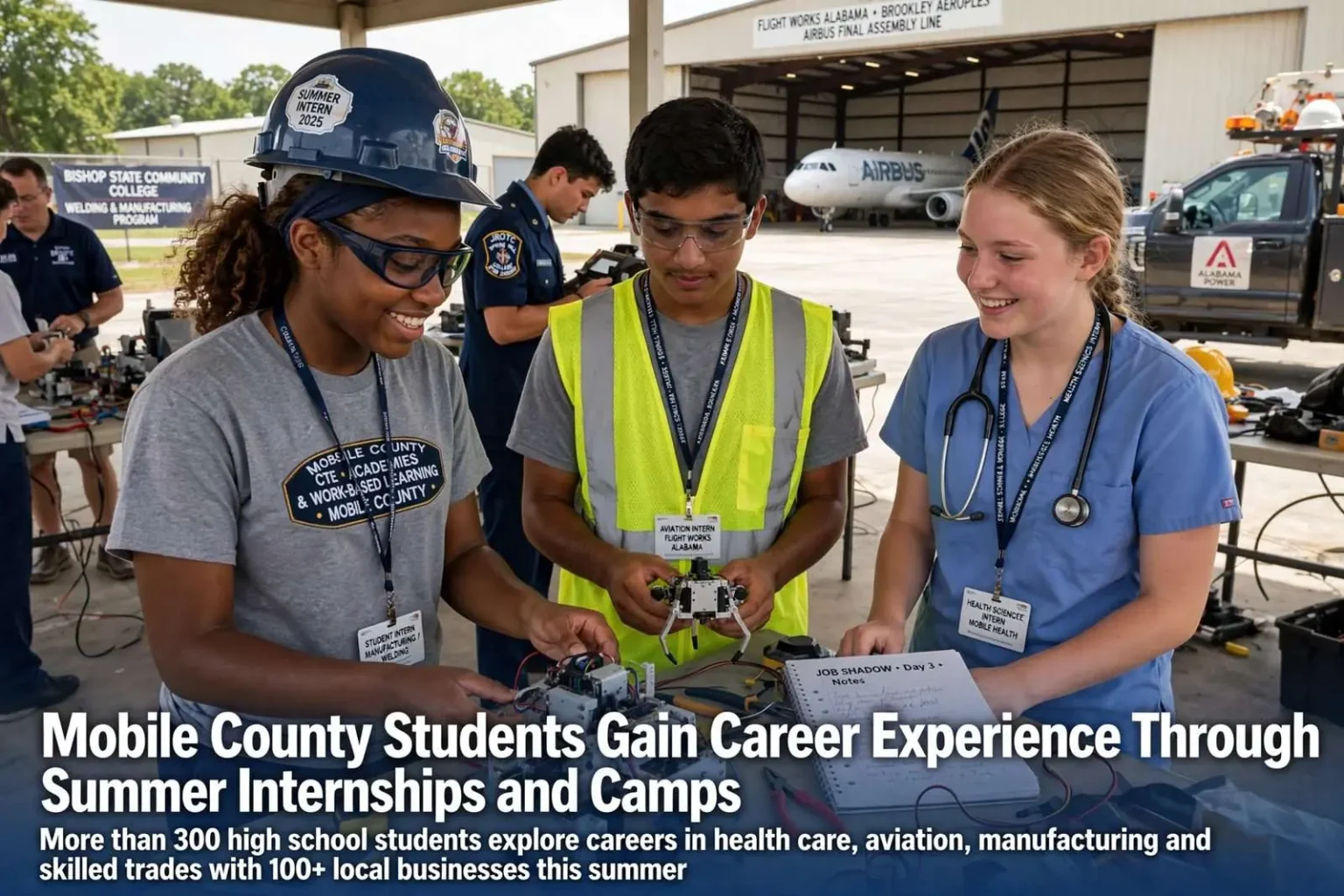
More than 300 Mobile County high school students spent part of their summer break gaining real-world career experience through STEM camps, internships, job shadowing, field trips and other educational opportunities, with more than 100 area businesses hosting student interns. The summer program has become one of the largest work-based learning efforts of its kind on the Gulf Coast, pairing classroom interest with actual workplaces across health care, shipbuilding, aviation, manufacturing and the skilled trades.
Claire Minto, supervisor of academies and work-based learning for Mobile County Public Schools, said the summer internship program helps students build confidence, expand their professional networks and discover career paths they may not have previously considered. She said some students have changed their planned college major entirely after an internship exposed them to a career they came to love. That discovery, she noted, works in both directions — students who confirm a passion arrive at college with conviction, and those who rule out a field early save themselves years of coursework in the wrong direction.
The school system’s Career and Technical Education Department partnered with area businesses, industry groups and the Mobile Chamber to organize the workforce development initiatives. The partnerships reflect a decade-long shift in how Mobile County prepares students for work: rather than treating career preparation as separate from academics, the district’s academy model embeds industry exposure into the high school experience itself, with themed academies aligned to the region’s major employers.
Camps, Colleges and Cockpits
Career enrichment camps held at the district’s three career tech centers gave middle schoolers hands-on activities and exposure to a range of CTE fields, including a tour of Airbus through Flight Works Alabama and a visit to Bishop State Community College to learn about training paths in manufacturing, welding, cosmetology, automotive repair and electrical engineering. The middle school focus is deliberate: students begin planning course schedules before they reach high school, and early exposure to career tech options shapes choices that compound over four years.
Flight Works Alabama, the aviation education center adjacent to the Airbus final assembly line at Mobile’s Brookley Aeroplex, has become a centerpiece of the region’s STEM education pipeline. Students who tour the facility see the A320 family jets under assembly and experience flight simulators and hands-on engineering activities — a tangible connection between their coursework and the largest single economic development project in Mobile’s history.
Bishop State Community College’s role gives campers a view of the postsecondary pathways that run alongside the four-year college track. Its programs in welding, machining, electrical technology and health sciences feed directly into the region’s industrial employers, and the college’s dual enrollment partnerships with Mobile County high schools mean students can begin earning credentials before graduation. Campers touring its labs see the classrooms they could occupy within a few years of leaving middle school.
More than 130 campers also took part in the 11th annual JROTC STEM Leadership Academy at Spring Hill College, tackling mental and physical challenges, touring industry sites and competing in a robotics competition to build a clawbot. The academy blends the discipline and structure of Junior ROTC with engineering challenges that push cadets to design, build and iterate under time pressure — skills that transfer directly to robotics teams, pre-engineering coursework and the district’s manufacturing academies.
Campers additionally learned skills related to power line repair work through a partnership with Alabama Power and Bishop State Community College. Line work is among the region’s most in-demand skilled trades, and utilities across the Gulf Coast face a coming wave of retirements in the trade. Giving high school students hands-on familiarity with the profession — the training path, the physical demands, the pay scale and the community role linemen play during storms — widens the recruiting funnel for a field many students would never otherwise encounter.
Job Shadowing at Scale
During the 2025-26 school year, more than 525 students from the district’s 12 high schools took part in job shadowing across fields including health care, engineering, public service, skilled trades and business, made possible by more than 70 industry and community partners. Job shadowing differs from internships in scope — typically a day or a week inside a workplace rather than a summer of employment — but educators say its impact can be just as large, because a single well-matched shadowing experience can redirect a student’s entire course plan.
The partner list spans the economy of metropolitan Mobile. Health systems open their hospitals to students interested in nursing, imaging and therapy careers; engineering firms and the area’s shipbuilders show students the design and trades behind the region’s industrial base; courts, city hall and public safety agencies host those drawn to public service; and banks, real estate offices and small businesses give future entrepreneurs a first look at how enterprises actually run. Each host that agrees to take a student becomes part of a pipeline the district has spent years cultivating.
School officials thanked the many businesses and professionals who opened their doors to students through the programs, crediting the region’s employers for treating the summer not as a burden but as a workforce investment. For many of the host businesses, the internships function as an extended interview: students who impress are invited back, and some move into part-time work during the school year, apprenticeships after graduation or scholarship opportunities tied to their host companies.
Why Work-Based Learning Matters in Mobile
The scale of the summer program reflects the scale of the region’s economic transformation. Mobile has landed successive industrial investments — the Airbus final assembly line and its supplier network, shipbuilding expansion, steel processing, chemical manufacturing and a growing port — all of which compete for the same technically skilled workforce. Employers consistently report that the constraint on growth is not orders or capital but people, and the pipeline that runs through Mobile County’s schools is where that constraint gets addressed.
The district’s career academies organize students around industry themes — health sciences, engineering, business, public service and the trades — beginning in the ninth grade. Course sequences progress from introductory classes through advanced technical coursework, work-based learning and, in many academies, industry certifications that carry real weight with employers. The summer programs sit at the top of that structure, giving the most engaged students a chance to test classroom knowledge against the demands of a real job.
The data behind the approach is the same data employers cite. Students who complete sequenced career tech coursework with work-based learning show stronger graduation rates and smoother transitions to either college or employment, and regional economists note that a community that grows its own skilled workforce keeps the returns of education spending at home. Mobile County Public Schools, as the state’s largest school system, treats those outcomes as central to its mission rather than peripheral to it.
Inside the Internship Experience
For the students themselves, a summer internship is usually the first time school skills meet workplace expectations. Interns learn to manage a schedule, dress for a professional environment, ask questions of supervisors and absorb the informal knowledge no classroom teaches — how a hospital unit actually runs at shift change, how a design review works, how a crew divides a day’s tasks. Minto and her staff prepare students with pre-internship training covering professionalism, communication and workplace safety, so hosts receive interns ready to contribute rather than observe.
The experiences often reshape summer routines in ways families notice. Students report to workplaces on time, keep schedules, and talk at dinner about what they did that day — a level of engagement that educators say carries into the school year. For juniors and seniors, the summer also builds the résumé lines and recommendation relationships that matter in scholarship and admissions cycles, giving work-based learning a practical payoff beyond the experience itself.
Host employers describe the reciprocal side. Professionals who mentor interns consistently report the experience refreshes their own sense of purpose, and workplaces gain an early look at the generation that will soon staff their industries. Several Mobile-area companies have built their summer programs into year-round relationships — inviting past interns to events, sponsoring robotics teams and visiting academies during the school year to keep the connection alive.
A District-Wide Commitment
Behind the summer numbers stands an administrative structure the district has built deliberately. The Career and Technical Education Department coordinates the calendars, matches students to hosts, handles transportation logistics and follows up with both sides after each placement. The three career tech centers — spread across the county so programs are reachable from every high school — house the camps, labs and certification courses that anchor the coursework during the year.
The Mobile Chamber’s involvement ties the effort to the region’s economic development strategy. Recruiters courting new industry to the area present the workforce pipeline as a selling point, and the existence of a school system that produces work-ready graduates — with camps, internships and shadowing proven at scale — strengthens that pitch. Economic development officials across Alabama increasingly describe K-12 work-based learning as infrastructure, no less essential than roads and ports.
The programs’ growth over eleven years — from a single JROTC leadership academy to a summer calendar spanning hundreds of students, dozens of camps and more than a hundred employers — mirrors the district’s broader transformation. A generation ago, career tech carried a stigma as the track for students not headed to college; today the programs stack credentials alongside college prep, and many of the region’s best-paying careers run through them.
As the 2025-26 school year approaches, the district’s staff will begin matching the next cohort — students who spent the summer touring an Airbus line, building a clawbot at Spring Hill or shadowing a nurse — into academies and advanced coursework that build on what they learned. The pipeline keeps moving: summer experiences feed school-year academies, academies feed internships, and internships feed the region’s employers with young professionals who discovered, sometimes by a single summer, the career they intend to pursue.