
Mobile County Teen Charged With Manslaughter in Fentanyl-Related Death of 15-Year-Old Adrianna Taylor
A 17-year-old boy faces manslaughter and distribution charges after 15-year-old Adrianna Taylor died from a fentanyl-laced pill in Semmes, Mobile County.
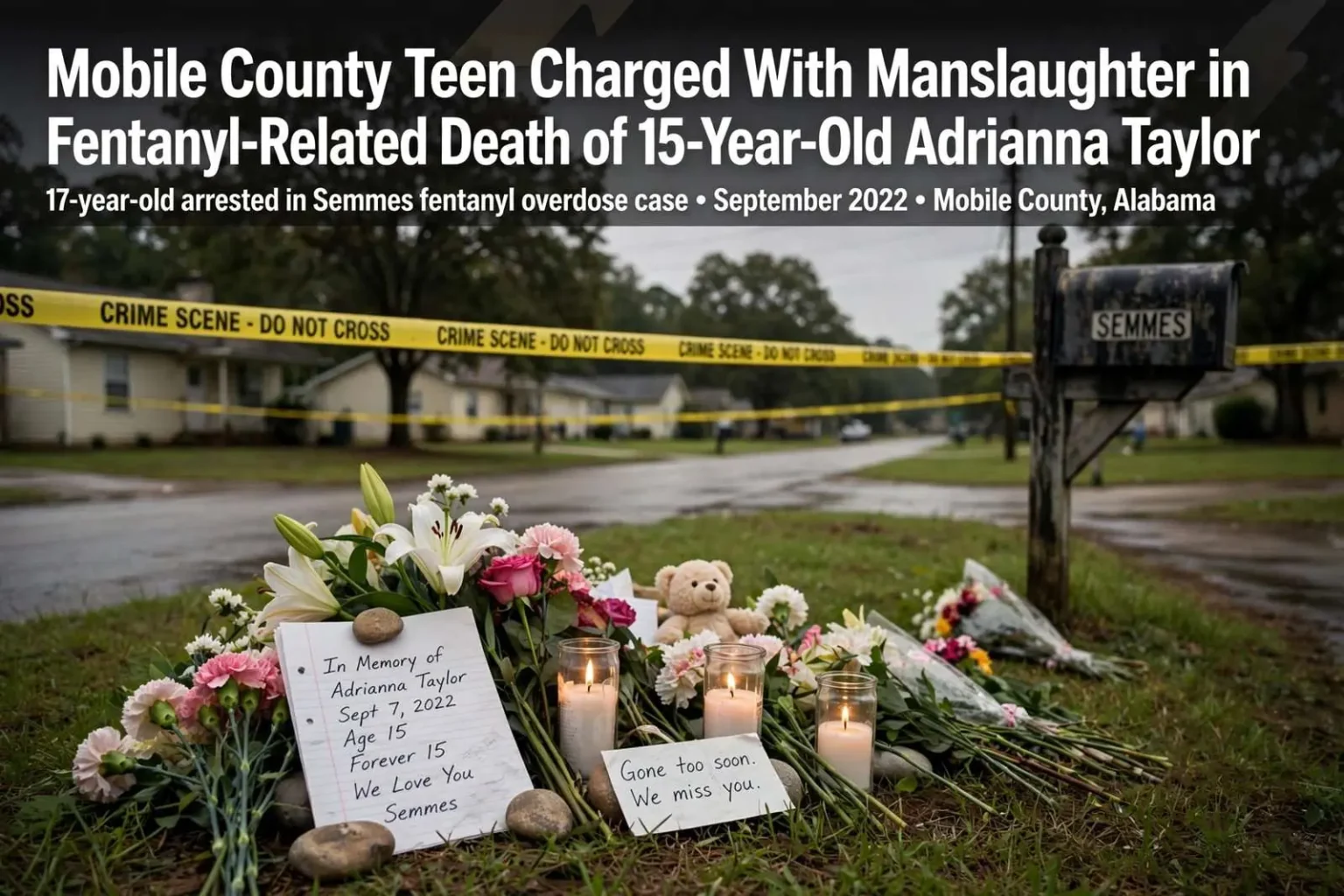
A 17-year-old boy has been arrested and charged in connection with the death of 15-year-old Adrianna Taylor of Semmes, who died of a fentanyl overdose in September 2022. The arrest, coming months after the sophomore’s death, marked a turning point in a case that has become emblematic of the fentanyl crisis sweeping through south Alabama’s schools, neighborhoods and families.
Taylor was found dead at a home in Semmes on Wednesday, Sept. 7, 2022. The Mobile County Sheriff’s Office determined her cause of death was an overdose caused by consuming a pill laced with fentanyl. The synthetic opioid, which is up to fifty times stronger than heroin and many times more potent than morphine, has become a common adulterant in counterfeit pills sold across the Gulf Coast, often without the buyer’s knowledge.
Semmes, a city in western Mobile County along the path of the region’s rapid suburban growth, had seen the broader opioid wave reach its schools and youth sports leagues like communities across the county. But the death of a 15-year-old girl in a residential neighborhood brought the scale of the problem home in a way that statistics could not.
The Arrest and the Charges
The suspect, whose identity was initially withheld under Alabama juvenile-privacy law, was charged with manslaughter and unlawful distribution of a controlled substance. Because he was 17 at the time of the arrest, his name could not legally be released while the case remained in the juvenile system, even as investigators signaled the seriousness with which they were treating it.
Authorities confirmed he will be tried as an adult, a decision that removes the juvenile-privacy protections and exposes the case to the full process of the adult criminal courts in Mobile County. Prosecutors treating fentanyl distribution deaths as manslaughter cases has become an increasingly common approach across Alabama, as law enforcement agencies look for legal tools that match the lethal consequences of the drugs being sold.
The two charges together reflect the arc of the alleged conduct: the unlawful distribution count speaks to the act of providing the laced pill, while the manslaughter count speaks to the death that followed. Cases of this kind often turn on forensic evidence linking the pill consumed to the distribution, along with phone records, witness statements and toxicology findings.
Sheriff’s Office Says Fentanyl Cases Are Rising
Capt. Paul Burch of the Mobile County Sheriff’s Office said deputies are aggressively pursuing fentanyl-related cases as the department has seen a sharp uptick in investigations.
“Tragically but fortunately, as a result of this case, people are coming forward, sending us information on persons who are dealing it,” Burch said. “We are obviously interested in any illegal drugs, but right now we have a strong focus on anything fentanyl-related because young people are losing their lives.”
Burch said that since Taylor’s death, community members had begun voluntarily sharing tips with investigators — a sign he described as both encouraging and reflective of how deeply fentanyl has affected Mobile-area families. That flow of information, he indicated, has helped deputies identify dealers and distribution chains that might otherwise have operated out of sight.
The Mobile County Sheriff’s Office, which covers the unincorporated county and municipalities like Semmes that contract for its services, has built its fentanyl strategy around speed: responding to overdose scenes quickly, collecting the pills and packaging that remain, and pushing those exhibits through the lab work needed to tie a specific sale to a specific death. Investigators have credited that turnaround discipline with the arrests that have followed overdoses across the county in recent years.
The sheriff’s emphasis on fentanyl reflects a reality that has reshaped drug enforcement across the country. Pills passed off as legitimate medications — pressed to look like oxycodone, Xanax or other prescription drugs — are frequently cut with fentanyl in quantities potent enough to kill a first-time user. A dose measured in grains of salt can stop breathing, and users who believe they are taking a prescription pill often have no way of knowing what is actually inside.
For investigators, that means a single pill recovered from an overdose scene can open an entire distribution case. Deputies trace where the pills came from, who sold them, and how they moved through the community, working backward from the most tragic evidence of all: a young victim.
Community Resources Available for Families
Virginia Guy of the Drug Education Council — a Mobile-based nonprofit — said the first step in curbing the fentanyl crisis is deterring people from drug use in the first place.
“We provide prevention, intervention and recovery support,” Guy said. “If there is any individual or family looking for help, we can direct them in the right way.”
The council’s free services are open to the public, and the organization has long served as a first phone call for families who suspect a loved one is using drugs or who are coping with the aftermath of addiction. Prevention programs reach into schools and community groups, while intervention and recovery support help families navigate treatment options in a region where waitlists and cost can otherwise put help out of reach.
Guy’s message about deterrence pairs with a hard truth of the fentanyl era: prevention is not only about stopping drug use before it starts, but also about making sure every potential user understands that a single pill from an unknown source can be lethal. Education campaigns across Alabama have increasingly focused on that message for teenagers, who may experiment with what they believe is a prescription drug and never get a second chance.
A Broader Regional Trend
The case underscores a broader regional trend: law-enforcement agencies across Mobile County and the Alabama Gulf Coast have increasingly focused on fentanyl distribution as overdose deaths among teenagers and young adults continue to climb across south Alabama. Sheriff’s deputies, municipal police departments and federal partners have prioritized the suppliers of fentanyl-laced pills, treating each overdose death as both a personal tragedy and a potential criminal case against the distributor.
Mobile County has also seen a sustained expansion in the availability of naloxone, the overdose-reversal medication carried by deputies and first responders across the county, as agencies confront the reality that a fentanyl emergency is measured in minutes. Public health organizations have worked to put the drug in more hands, from school resource officers to family members of those at risk.
That enforcement posture has been matched by growing public awareness. Town halls, school assemblies and community meetings across Mobile County have taken up the subject of fentanyl in recent years, as parents and educators grapple with a drug threat that did not exist in the same form a decade ago. The Mobile County Sheriff’s Office has used its public platforms to urge families to talk with their children about the risk of any pill that does not come from a pharmacy.
The Community’s Response in Semmes
In Semmes and across western Mobile County, Taylor’s death rippled through the community in ways that extended beyond the criminal case. Students at her school returned to classrooms carrying the grief of losing a classmate, and local families began asking harder questions about how pills reach teenagers — through social media, through friends, through the same everyday channels teens use for everything else.
The tips that reached investigators after her death, as Burch described, suggested that residents were no longer willing to treat drug dealing as background noise. For a suburban community that has grown quickly along the corridors west of Mobile, the case became a rallying point for the kind of community-police cooperation that investigators say makes cases like this one solvable.
What Happens Next
With the suspect now charged and headed to adult court, the case will move through the standard machinery of the Mobile County court system: arraignment, discovery, and eventually a resolution by trial or plea. Prosecutors will bear the burden of proving both the distribution and the death, and the outcome will be watched closely by a community that has followed the case since the morning Taylor was found.
No criminal case can undo the loss of a 15-year-old girl, and officials on both the enforcement and prevention sides have acknowledged as much. What the arrest offers, they argue, is accountability for the distribution of the pill that killed her, and a signal to anyone else selling fentanyl-laced pills in Mobile County that the consequences are no longer hypothetical.
For families looking for help, the Drug Education Council’s services remain free and available to the public, and law enforcement agencies across the county continue to accept tips on fentanyl distribution. The message from both directions is the same one that has defined this case from the beginning: the pills are more dangerous than they look, the loss is real, and the community is watching.
Anyone with information about fentanyl distribution in Mobile County can contact the Mobile County Sheriff’s Office or submit tips anonymously through established crime-reporting channels. In a crisis involving a suspected overdose, the immediate step is always to call 911.


