Mobile County Weighs Repurposing NOAA Disaster Center Instead of Building New EMA Hub
Mobile County officials are weighing whether to repurpose NOAA's Disaster Response Center in West Mobile instead of spending millions on a new emergency operations center, even as the county moves ahead with plans and financing for a replacement facility.
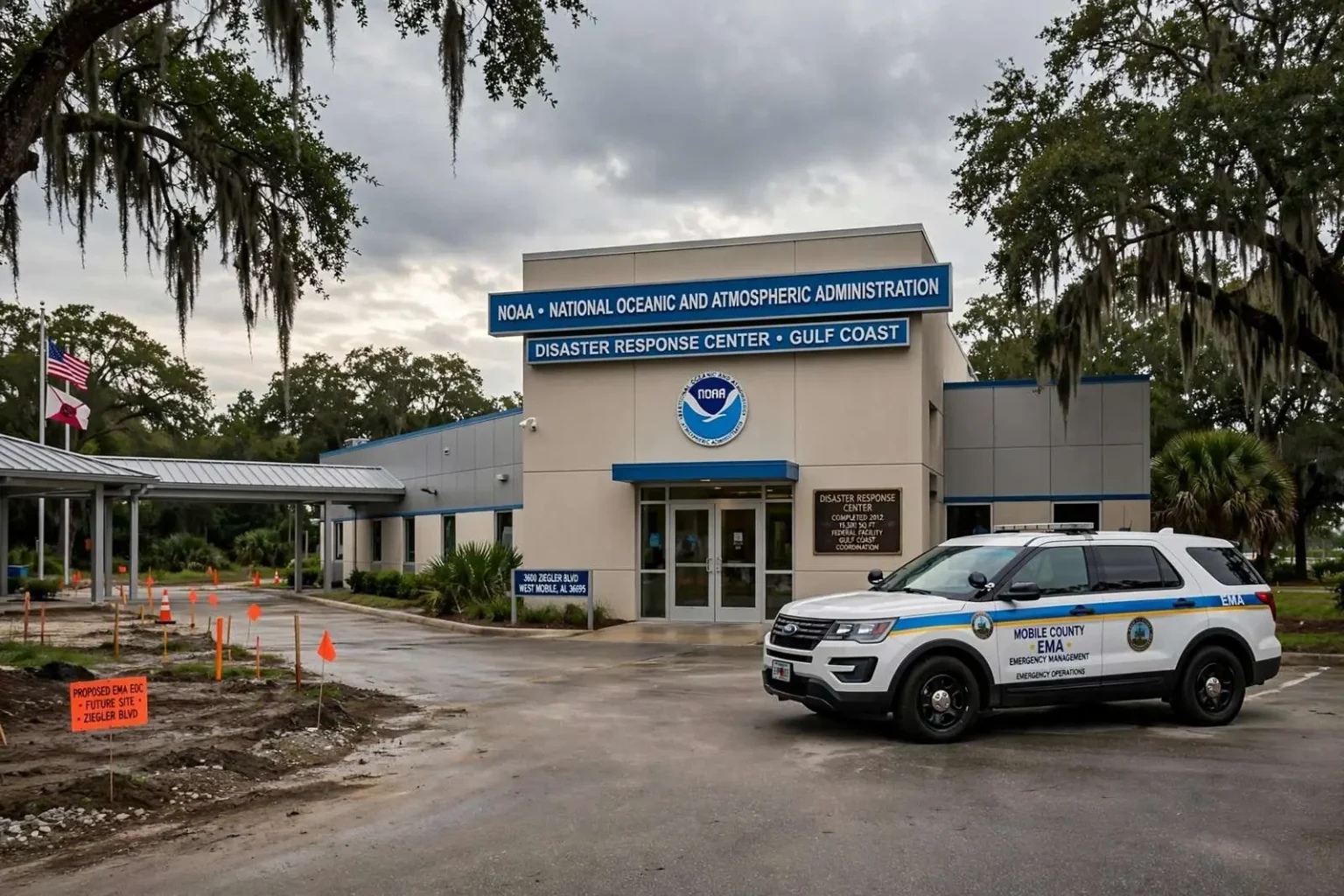
Mobile County officials are taking a closer look at whether a federally built disaster center already standing in West Mobile could solve a problem county leaders have wrestled with for more than a year: what to do about an emergency operations center that is decades past its prime. For more than a year, county officials have discussed building an upgraded emergency operations center to replace the one used by the Mobile County Emergency Management Agency on McGregor Avenue, portions of which are more than 60 years old.
Plans have called for a new facility on Ziegler Boulevard near the Mobile County Communications District, on land the city of Mobile gave to the EMA. But board members with the Mobile County Communications District have recently floated a different idea: using the National Oceanic and Atmospheric Administration’s Disaster Response Center, which sits on the same property, instead of building something new from scratch. The 15,500-square-foot, $11 million Disaster Response Center was completed in 2012 with the backing of Sen. Richard Shelby and is funded entirely by the federal government.
Though similar in purpose to a local emergency operations center, it operates on a far larger scale, serving as a coordination point for agencies across the entire Gulf Coast when disaster strikes. County Engineer Joe Ruffer, who sits on both the Mobile County Communications District board and the county’s Emergency Management Agency Authority Board, laid out the arrangement behind the center’s construction during a November meeting. The EMA owns the land and leased it to NOAA to build the facility, he said, under an agreement that gives the EMA first claim on the building if NOAA ever stops using it.
“It’s set up for that, but only if NOAA doesn’t get funding to stay in the building,” Ruffer said. Mobile County EMA Director Ronnie Adair compared the situation to how National Guard armories revert to local control when federal funding disappears. He said he has not heard of any funding changes on the horizon for the Disaster Response Center, but cautioned that circumstances can shift from one budget year to the next. Gary Tanner, director of the Mobile County Communications District, said he approached Sen. Jeff Sessions about defunding the center to save the county money roughly three years ago, but no changes were made. Asked what would happen if the county built a new emergency operations center only to see the Disaster Response Center lose its federal funding and revert to local control, Tanner did not mince words: “That would be a disaster.” Charlie Henry, director of the Disaster Response Center, said the facility’s funding is ultimately up to Congress. “I have no way to look ahead in the future, but right now we’re funded from multiple sources,” he said.
He estimated it takes roughly $1 million a year to operate and maintain the center, with additional money going toward projects meant to benefit the broader Gulf region. Henry said the center, which has just 15 offices, already has more personnel than space, and is preparing to bring in two additional staff members from the Gulf Coast Recovery Council in mid-December. He noted that the original design for the Disaster Response Center anticipated the EMA’s planned facility being built alongside it.
“The idea was they were going to design their facility parallel to ours, connect them by a covered walkway and they would be mutually supportive,” Henry said. “They weren’t going to duplicate some of the rooms we have and we could both use either facility.” More than 700 first responders — including personnel from the county, the state, the U.S. Coast Guard and other federal agencies — have used the Disaster Response Center for training drills, according to Henry. “We’re actually providing a service by using it to support the area,” he said.
“In fact, the region has the added value that, basically, NOAA and the federal government are paying for them to use the facility.” Even so, Adair said building a larger, modernized facility for the EMA remains a priority given the condition of the current operations center. “They started construction on pieces of the current facility in 1952, and it was upgraded in the ’60s,” he said.
“There’s still copper wiring.” Mobile County Commission President Connie Hudson said the EMA has already received about $2 million in federal grants toward the new operations center, roughly $800,000 of which has gone toward designing a structural plan for the building. “We’ve been looking at different funding mechanisms, but have sort of put it on the front burner because we know time is an issue,” Hudson said.
“The federal government wants to see what sort of progress you’ve made, and if by a certain deadline you haven’t made progress, they want the money back.” The county has already been granted two extensions on that federal deadline, she said, with no guarantee more will follow. Under the current structural plan, the new operations center could cost close to $14 million and span about 36,000 square feet. Funding would be pieced together from the Mobile County Communications District, the county and federal grants.
At a County Commission meeting last month, Ruffer told commissioners the county’s share of the project would require only a $7 million commitment from its capital improvements plan, even after the city of Mobile withdrew its pledge to help fund the project. “The city, as you know, told us they would not be able to come up with their $7 million,” Ruffer said.
“We also have about $2.6 million of road work we moved from our 2012 CIP into the most recent Pay As You Go program.” That leaves the county needing $9.6 million, Ruffer said, with the communications district likely contributing another $1.3 million indirectly. According to Tanner, the district has set aside funds — budgeted for more than four years — to purchase the old operations center building once it is vacated. Not everyone at last month’s commission meeting was fully on board with how the project might be financed.
Trey Oliver, a Mobile County Communications District board member who also represents the Mobile County Merit System Employees Association, raised concerns about rumors of borrowing money to cover the project’s cost. Hudson acknowledged the funding picture is not entirely settled, but pushed back on concerns about additional debt. “Even with this bond issue we’re contemplating at the beginning of the year, our debt service has been reduced by $2 million in our most recent budget,” she said.
“If we stop borrowing money, we would very shortly end up in the same situation the city has been in for years with all the money going to operations. Our constituents don’t expect us to put all the money in operations. It’s a balancing act.” Oliver, who serves as warden at the Mobile Metro Jail, said he worried that additional debt could limit the county’s ability to fund day-to-day operations, raise employee wages, address infrastructure needs and relieve overcrowding at the jail.
Commissioners agreed that the jail’s population is a growing concern, but District 2 Commissioner Merceria Ludgood said the emergency operations center remains a critical need. “The existing EOC is trying to function, but isn’t able to, and that’s just not sustainable,” Ludgood said. “With us being the vulnerable type of community that we are, we’ve just got to do better.”
What an emergency operations center does
An emergency operations center is the central location where county officials, first responders and partner agencies gather to coordinate response and recovery during hurricanes and other large-scale emergencies. Because the building must stay operational when a storm strikes, such centers are typically built to withstand high winds and to keep power and communications running when the rest of the area has lost them.