Mobile County Youth Dove Hunt Draws Peaceful Protest From Animal Rights Advocates
A youth dove hunt in Mobile County drew a peaceful demonstration from animal rights advocates, prompting questions about the state-run mentoring program.
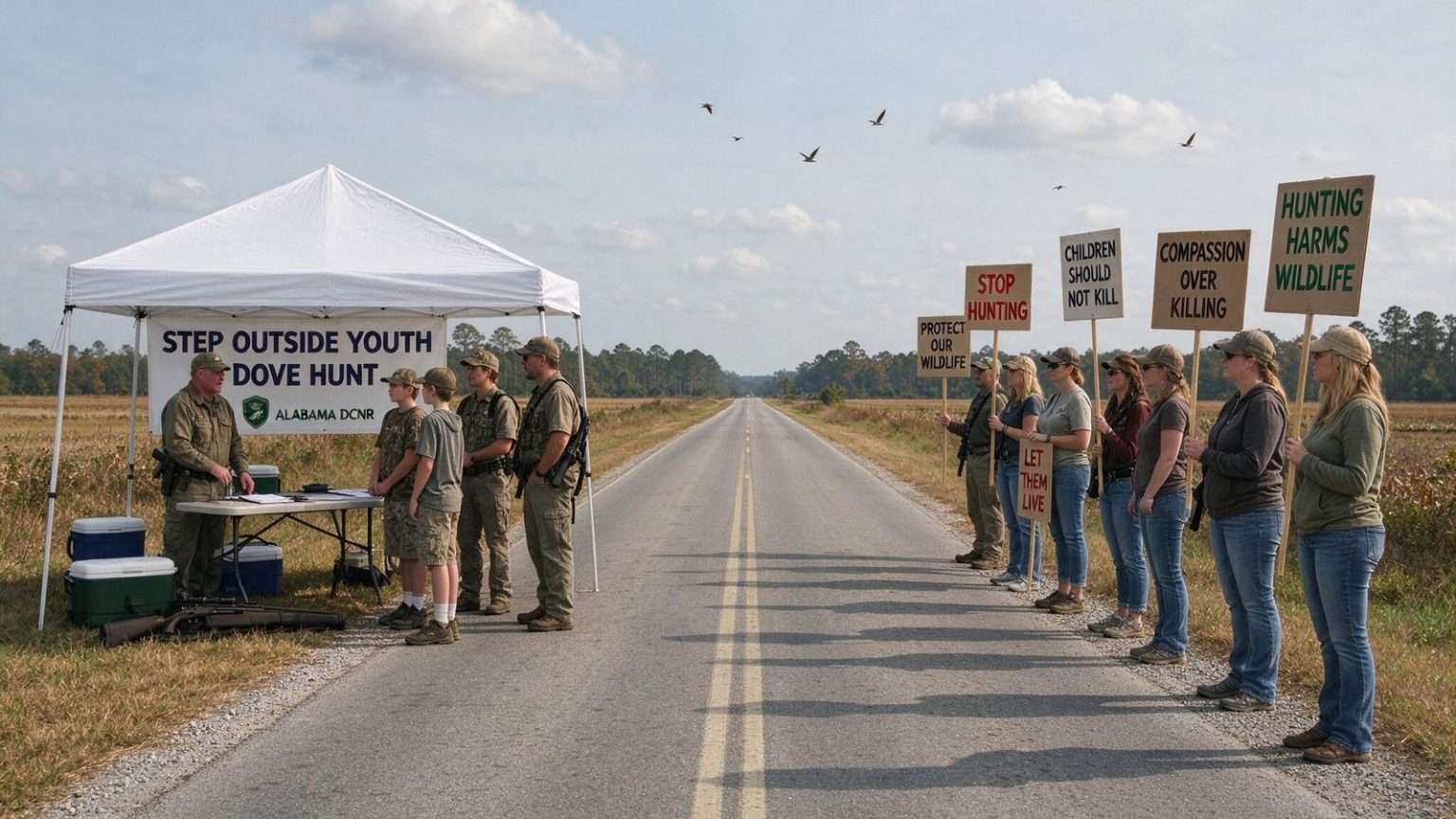
A youth dove hunt held in Mobile County recently became the site of a peaceful demonstration, as a small group of animal rights advocates gathered across the street to protest the killing of doves, particularly by children participating in the state-sponsored program. The demonstrators stayed on public ground across from the hunt site, carrying their objections without confronting participants directly. The scene paired two views of the same event that rarely share a field: a state program built to recruit young hunters and activists who believe that recruitment should stop.
The hunt was one of two scheduled in Mobile County this year as part of the Alabama Department of Conservation and Natural Resources’ Step Outside youth dove hunt program, which has introduced young people across the state to hunting since 2001. The program operates through the department’s Wildlife and Freshwater Fisheries Division and runs on a seasonal calendar each fall, when dove season opens across South Alabama. More than two decades in, Step Outside has become one of the state’s most established recruitment efforts for new hunters.
Conservation officials on site declined to comment directly on the protest, but the demonstration was described as peaceful and did not disrupt the scheduled hunt. Participants arrived, checked in and took the field on schedule, with the demonstration visible but peripheral to the event itself. The separation between protesters and the hunt reflected the site’s layout, a rural field setting with a public roadway dividing the two groups.
How the Step Outside Program Works
The Step Outside program pairs an adult mentor, at least 25 years old, with up to two youths under age 16 for a supervised hunting outing. The mentorship structure is deliberate: every child in the field is within arm’s reach of an experienced adult responsible for their conduct and safety. Registration takes place online, and the size of each hunt is capped based on the size of the field being used to ensure safety for participants.
Most of the hunts, including those in Mobile County, are held on private land donated by local landowners, and some hunts include cookouts or skeet-shooting demonstrations before the actual dove hunt begins. The donated fields are an essential part of the program’s economics, giving the state access to managed dove habitat without purchase or lease. The pre-hunt activities serve as informal instruction, letting first-time shooters handle a shotgun in a low-pressure setting before live birds fly.
Before hunters take to the field, a conservation officer or wildlife biologist reviews safety rules, including proper firearm handling and restrictions on shooting at low-flying birds. The briefing covers muzzle direction, loading procedures, zone-of-fire discipline and the identification rules that govern dove hunting. Officers and biologists remain present through the hunt, reinforcing the standards the state expects from every participant.
Officials say the program is designed as much to teach conservation ethics and firearm safety as it is to introduce young people to the outdoors, with mentors required to stay with their assigned youth throughout the hunt. The curriculum, such as it is, embeds lessons about habitat, seasons and limits into the experience of a morning afield. Program materials frame hunting as one part of a broader conservation ethic that includes land stewardship and respect for wildlife resources.
Dove hunts occupy a particular place in Alabama’s hunting culture. The season opens in early fall, the birds present fast, challenging shooting, and the social format, hunters stationary in a field with companions nearby, makes doves a traditional first quarry for young shooters. Families across South Alabama have passed the practice down for generations, which is precisely the audience Step Outside was created to formalize.
The Protest and Its Context
The animal rights advocates who demonstrated near the Mobile County hunt represent a recurring, though relatively small, strain of opposition to youth hunting programs statewide. Similar objections have surfaced at public meetings and online forums over the years, typically focused on the age of the participants rather than the legality of the hunt. The Mobile County demonstration was notable mainly for its proximity to the event, with protesters positioned where participants and their families could not miss them.
Critics argue that involving children in the killing of animals sends the wrong message, while wildlife officials counter that regulated hunting functions as a conservation tool that helps fund habitat and species management through license fees and related federal programs. That funding argument is central to the state’s position: hunting license purchases and federal excise taxes on sporting equipment flow back into wildlife management work that benefits game and non-game species alike. Officials point to the framework as the reason Alabama’s game populations remain healthy enough to support regulated seasons at all.
The philosophical gap on display at the hunt site is a standing feature of American conservation debates, and Alabama sits squarely within the hunting tradition that state agencies administer. Demonstrations at youth hunts remain uncommon, and organizers have treated them as an expected cost of holding public events on visible rural roadsides. The Mobile County protest ended without incident, consistent with the pattern statewide.
Mobile County’s dove fields have hosted youth hunts for years as part of the statewide rotation, drawing families from across the region who want to introduce children to hunting traditions passed down within their own families. The county’s mix of farmland, pine flats and managed fields provides the habitat doves favor, and its population provides the participants. Hunts here typically fill their registration slots well before the season opens.
Organizers say the hunts are heavily supervised, with strict limits on the number of participants and close mentorship expected from the adults involved. The caps protect both the shooters and the quality of the experience, preventing the crowded conditions that turn a beginner’s outing into a hazard. Landowners who donate fields do so with the understanding that the state will keep the events controlled and lawful.
No injuries, arrests, or disruptions were reported in connection with the demonstration, and the hunt proceeded as scheduled. By the standards of public controversy, the day closed quietly: birds were taken, young hunters got their introduction, and the protesters made their point from across the road. Both sides described the event in ways that suited their purposes, and neither was contradicted by disorder.
The Broader Recruitment Question
The demonstration arrives against a backdrop that both sides of the debate follow closely: hunter numbers. State wildlife agencies across the country, Alabama’s included, have spent two decades working against a gradual decline in hunting participation, driven by urbanization, changing family routines and the aging of the license-buying base. Youth programs like Step Outside are the direct institutional response, built to create hunters at the age when outdoor habits form.
The stakes for agencies are practical as much as cultural. License revenue underwrites a large share of wildlife management work, and federal matching programs tied to hunting and shooting participation fund habitat projects on public lands. A shrinking hunter base therefore means a shrinking budget for the full range of conservation work, including the management of species that hunters never pursue. That is the argument officials make when programs like Step Outside are questioned.
For the families who participate, the calculus is simpler. A supervised dove hunt offers a structured first experience, complete with safety instruction, loaner mentorship and a setting designed for beginners, that would be hard to arrange privately. Parents who did not grow up hunting, a growing share of the population, use programs like this one to give their children an outdoor tradition they cannot teach themselves.
The animal rights position, in turn, rests on a different reading of the same facts. Advocates argue that introducing children to killing animals normalizes violence before young people can evaluate it, and that the state should not be in the business of recruitment at all. The demonstration’s focus on the children’s participation, rather than on dove hunting generally, sharpened that argument for the passing traffic.
State wildlife officials say they expect the Step Outside program, including future dates in Mobile County, to continue as part of its broader effort to recruit the next generation of Alabama hunters. The department’s schedule for the fall season includes hunts across the state’s wildlife districts, with Mobile County’s fields a recurring stop. Officials have shown no indication that demonstrations will alter the program’s structure or calendar.
What the day in Mobile County illustrated is the coexistence of the two views on the same roadside. A state agency ran a two-decades-old program exactly as designed, mentors and children in the field, officers delivering safety briefings, limits enforced, and a small group of citizens exercised their right to protest it from the far side of the road. Nothing in the encounter required either side to change its mind, and nothing prevented either side from showing up again next season.
The youth dove hunt, like the program it belongs to, will keep its place on the fall calendar. The families who filled the Mobile County field came for an introduction to a tradition, and they got it, undisturbed. The advocates who lined the opposite shoulder came to object, and they made themselves heard. Both outcomes were, in their different ways, the point.