
Mobile Creates State’s First Tourism Improvement District to Boost Lodging, Tourism
Mobile's new Tourism Improvement District will raise $1.3 million a year for lodging and tourism marketing, the first such district in Alabama.
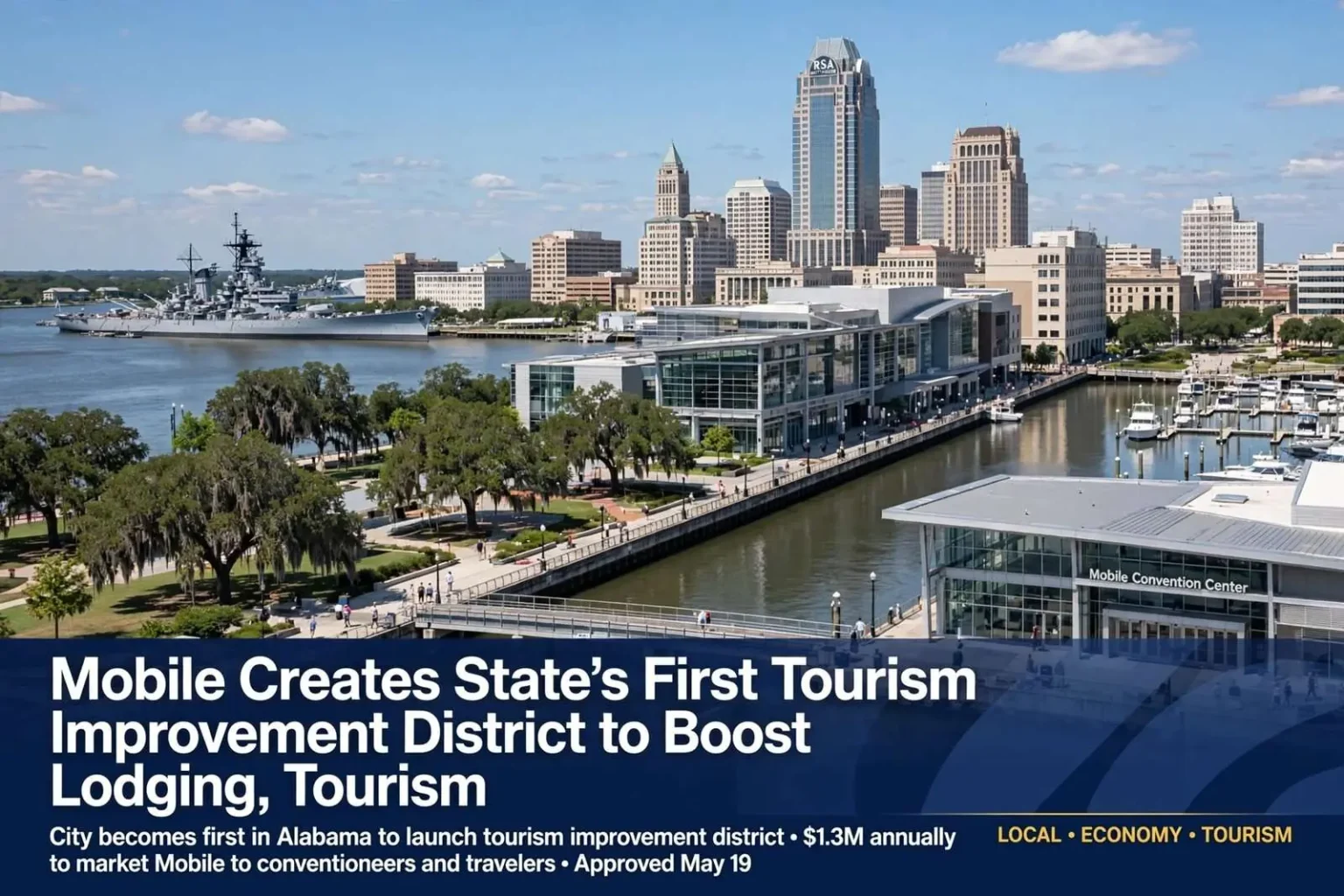
The Mobile City Council has approved the formation of the Mobile Tourism Improvement District (MTID), a five-year public-private partnership designed to raise about $1.3 million annually to support the city’s lodging industry and tourism marketing — a move that makes Mobile the first city in Alabama to create such a district.
The ordinance passed on May 19 followed models used in cities such as Savannah, Memphis and Tampa, where the lodging industry taxes itself to fund marketing and destination promotion that no single hotel could afford on its own. “The Tourism Improvement District is a game-changer and is a terrific example of what coming together collectively can do to raise the bar in elevating lodging and tourism in our great city,” said Kent Blackinton, president of the Mobile Area Lodging Association. “Our lodging partners are united and are ready to be innovative to produce positive results. All stakeholders win.”
How a tourism improvement district works
Tourism improvement districts are built on a simple mechanism: hotels within a defined district agree to an assessment on their gross room revenues, collected with the lodging tax and dedicated to programs that promote the destination and strengthen the lodging sector. The assessment is a public-private partnership in the literal sense — authorized by the city through an ordinance, but funded and governed in large part by the hoteliers themselves.
That self-assessment structure is why TIDs have spread across the country over the past two decades. Hotels in a market collectively decide how much to invest in marketing their destination, and the funds cannot be diverted to unrelated city priorities the way general tourism tax revenue sometimes is. The district typically operates under a contract with the city, with oversight that includes representation from the lodging properties that pay the assessments.
Mobile’s version, as approved, commits the district to a five-year term with expected collections of about $1.3 million annually. That is a meaningful sum in a market of Mobile’s size — money dedicated to selling the city to convention planners, group tour operators, sports event organizers, and leisure travelers who might otherwise choose another Gulf Coast destination.
The May 19 vote put Mobile ahead of every other city in Alabama. Despite the state’s growing tourism economy — Gulf Shores and Orange Beach on the coast, Huntsville in the north, and Birmingham in the center — no Alabama municipality had previously formed a tourism improvement district under the models that have become standard in Tennessee, Georgia, and Florida.
The cities Mobile is copying
The models cited — Savannah, Memphis and Tampa — are instructive. Savannah’s tourism improvement district was among the early examples in the Southeast, built around a historic downtown that draws millions of visitors a year and funded by an assessment that hoteliers there helped design. Memphis created its district to compete for conventions and group business in a market anchored by Beale Street, Graceland, and the National Civil Rights Museum.
Tampa’s version operates in a market that has become one of Florida’s strongest, with district funds supporting the marketing that fills downtown hotels during conventions, sporting events, and the cruise season that departs from Port Tampa Bay.
The common thread among those cities, and the reason Mobile’s lodging leaders studied them, is the distinction between a destination that passively waits for visitors and one that actively markets for them. Tourism improvement districts convert a fraction of room revenue into a permanent, professionally managed marketing budget — and the cities that adopted them did so because their hotel industries concluded that collective investment paid for itself in occupancy.
The district’s funding level places Mobile among the mid-sized markets that have adopted the model nationally, and that comparison is part of the case its backers made. Cities that formed districts at similar assessment levels have used the funds to hire dedicated sales staff, produce professional advertising assets, and measure results through occupancy data that shows whether the investment is returning. Those benchmarks — occupancy, average daily rate, and revenue per available room — become the scorecard on which the MTID’s first five years will be judged by the very hoteliers funding it.
Why Mobile’s hotels wanted it
Mobile’s lodging market has distinctive strengths and distinctive challenges. The city hosts a convention center on the riverfront, a cruise terminal that has brought seasonal cruise departures, major annual events, and a tourism base built on centuries of history — historic districts, museums, the USS Alabama Battleship Memorial Park across the bay, and the Mardi Gras celebrations that predate New Orleans’. But it competes for visitors against destinations with far larger marketing budgets, most visibly the beach markets down the road and the convention cities across the region.
The $1.3 million a year the district is expected to raise addresses that gap directly. Funds of that scale allow for a consistent advertising presence, representation at trade shows where meeting planners book group business, and the kind of professional destination marketing that individual properties — from downtown’s full-service hotels to the suburban properties along the interstate corridors — cannot sustain independently.
Blackinton’s description of the lodging partners as “united” points to the other condition a district requires. TIDs succeed only when the hotels that will pay the assessment support the structure — typically through petitions or consent from properties representing a majority of the district’s room inventory. The Mobile Area Lodging Association’s role in organizing that support is part of why the city council’s vote could proceed on May 19 with the district ready to function.
The “all stakeholders win” framing reflects the argument district backers make everywhere: hotels gain occupancy, the city gains the sales tax, lodging tax, and economic activity visitors generate, and attractions, restaurants, and venues gain the attendance that marketing brings. No stakeholder carries the cost alone, because the cost is spread across every guest night sold in the district.
What the money will do
Tourism improvement district revenue is generally spent on the tools that move markets: advertising campaigns aimed at drive markets within a few hours’ radius, digital marketing that targets travelers planning Gulf Coast trips, sales missions to meeting planners and tour operators, and support for the events that fill hotels on weekends that would otherwise run light.
In Mobile’s case, the five-year term gives the program a horizon long enough to plan strategically rather than year to year. Destinations marketing for group business often book conventions and tournaments years in advance, and a district that can commit to multi-year sales efforts competes for that business in a way that hand-to-mouth marketing budgets cannot.
The district’s creation also signals to the regional tourism industry that Mobile’s hotel sector is organizing. Group business is booked on reputation and follow-through, and a destination whose hotels visibly invest in their own market tends to earn the attention of planners deciding between similarly priced cities.
Mobile’s tourism economy
The district arrives as Mobile’s visitor economy has grown into one of the cornerstones of the local economy. The city’s attractions — the historic districts of downtown, the GulfQuest maritime museum, the history museum and galleries, the USS Alabama and the submarines and aircraft at the battleship park, Bellingrath Gardens across the river, and the ecotourism along the Mobile-Tensaw Delta — draw leisure travelers year-round, while conventions, sporting events, and Mardi Gras fill the calendar with peak weekends.
Lodging is where that activity is measured. Hotel occupancy and room rates are the statistics that track a destination’s health, and they are the numbers the district’s backers will watch as the assessment-funded marketing takes effect. Each point of occupancy in a market of Mobile’s size represents substantial annual revenue flowing to properties, to their employees, and to the city’s tax base.
Mobile’s position as the first city in Alabama to form such a district also carries a competitive meaning inside the state. The city’s tourism leaders have watched Huntsville’s growth, Birmingham’s conventions, and the beach markets’ dominance of the state’s leisure travel, and the district is a statement that Mobile intends to market itself with the same seriousness.
The five-year commitment
Five years is the standard term for a first-generation tourism improvement district, and it is designed to be renewed. Districts across the country have typically renewed for successive terms once the lodging industry sees results, and the first term is structured to demonstrate that the assessment produces occupancy that exceeds its cost.
The city’s role after the May 19 vote is oversight rather than operation. The district’s programs will be managed by the tourism and lodging leadership that designed it, under the ordinance’s requirements, with the annual collections dedicated to the purposes the ordinance specifies. That structure keeps the marketing decisions in the hands of the people whose room revenue funds them — the accountability mechanism that district backers cite when they describe the model as a partnership rather than a tax.
For travelers, the district’s work will be visible in the ordinary places: the ads that follow someone researching a Gulf Coast trip, the trade show booth where a planner hears Mobile’s pitch, the events that appear on the calendar because a sales team recruited them. For the city’s hotels, it is the difference between marketing individually and marketing as a destination — the collective approach that, in Blackinton’s words, raises the bar for lodging and tourism across the city.
Mobile’s lodging industry, by the terms of the ordinance, now has five years and roughly $6.5 million in dedicated funding to prove the model in Alabama — a first in the state, and a bet the city’s hoteliers have publicly said they are ready to make.


