After Downtown Shooting Shuts Down Nightclub, MPD Reminds Residents of Curfew
A weekend shooting downtown led to a large police response, the permanent closure of a nightclub, and a reminder about Mobile's curfew rules.
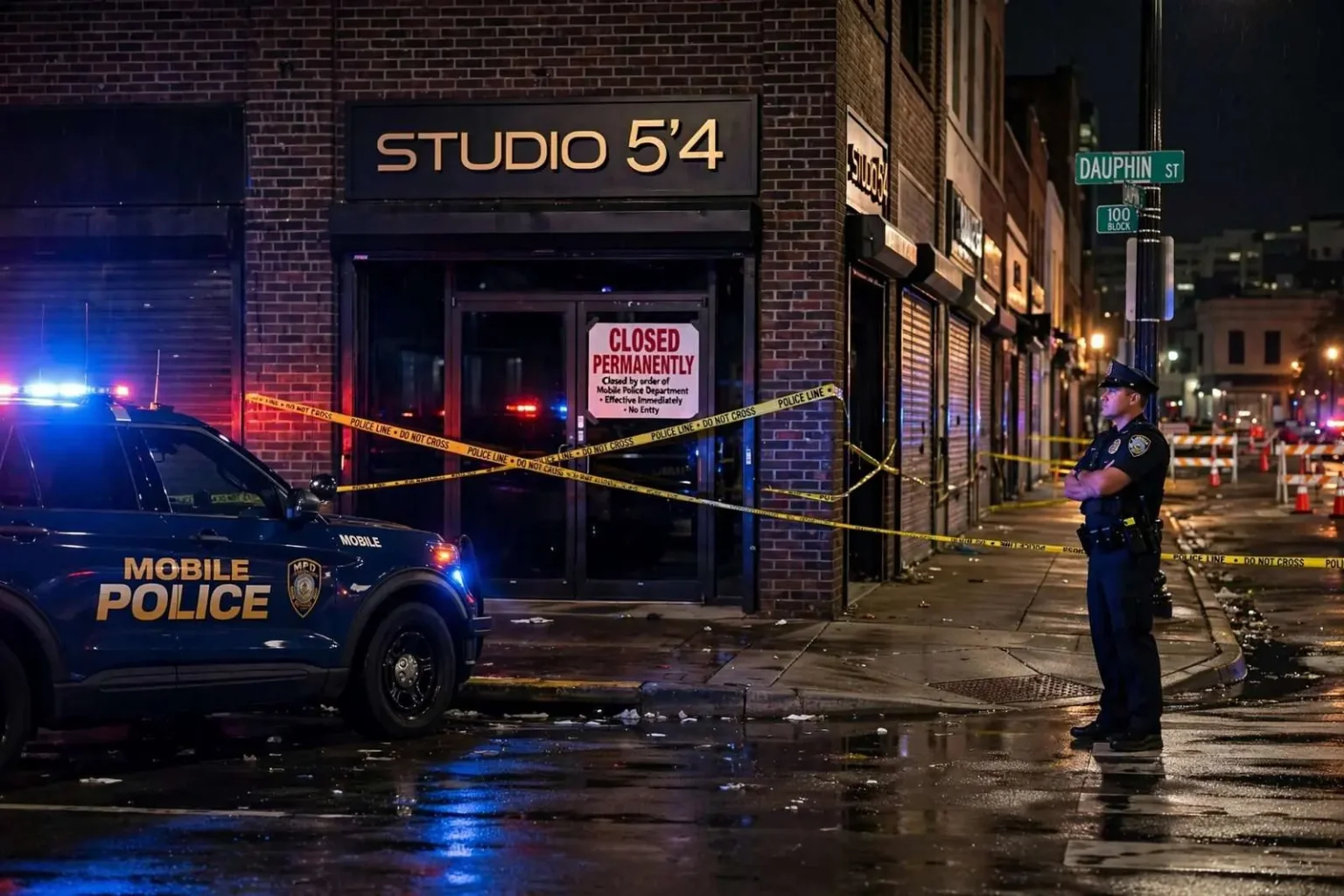
A shooting in downtown Mobile early one Sunday drew a large police response and led to the permanent closure of Studio 5’4, a nightclub that had drawn crowds to the area. In the aftermath, Mobile police used the incident to remind residents — and parents in particular — about the city’s curfew ordinance covering minors.
Officials said part of the chaos that unfolded that night stemmed from a large crowd gathered downtown that was not connected to a nearby Beer Fest event taking place at the same time. The mix of unrelated gatherings and the shooting combined to strain police resources responding to the downtown entertainment district, where a handful of blocks routinely absorb thousands of visitors on busy weekend nights.
The episode gave police a second message alongside the investigation: that the city’s curfew rules apply downtown as surely as they do in residential neighborhoods, and that stepped-up enforcement should be expected on nights when large crowds converge on the entertainment district.
The curfew rules, spelled out
In response, the Mobile Police Department pointed residents back to the city’s existing curfew rules, which have been in effect since 2011. Under the citywide ordinance, minors are subject to a curfew from 11 p.m. until 6 a.m. Sunday through Thursday, and from midnight until 6 a.m. on Friday and Saturday nights — the later weekend start reflecting the reality that school-age residents legitimately stay out later when there is no school the next morning.
Within the downtown entertainment district specifically, the curfew is stricter, running from 10 p.m. until 5 a.m. every night of the week. The tighter downtown window exists because the district’s bars and clubs concentrate adult nightlife in a compact area, and city officials have long treated the corridor differently from residential neighborhoods when it comes to unsupervised minors.
The ordinance includes several exemptions. Minors may be out past curfew if accompanied by a parent, guardian or another adult authorized by a parent for a specific purpose. Exceptions also apply when a minor is running an approved errand, traveling to or from a job, responding to an emergency, or attending an approved activity such as a prom, sporting event, school function or religious event. Minors are also exempt while on the property or sidewalk where they live, or at a next-door neighbor’s home, provided no complaints have been filed about their presence there.
Why the exemption list matters
The carve-outs are designed to keep the ordinance from punishing ordinary life. A teenager closing a shift at a restaurant, heading home from a church youth event, or driving home from a ballgame with a parent is not the target of the law, and officers are expected to make those distinctions in the field. Parents often discover the details only after their child is stopped downtown, which is part of why police periodically re-publish the rules rather than assume everyone knows them.
City officials directed residents seeking the full text of the ordinance to the city’s website for complete details on enforcement and penalties. The reminder serves another practical purpose: when officers know the public understands the rules, enforcement conversations go more smoothly, and the ordinance functions as a prevention tool rather than a surprise.
Downtown on a crowded weekend night
Downtown Mobile’s entertainment district — anchored by the Dauphin Street corridor and the blocks around it — operates on a scale that few other parts of the city see. On weekend nights with a signature event, the combination of bar patrons, festivalgoers and passers-through can push crowds into the streets, and policing the area takes coordination between patrol officers, the department’s downtown unit and private security working the venues.
That is why the unaffiliated crowd mattered so much the night of the shooting. A Beer Fest crowd is counted for, staffed and staged; a large gathering with no organizer, no permits and no plan is not. When both land in the same few blocks at once, the math of policing changes — officers who would normally be spread along the corridor get pulled toward one incident, and the response to everything else slows. The shots fired early that Sunday arrived in exactly that environment.
For businesses, the fallout was immediate. The closure of Studio 5’4 marked the end of one of downtown Mobile’s nightlife venues following the shooting, a decision that removes a late-night destination from the corridor and shrinks the district’s footprint by one establishment. Venue operators along Dauphin Street have long understood that a serious incident anywhere in the district colors perceptions of all of them; safety, crowds and commerce are linked in a way that suburban retail never quite is.
Enforcement going forward
Police signaled that stepped-up curfew enforcement in the entertainment district would likely continue as officials looked to prevent similar large, unaffiliated crowds from gathering downtown during high-traffic weekend events. Curfew enforcement downtown is as much about managing the crowd as it is about any individual minor: clearing unsupervised teenagers from the corridor reduces the pool of bystanders who swell crowds, and it gives officers a lawful, low-friction tool to move young people out of harm’s way before trouble starts.
The approach fits a broader pattern in cities across the Gulf South, where entertainment-district policing leans on a mix of hours-based rules, barrier closures on the busiest nights, and heavy visibility from officers on foot. None of it prevents every incident, but city officials argue the combination keeps the downtown corridor viable as the region’s central nightlife destination — and keeps the nights when something goes wrong from becoming nights when everything goes wrong at once.
For parents, the practical takeaway from the department’s reminder is straightforward: the downtown curfew starts at 10 p.m., every night, and applies regardless of whether a special event is happening. On weekends with festivals, concerts or holiday crowds, families planning to be downtown with teenagers should plan around the earlier hour — and know the exemptions before an officer asks.
The nightclub and its neighborhood
Studio 5’4 operated in the heart of the downtown corridor, the kind of late-hours venue whose closing time shapes the flow of crowds through the surrounding blocks. Venues like it anchor the tail end of a night out: when they close, the streets fill briefly with everyone heading home at once, and the last hour before closing is traditionally when downtown police staffing is stretched thinnest. A shooting in that window compounds every other pressure the district faces on a busy weekend.
The permanent closure leaves a gap in the district’s lineup that other operators will eventually fill — downtown real estate along the corridor has rarely stayed dark for long — but it also removes a location that had become associated with exactly the kind of large, late-night crowds officials were already worried about. For neighbors and other business owners, the closure reads as a signal that the tolerance for venues connected to serious incidents is limited, and that the city’s economic bet on downtown nightlife depends on keeping the district safe enough to draw crowds from across the metro area.
The 2011 ordinance’s long arc
The curfew ordinance police pointed back to has been on the books since 2011, adopted amid concern about juvenile violence and unsupervised gatherings, and it has survived long enough that a generation of Mobile teenagers has grown up under it. Its durability reflects a pragmatic consensus: parents generally accept the hour rules, the exemptions keep the law from reaching ordinary activities, and downtown’s stricter window was negotiated with the business community rather than imposed on it.
Enforcement patterns have shifted with the years and with police staffing, but the department’s habit of re-publicizing the rules after major downtown incidents has been consistent. The reminders tend to follow the same formula as this one: a serious incident draws attention, officials explain the rules that already existed, and enforcement ticks up for a stretch of weekends before settling back toward routine levels.
What residents should know before the next big weekend
With festival season and other high-traffic events guaranteed to fill downtown again, the practical guidance is simple. Minors downtown after 10 p.m. on any night are subject to the district curfew unless an exemption applies; the citywide hours are 11 p.m. on school nights and midnight on Friday and Saturday. Parents authorizing another adult to accompany a teenager should understand that the authorization is for a specific purpose, and officers can ask about it.
Anyone with questions about the ordinance’s exact language, enforcement procedures or penalties can find the full text through the city’s website, as officials directed after the shooting. And for the businesses along the corridor, the message from police and city hall alike is that the coming weekends will be watched closely — with curfew enforcement treated as one part of keeping the district’s busiest nights from turning into its worst.