Historical community report, published from archived local news coverage.
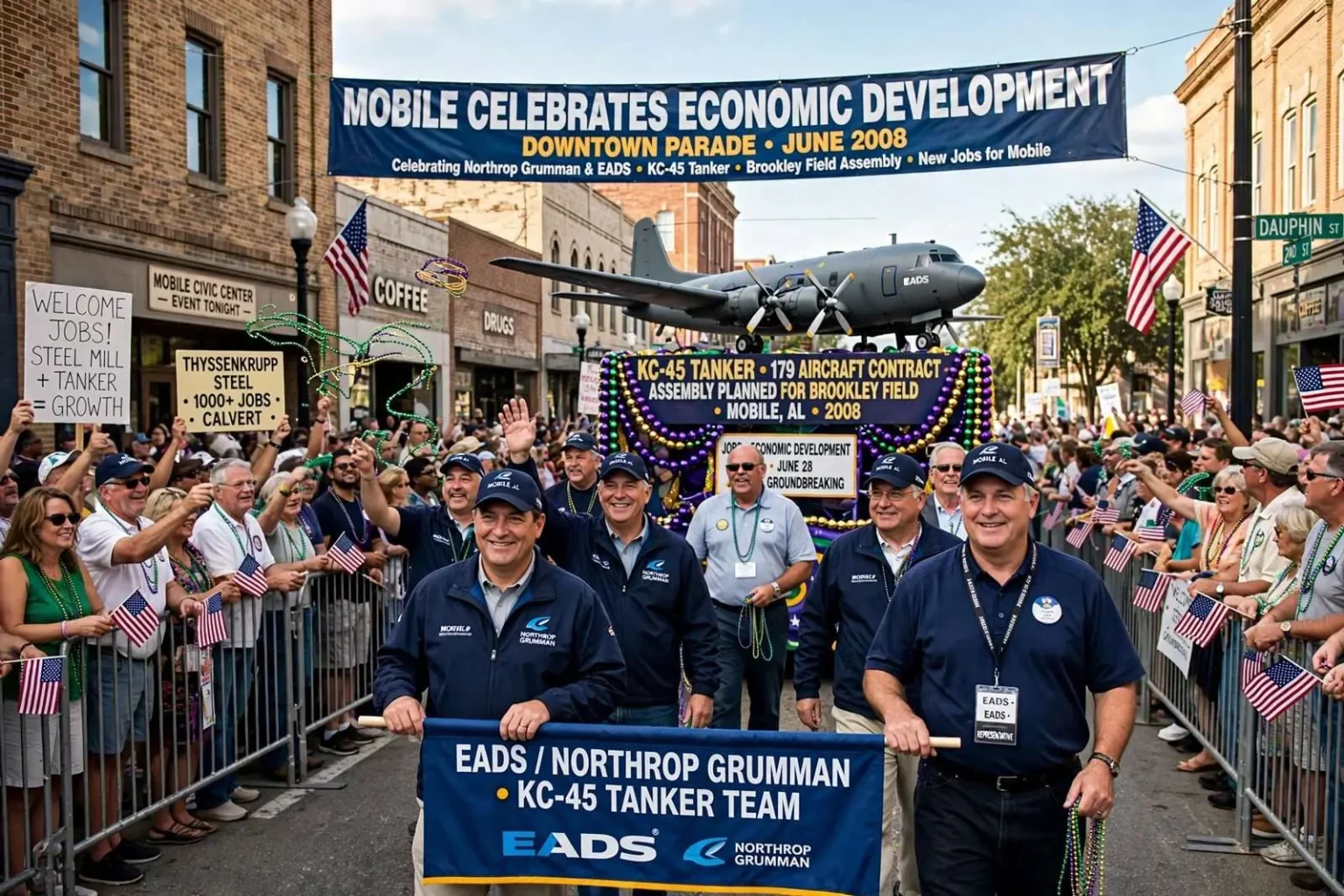
Mobile staged a downtown parade in June 2008 to celebrate the city’s economic-development accomplishments, according to an archived local news report. The parade borrowed the pageantry of the city’s most famous tradition and turned it toward a civic theme: the major industrial projects that, at the time, promised to reshape the region’s economy.
The event carried a piece of custom-made memorabilia. The parade included a special bead featuring a Northrop Grumman KC-45 tanker medallion — a Mardi Gras-style throw bearing the emblem of the military aircraft project that stood at the center of Mobile’s economic ambitions that year. Representatives from Northrop Grumman and EADS took part in the procession, putting the faces of the two aerospace companies behind the tanker effort on public display downtown.
Residents told the station they were hopeful that major projects, including the steel mill and tanker work, would help the city grow. That hope was the emotional core of the event: a city long accustomed to watching larger economies boom had, in the space of a few years, landed two of the largest industrial projects in its modern history, and the parade gave the public a chance to celebrate both at once.
Timing shaped the logistics as much as the celebration. The event coincided with a Carrie Underwood concert at the Mobile Civic Center, and the station reported that the parade used a different route, avoiding major traffic and parking problems near the concert — one crowd inside the arena, another lining the streets outside it.
The tanker project at the center of the celebration
The KC-45 medallion on the parade bead referred to the aerial refueling tanker that Northrop Grumman and its European partner EADS had proposed building in Mobile. The two companies had teamed to bid for the United States Air Force’s next-generation tanker fleet, and Mobile — with its aerospace assets at and around Brookley Field — was the proposed assembly site.
In early 2008 the Air Force selected the Northrop Grumman–EADS team for the contract, a decision that landed on Mobile like a civic jackpot. The work’s estimated scale ran to thousands of direct and indirect jobs at the proposed Brookley assembly operation, and the announcement made Mobile the center of one of the largest defense-procurement stories in the country — the biggest economic-development victory in the city’s memory.
That victory explained the parade’s aerospace theming. A Mardi Gras-style bead carrying the KC-45 medallion fused the city’s oldest public tradition with its newest industrial hope, and the presence of Northrop Grumman and EADS representatives in the lineup underscored the partnership the project represented — an American defense contractor and a European aerospace manufacturer, planning to build American tankers on Mobile Bay.
The parade’s celebration came at a hinge moment. The contract award was contested that summer through the federal protest process, and the tanker program’s future remained unsettled for years afterward as the competition was reopened and reworked. But in June 2008 the community’s public posture was celebration and hope — the parade was staged, the bead was struck, and the companies’ representatives marched.
The steel mill and the industrial moment
The other project residents cited — the steel mill — referred to the massive steelmaking complex under construction in north Mobile County. The project, one of the largest private industrial investments in the United States at the time, had been announced the year before the parade and was transforming both the landscape and the economic outlook of the region.
The steel mill’s footprint reached well beyond its site. Thousands of construction workers were employed building the complex, and its permanent operations promised a payroll that would ripple through Mobile County’s economy — in housing, in services, in the schools and municipalities of northern Mobile County. Combined with the tanker work proposed for Brookley, the project put Mobile into an unfamiliar position: a region with more industrial promise than it had jobs to fill.
That pairing — aerospace on the south side of the city, steelmaking to the north — framed the way Mobile leaders talked about the economy in 2008, suggesting a different scale of ambition than the port and chemical and shipbuilding plants that had anchored generations of steady but unspectacular industry. The June parade was the community’s public embrace of it.
A parade in the city that invented them
Mobile’s claim to the parade is old and fiercely held. The city’s Mardi Gras tradition predates the more famous celebrations to the west, with organized mystic societies parading and throwing favors since the early 18th century, and the annual Carnival season remains the defining public ritual of the city’s calendar. Downtown Mobile is built for parades — its streets are designed around the routes, the balconies are built for watching, and generations of residents have grown up catching beads from the floats.
It was fitting, then, that when the city wanted to celebrate its economy, it reached for the parade form. A civic parade in Mobile is not a novelty; it is the city’s native language of public celebration. And the special bead — the KC-45 tanker medallion — was the perfect emblem of the occasion: the parade throw, Mobile’s signature token of festivity, repurposed to commemorate the project the city hoped would define its future.
The parade’s place in the civic calendar also mattered. June sits far from the Carnival season, which means a summer parade downtown was an unusual sight — organized not by a mystic society but around a civic theme, celebrating economic development rather than the weeks before Lent. The unusualness was part of the point: the occasion was exceptional, so the celebration broke the calendar.
The route change, worked out to avoid major traffic and parking problems near the Carrie Underwood concert at the Mobile Civic Center, showed how downtown Mobile’s event infrastructure had matured. The city’s capacity to run a parade and an arena concert in the same district on the same evening — with the parade rerouted around the concert crowds — reflected a downtown that had learned to host multiple large events at once.
The Civic Center and the concert night
The Mobile Civic Center, the downtown arena complex where the Carrie Underwood concert took place, has been the city’s principal indoor venue for touring acts, concerts and events for decades. Its location in the heart of downtown puts it amid the same streets where Mardi Gras parades roll, making it a natural anchor for downtown evening crowds.
Carrie Underwood, by 2008, was one of the biggest names in American music. Rising from a television singing competition to country-pop superstardom within a few years, she drew arena-sized crowds across the country, and her Mobile date gave the civic celebration an unexpected marquee attraction. Concertgoers and parade watchers converged downtown simultaneously, filling restaurants and parking structures and putting a dense, festive crowd into the city’s core.
The pairing of concert and parade was, in the broadest sense, a picture of the downtown that civic leaders had been working toward: a center city busy at night, drawing crowds for entertainment as well as work, with enough capacity — garages, routes, police coverage — to absorb both events without gridlock. The parade’s alternate route was the operational expression of that capacity.
For the residents interviewed by the station, the evening combined the two things Mobile had to offer in 2008: its traditions, expressed in a parade with a commemorative bead, and its prospects, expressed in the tanker medallion those beads carried and the steel mill and aerospace work everyone was talking about. Hope for growth was the theme, and downtown on that June evening was the stage.
What the parade said about Mobile
Civic celebrations tend to mirror a community’s self-image, and the June 2008 parade captured Mobile’s at a moment of unusual confidence. A city whose economy had been built on the port, on shipbuilding and chemicals, and on the steady churn of Gulf Coast commerce was, in 2008, auditioning for a different role: a manufacturing and aerospace center with two of the largest industrial projects in the country underway in its county.
The choice of a parade — and of a commemorative bead — said something too. Mobile does not celebrate with ribbon-cuttings alone; it celebrates in the street, with floats and throws, the way it has celebrated for generations. The KC-45 medallion bead joined the long lineage of Mobile’s parade throws, from doubloons to cup tokens, each one a small keepsake of a moment the city wanted to remember. Collectors and residents who caught one that June held a piece of the year’s civic story in the palm of a hand.
The participation of Northrop Grumman and EADS representatives also reflected how the city courts and keeps industry. In Mobile, major employers are not background actors; they appear in public celebrations, they march in the streets, and they are woven into the community’s rituals. A parade lineup that included the tanker companies was a public acknowledgment that the projects belonged to the whole community, not just to the industrial parks where they would be built.
Hope and the caution of hindsight
The residents the station spoke with expressed hope — the record’s own word — that the steel mill and the tanker work would help the city grow. Hope is the appropriate verb for an economic moment like 2008: the projects were announced or newly won, the jobs were still prospective, and the benefits lay ahead of the community rather than behind it.
Hindsight adds nuance that the parade’s optimism could not have contained. The tanker contract that inspired the medallion did not proceed to production as awarded; the competition was reopened after the losing bidder’s successful protest, and the program’s Mobile chapter entered a years-long period of uncertainty before the city ultimately pursued and later won a different tanker mission at Brookley. The steel mill, by contrast, was completed and became a fixture of the regional economy. The two projects together illustrate the volatility of economic development — how one marquee win can be delayed and reshaped while another quietly delivers.
Downtown Mobile as a stage
The parade’s success depended on the stage it used. Downtown Mobile is one of the Gulf Coast’s most distinctive central districts — a grid of historic streets lined with antebellum and early-20th-century buildings, church spires, parks and the high-rise skyline of a small port city. It is a district built, physically and culturally, around public gathering: the Carnival routes, the festivals, the ballpark and the Civic Center all sit within walking distance of one another.
That geography is why a parade and an arena concert could share the district on a single June evening. The Civic Center sits on the northern edge of downtown, close to the main thoroughfares, while the traditional parade routes thread the streets to its south. The station’s report that the 2008 parade used a different route to avoid traffic and parking problems near the concert describes that geography in action — two event footprints, deliberately kept apart, sharing one downtown.
The record and what it preserves
As an account drawn from archived local news coverage, this history preserves the essentials of the June 2008 event as reported: Mobile staged a downtown parade celebrating its economic-development accomplishments; the parade included a special bead featuring a Northrop Grumman KC-45 tanker medallion; representatives from Northrop Grumman and EADS took part; residents told the station they were hopeful that the steel mill and tanker work would help the city grow; the event coincided with a Carrie Underwood concert at the Mobile Civic Center; and the parade used a different route to avoid major traffic and parking problems near the concert.
It is a historical account of the 2008 event and of the projects discussed at the time — not a report on their eventual outcomes. Read that way, the parade stands as a snapshot of Mobile at an optimistic hinge: a city celebrating in its oldest civic form the newest thing it had — the prospect of tankers over Brookley and steel from the prairie north of the city, and the hope, in the words of the residents the station recorded, that the growth would follow.