Mobile Police Announced First Precinct Checkpoints in 2008
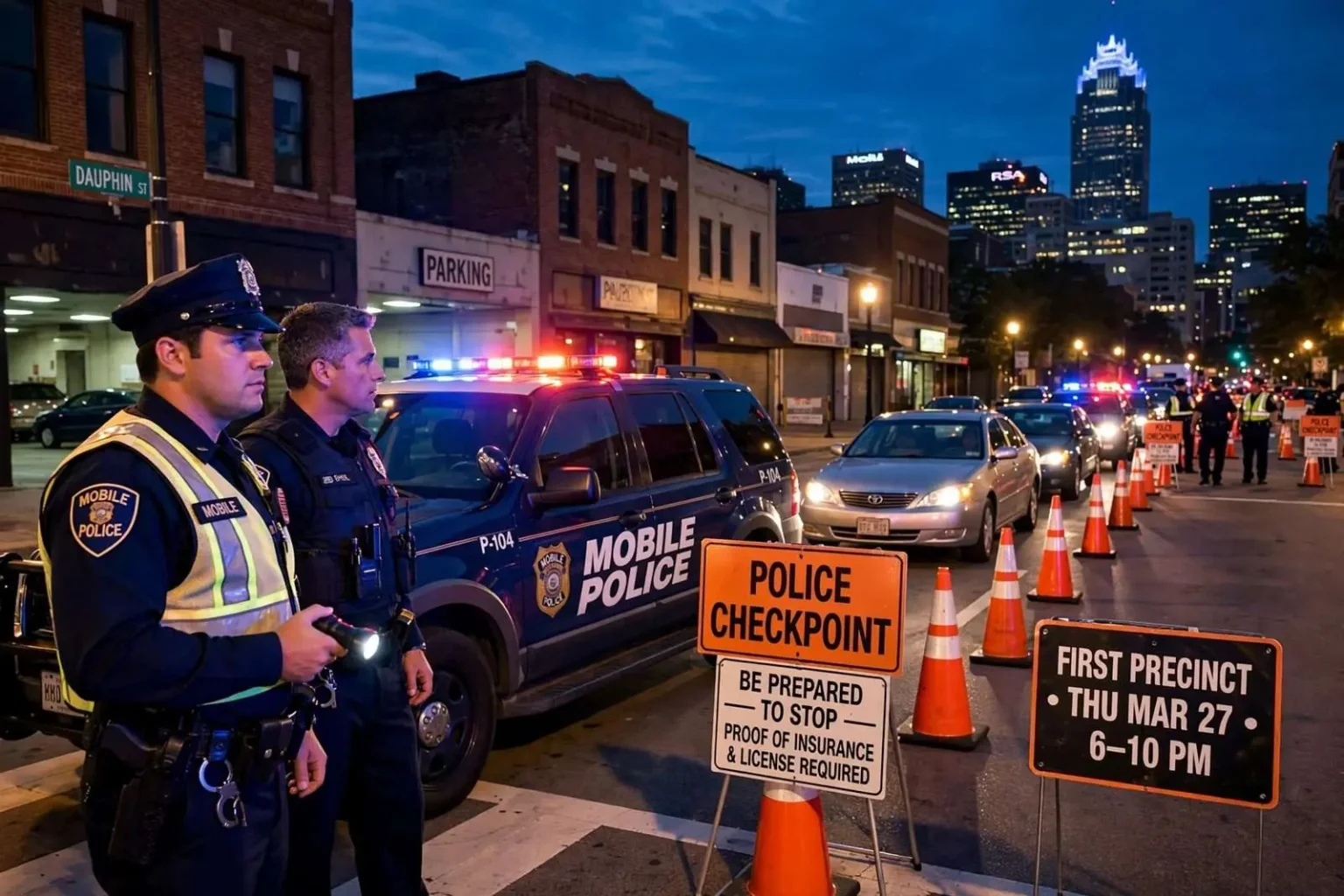
Mobile Police announced evening checkpoints in the First Precinct for March 27, 2008, after officers wrote 230 tickets during prior weekend checkpoints.
Originally reported March 25, 2008.
Mobile Police announced in March 2008 that officers would conduct evening checkpoints in the First Precinct on Thursday, March 27, 2008, continuing a traffic enforcement operation the department had launched the previous weekend. The announcement was part of the department’s public notice of where and when its officers would be checking vehicles — with one deliberate omission: police did not identify the roads where the new checkpoints would occur.
The department said officers had conducted checkpoints the previous weekend and written 230 tickets, most of them involving a lack of proof of auto insurance. That number, from a single weekend of enforcement, illustrated both the prevalence of the violation and the productivity of the checkpoint strategy as a way of catching it. Drivers cited at checkpoints faced the standard process for an insurance violation, which under Alabama law at the time carried a fine and the requirement to show proof of coverage to resolve the citation.
Checkpoint operations of this kind were a recurring tool for the department, used both to address specific violations and to maintain a visible presence in the precinct. The decision to announce the checkpoints while withholding the specific streets reflected a balance the department struck between public notice and enforcement effectiveness — giving drivers general warning that checkpoints were planned while keeping the locations unpredictable enough that they could not simply be avoided.
The First Precinct and Its Coverage Area
Mobile’s police department divides the city into precincts, each responsible for a geographic portion of the city, and the First Precinct has historically covered portions of downtown and the eastern side of the city. Precinct-based policing assigns officers to the same areas on a continuing basis, with commanders responsible for crime patterns and community concerns in their zone. Checkpoints within a precinct are typically planned at the precinct level, using officers who know the roads and the traffic patterns of the area they patrol.
Downtown Mobile and the neighborhoods around it present a particular mix of traffic enforcement challenges: commuter traffic funneling in and out on the city’s one-way grid, port and industrial traffic, entertainment district crowds at night, and residential streets in communities that border the business core. Evening checkpoints in that environment catch a cross-section of drivers, from commuters heading home to patrons leaving restaurants and bars, which is part of why they serve multiple purposes — from insurance verification to impaired driving deterrence.
The First Precinct’s territory includes some of the city’s most traveled corridors, connecting downtown with the eastern suburbs across the Mobile River and the tunnels that pass beneath it. Enforcement activity on those routes is visible to thousands of drivers daily, which gives checkpoint operations a public visibility that other enforcement tactics lack. A driver’s experience of being stopped, questioned, and sent on their way — or cited — sends a message that extends well beyond the people actually checked.
Insurance Enforcement in Alabama
The focus on proof of insurance reflected a persistent problem in Alabama, which for years ranked among the states with the highest estimated percentages of uninsured motorists. In 2008, the state’s insurance verification system was limited: drivers were required to carry proof of insurance in their vehicles and to show it on request during a traffic stop, but there was no statewide electronic database that officers could check instantly. Enforcement therefore depended on stops and checkpoints like the ones the Mobile Police announced, making the physical proof card the decisive document.
The state later modernized this system. Alabama moved to an electronic insurance verification program that allows officers and the state to confirm coverage through a database linked to insurers, reducing reliance on paper cards that could be outdated, borrowed, or fabricated. Registration renewals became tied to insurance verification as well, closing some of the loopholes that had allowed drivers to lapse coverage between checks. Mobile’s 2008 checkpoint operation belongs to the era before those changes, when weekend ticket counts were one of the few tools available to measure the scale of the uninsured-driver problem.
Uninsured driving has consequences that reach well beyond the driver cited at a checkpoint. When a crash involves an uninsured motorist, the injured party’s own insurance often covers the loss through uninsured motorist coverage, if they carry it, and costs flow into premiums across the insured population. That cost-shifting is the economic argument behind enforcement campaigns: every uninsured driver removed from the road reduces a burden that would otherwise be spread among people who carry the required coverage.
Checkpoints and the Law
Sobriety and license checkpoints occupy a specific place in American law. The U.S. Supreme Court has upheld brief, systematic vehicle checkpoints for purposes such as drunk driving enforcement and license verification, provided the stops follow a neutral plan — officers stop every vehicle, or every vehicle at fixed intervals, rather than choosing drivers at their own discretion. That structure separates checkpoints from arbitrary stops, and departments document the location, duration, and selection method for each operation to keep the practice on solid legal ground.
Announcing checkpoints in advance, as the Mobile Police did in 2008, is a practice many departments follow both for transparency and because the deterrent value of a checkpoint depends partly on drivers knowing it could happen. The announcement generally identifies the precinct and time window while leaving the specific intersections unstated, which is exactly the approach reflected in the March 2008 notice. Drivers approaching a checkpoint can expect to see cones, signs, and uniformed officers directing some or all vehicles into a checking lane, where license, registration, and proof of insurance are reviewed briefly before the driver is released or cited.
For the officers involved, checkpoint duty is methodical work — repeated brief contacts with a stream of drivers, watching for signs of impairment or expired credentials, and handling the paperwork for violations found. A single weekend producing 230 tickets, most for lack of proof of insurance, reflects that volume: checkpoints process hundreds of vehicles in a shift, and even a modest violation rate among them yields substantial citation counts.
The Historical Record
This notice is a historical account of a 2008 enforcement operation and does not reflect present-day checkpoint locations or schedules. The Mobile Police Department’s current operations, precinct boundaries, and enforcement priorities have evolved in the years since, and nothing in this account should be read as a description of where or when checkpoints occur today. Its value is as a record of how the department operated at that moment — announcing a Thursday evening operation, publicizing the prior weekend’s totals, and letting the numbers speak to the size of the insurance-verification problem.
Checkpoint operations like the ones announced in March 2008 became part of the department’s regular pattern of traffic enforcement in the years that followed, alongside saturated patrols, impaired-driving mobilizations during holiday periods, and participation in statewide enforcement campaigns. Each approach targets a different slice of driver behavior, and departments typically adjust the mix based on crash data and violation trends observed in their precincts.
The 230 tickets written over a single weekend in the First Precinct remain the most concrete detail from the announcement — a measure of how many drivers on Mobile’s roads in 2008 could not show proof of insurance when asked. For the department, it validated the checkpoint strategy; for the drivers cited, it was a reminder that the requirement to carry insurance followed them every time they took to the road, whether or not a checkpoint was standing along the way.
Downtown Mobile in 2008 was in the midst of its own transformation, with the RSA Tower and other office projects anchoring a skyline that had grown steadily since the 1990s, and entertainment venues drawing crowds to Dauphin Street at night. The traffic generated by that activity — office workers commuting in each morning, evening visitors parking in decks and spilling onto the sidewalks — gave the First Precinct a daily rhythm that peaked twice: at the morning commute and after dark on weekends. Evening checkpoints were timed to that rhythm, catching drivers at hours when insurance lapses and impairment were most likely to surface.
The precinct’s coverage of the downtown core also meant checkpoint crews encountered the full range of drivers the city produces: port workers coming off shifts, hospitality staff heading home, and drivers passing through on the corridors that link the city with the Eastern Shore. Mobile’s position as the Gulf Coast’s transportation hub — with the Interstate 10 and 65 corridors converging near downtown and the port’s truck traffic threading through city streets — meant that enforcement on local roads touched drivers from across the region, not just residents.
Insurance enforcement, in particular, interacts with that regional traffic. Alabama’s estimated uninsured rates put it among the higher states nationally in the years around 2008, and drivers crossing state lines added another layer, since officers checking credentials in Mobile encountered drivers governed by the insurance requirements of Mississippi, Florida, Louisiana, and beyond. A checkpoint on a downtown corridor sampled that whole mix in a way that neighborhood patrol stops rarely did.
What the March 2008 announcement captures, in the end, is a department working its traffic problems in public view: declaring the operation in advance, tallying the prior weekend’s results, and keeping the specifics vague enough that the operation could actually function. The numbers from that weekend — 230 tickets, most for a lack of proof of insurance — are a small piece of the historical record of Mobile policing, but they document precisely what the checkpoints were for and what they found when the cones went out on the streets of the First Precinct.