
Mobile First Precinct Moving to Dauphin Island Parkway for Faster Response
Mobile is moving its First Precinct to a new Dauphin Island Parkway building to improve response times and community policing in District 3.
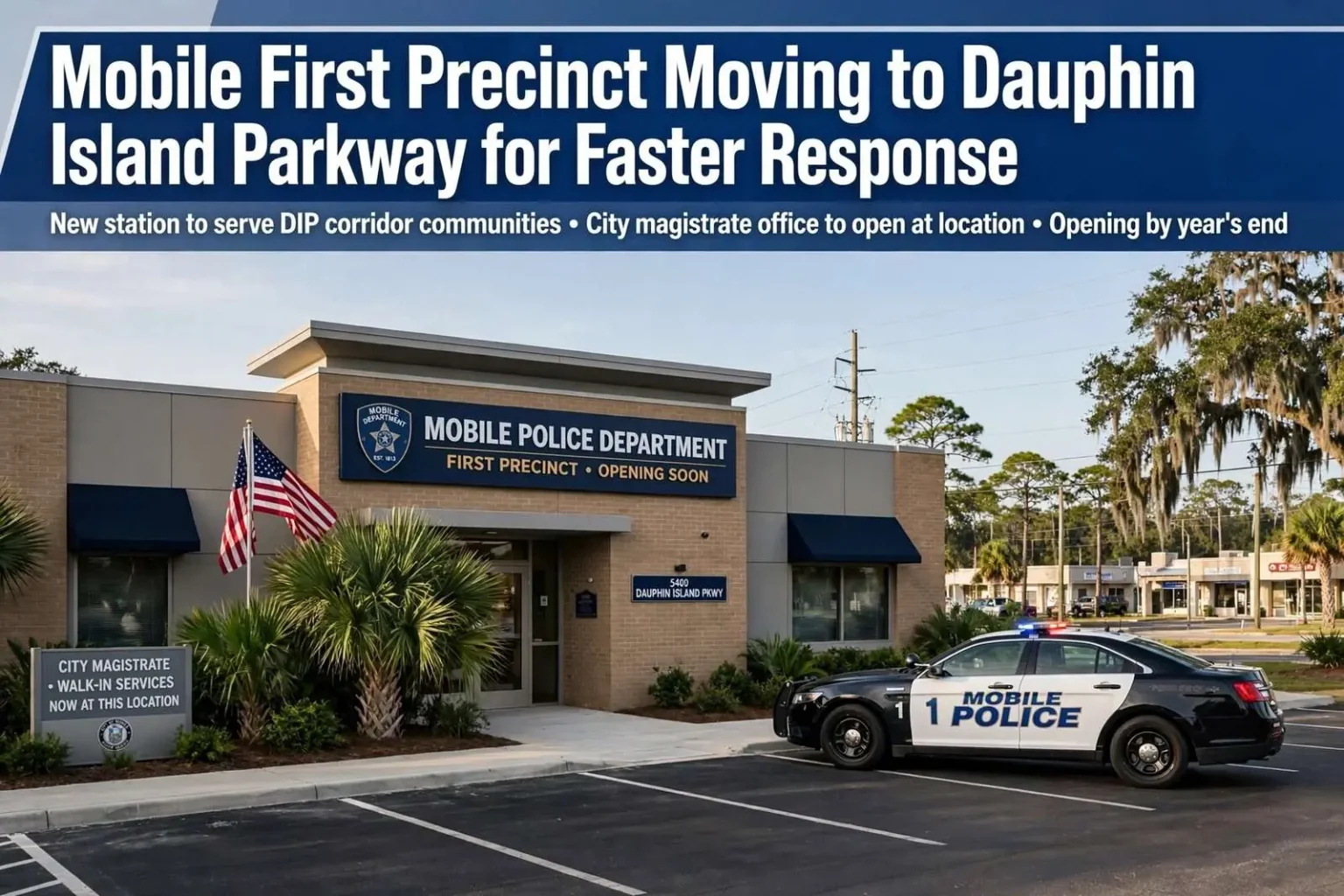
The Mobile Police Department’s First Precinct is relocating to a new building off Dauphin Island Parkway, a move city leaders say will put officers closer to the neighborhoods they serve and cut response times. The current precinct on Virginia and Broad streets will close once renovations are complete, ending decades of operation from the downtown-area facility and shifting the department’s westernmost-lying patrol anchor to the heart of the peninsula communities it serves. The new location will also house a city magistrate, adding a walk-in service point for residents who currently travel elsewhere for that function.
“Many times citizens down here on DIP really just thought they had been forgotten about,” said Mobile City Councilman CJ Small, who represents the area. The precinct’s arrival follows years of requests from residents who have dealt with high crime rates, including five homicides in the precinct’s area by late May 2021, the second-highest rate in the city. For the neighborhoods along the parkway and its side streets, the physical presence of a police station is the most visible kind of answer to those long-standing requests.
Why Location Matters for Response
Police response times are shaped substantially by geography. When officers stage out of a precinct that sits at the edge or outside the area they patrol, every call begins with a drive, and every minute of that drive is time a person in crisis waits. Dauphin Island Parkway, known locally as DIP, runs south from the downtown area through a long chain of communities, Rabbit Creek, the peninsula neighborhoods and out toward the communities near the Dauphin Island bridge, and its length means response demands cover a wide territory. A station positioned on the corridor itself shortens the run to the great majority of those calls.
The addition of a city magistrate at the new site compounds the practical benefit. Magistrates handle the initial processing of criminal complaints, the issuance of arrest warrants in many cases and other walk-in business that currently draws residents to facilities farther from the peninsula. Co-locating that function with the precinct turns the new building into a one-stop civic destination for a part of the city that has historically traveled north for such services, and it increases daily foot traffic and visibility at the station itself.
District 3 and the Long Campaign
Councilman Small’s comment about residents feeling forgotten reflects the history of this request. District 3, which Small represents, takes in the DIP corridor and the peninsula communities, an area with its own distinct identity within Mobile, shaped by the parkway that binds it to the rest of the city and by the bay that borders it. Residents there have organized for years around public safety concerns, attending council meetings, compiling crime data and asking successive administrations for a greater police presence.
The numbers behind those requests were stark. By late May 2021, the First Precinct’s area had recorded five homicides, the second-highest rate in the city, a figure that residents cited repeatedly in their campaign for a local station. Crime on the corridor had been concentrated in specific trouble spots, and community groups had supplemented police efforts with neighborhood watch activity, clean-up campaigns and cooperation with the department’s community policing units. The precinct relocation converts that partnership into a physical commitment.
Mayor Sandy Stimpson said the old facilities were designed for other services and that the new precinct will allow for more positive community interactions as well as faster emergency response. His point about the old building speaks to the reality of municipal facilities: the Virginia and Broad streets station was not purpose-built for modern precinct operations, and adapting aging buildings to contemporary police work, evidence handling, roll call space, community meeting rooms, parking for patrol fleets, has limits that new or fully renovated space does not. The Stimpson administration has pursued a series of public safety facility improvements during its tenure, and the First Precinct relocation fits that pattern of matching facilities to operational needs.
The community interaction element matters as much as the response-time element. Departments across the country have found that stations which invite the public in, hosting meetings, offering space for neighborhood groups and putting services like magistrates at the counter, build the trust that community policing depends on. On a corridor where residents have felt overlooked, a station designed for interaction is a message as much as a facility.
The DIP Corridor’s Character
Dauphin Island Parkway anchors one of Mobile’s most geographically distinct areas. The road begins near the downtown area and runs south through residential neighborhoods of every era, from mid-century subdivisions to older waterfront communities, passing schools, churches and small commercial strips before reaching the communities that face the bay. Its residents include families who have lived on the peninsula for generations and newcomers drawn by comparatively affordable housing and the area’s proximity to the water.
That geography has always shaped policing on the corridor. The peninsula is connected to the rest of Mobile by a limited number of routes, which means patrol coverage, emergency response and even residents’ own trips to city offices all funnel through the same arteries. A police station on DIP changes the daily texture of that geography: cruisers staging from the corridor rather than arriving over it, and a visible departmental presence at a location residents pass every day.
The Renovation Timeline
Construction and renovations are expected to wrap up by year’s end, with the First Precinct’s move to follow and the Virginia and Broad streets facility closing at that point. The timeline gives the department a transition window to transfer equipment, records and staging operations, and gives residents a clear date to anticipate. City capital projects of this kind typically involve both building renovation and the communications infrastructure a modern precinct requires, dispatch connections, records systems and the network links that tie the station into the department’s citywide operations.
When the doors open, the new station will bring together the elements residents asked for: proximity, visibility, a magistrate’s office and a facility built for its purpose rather than adapted from another era. Councilman Small’s summary of the community’s history with the project, the feeling of being forgotten, sets the standard by which the station’s success will be measured: whether residents on DIP now see the department as a presence in their neighborhoods rather than a service dispatched from somewhere else. The years of requests, the homicide figures that gave them urgency and the city’s decision to relocate rather than simply staff more heavily together mark this as one of the more consequential public safety investments in the area in recent memory.
The First Precinct’s history adds context to the move. The precinct’s territory takes in a broad swath of the city south and west of downtown, and its Virginia and Broad streets station sat at the northern edge of that territory, convenient to downtown government offices but distant from much of the population it served. Over the years, precinct substations and community policing posts have been used by departments nationwide to address exactly this kind of distance problem, but a full precinct relocation is a stronger commitment: it moves the command structure, the daily roll call and the department’s institutional presence into the community itself.
Residents’ years of requests for the move also illustrate how public safety investment decisions get made in municipal government. Council members advocate for facilities in their districts, the administration weighs capital costs against competing needs across the city, and neighborhoods with organized leadership are best positioned to keep their case in front of both. District 3’s success in securing the precinct reflects years of that advocacy, through multiple budget cycles and administrations, until the project reached the capital plan.
What Response Time Improvements Look Like
Shorter response distances change outcomes in ways both dramatic and subtle. In the dramatic cases, medical emergencies, crimes in progress, the seconds saved by staging nearby can determine outcomes. In the subtle cases, the effect is on the rhythm of daily policing: officers on patrol from a local station cover their beats with greater frequency, problems get noticed earlier, and the department’s knowledge of the corridor’s specific trouble spots deepens because officers spend their shifts there rather than commuting through it.
Visibility works in the other direction as well. A station on the corridor is a deterrent that operates around the clock, and residents who see cruisers coming and going from a local facility report a different sense of security than those who only encounter police when something has gone wrong. Combined with the magistrate’s office bringing routine civic business into the building, the station becomes part of the community’s ordinary landscape, which is the foundation the “positive community interactions” Mayor Stimpson described are built on.
The Broader Public Safety Picture
The precinct move is one piece of Mobile’s wider response to the crime pattern of 2021, a year in which the city, like many across the country, saw elevated homicide numbers. The administration’s approach has combined enforcement initiatives with community-based programs, and facility investment sits alongside both. For the DIP corridor specifically, the precinct gives the department the platform for sustained attention that periodic crackdowns cannot provide, and community leaders in the area have consistently argued that sustained presence, not surge enforcement, is what their neighborhoods need.
The year-end completion target will be followed closely by the corridor’s neighborhood associations, which have tracked the project from announcement through construction. When the First Precinct raises its flag on Dauphin Island Parkway, it will close a chapter that Councilman Small described in one sentence, years of residents feeling forgotten, and open a new one in which the city’s commitment to the peninsula is measured in brick, staff and response times rather than promises. For the families along the parkway, that is the change they asked for, delivered where they live.


