Mobile Police Announced Fourth Precinct Checkpoints in 2008
Mobile Police announced daytime checkpoints in the Fourth Precinct for March 13, 2008, focused on driver documentation and seat-belt compliance.
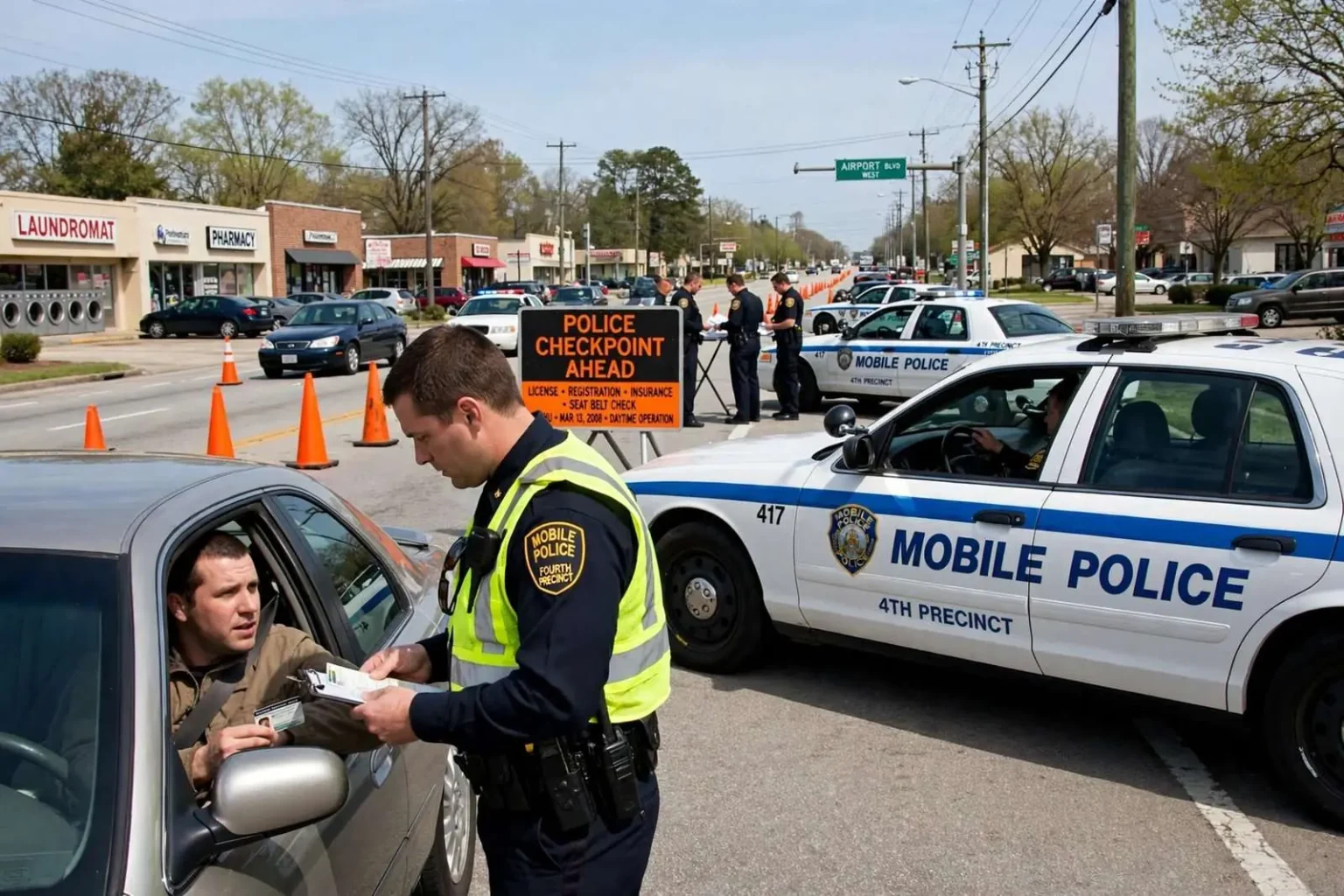
Mobile police leaders announced in early March 2008 that officers from the department’s Fourth Precinct would conduct traffic checkpoints later that week, part of a continuing effort to reduce crashes and curb violations across the western reaches of the city. The announcement, originally reported March 11, 2008, told drivers to expect the checkpoints on Thursday, March 13, 2008, during daytime hours.
According to the department, the checkpoints would concentrate on four basic areas of traffic law: driver’s licenses, vehicle registrations, proof of insurance and seat-belt use. Each is a common factor in serious wrecks. An unlicensed or suspended driver is statistically far more likely to have been involved in a prior crash, an expired tag often signals a lapsed insurance policy, and Alabama’s seat-belt law made failure to buckle up a primary offense, meaning an officer could stop a vehicle for that violation alone. By checking all four at once, a small crew of officers could contact a large number of drivers in a few hours.
Where the Fourth Precinct fits in Mobile
Police did not disclose the specific intersections or streets where the checkpoints would be set up, a standard practice intended to keep the operations effective. They did say officers would be working during the day, giving commuters, school traffic and midday errand-runners the most exposure. What the department did describe was geography: at the time, the Fourth Precinct was described as the area west of Interstate 65, north of Airport Boulevard and east of Cody Road.
That corridor takes in some of Mobile’s busiest commercial strips and residential neighborhoods. Airport Boulevard serves as a major east-west artery carrying tens of thousands of vehicles a day, while Interstate 65 bounds the precinct on the east and Cody Road marks the western edge. Between those anchors sit dense neighborhoods, shopping centers, schools and churches, all generating steady traffic through the day. A daytime checkpoint operation in that district would touch drivers heading to work, parents on school runs and shoppers moving between the commercial centers along Airport and the parallel streets to the north.
Why checkpoints became a routine tool
By 2008, checkpoints had become a regular feature of policing in Mobile and across Alabama. Departments used them not only to catch violators but to change behavior broadly: a driver who knows checkpoints happen in his precinct is more likely to keep his license current, renew his tag and click the seat belt on every trip. Traffic units typically announced the general timing and purpose in advance, as Mobile did here, while keeping the exact sites confidential so drivers could not simply route around them.
The announced focus areas also reflected the traffic realities of the Gulf Coast. Uninsured-motorist rates in Alabama ranked among the higher in the nation during that era, which pushed premium costs up for law-abiding drivers. License and registration checks caught drivers whose paperwork had lapsed, and seat-belt enforcement aimed directly at the leading cause of death in crashes: ejection. Public-health officials had spent years emphasizing that belts roughly halve the risk of fatal injury for front-seat occupants.
What the operation meant for residents
For drivers in the Fourth Precinct, the practical advice was simple. Have the license in hand, the current registration in the glove box, proof of insurance within reach and everyone buckled. Officers working a checkpoint generally wave most vehicles through with a brief look at documents, pulling aside only the cars with a problem. A violation might bring a citation on the spot; a suspended license could mean the car being towed.
Checkpoint days also served as a visible reminder of the department’s presence in the district. The Fourth Precinct covered a wide and varied swath of the city, and traffic operations of this kind were among the most public things its officers did. Residents who saw cones and officers on a Thursday morning knew the department was working the neighborhood’s streets, not just responding to calls.
A historical notice
This report is a historical notice about a 2008 enforcement operation. It does not refer to present-day checkpoints, schedules or policing plans, and the dates, boundaries and departmental descriptions all reflect Mobile as it stood in March 2008. Precinct boundaries, staffing and enforcement priorities have all evolved in the years since.
What has not changed is the underlying arithmetic that made checkpoints a fixture. Seat belts still save lives, uninsured drivers still raise everyone’s premiums, and a few hours of document checks in a busy precinct still produce more contacts than a day of random patrols. The March 13, 2008, operation was one instance of a strategy Mobile police used repeatedly that year, announced in advance, worked in daylight and aimed squarely at the basics of safe, legal driving.
For anyone reviewing Mobile’s enforcement history, the notice preserves the essentials: the announcement date of March 11, 2008, the execution date of Thursday, March 13, the four focus areas of licenses, registrations, insurance and seat belts, and the precinct boundaries of I-65 on the east, Airport Boulevard on the south and Cody Road on the west. Together they sketch how a mid-sized Southern city’s police department went about the routine but consequential work of traffic safety.
To understand why the Fourth Precinct drew the operation, it helps to picture the district as it existed in 2008. Mobile’s precinct system divided the city into sectors each commanded by a captain, with the Fourth covering the city’s northwestern quadrant. The area west of I-65 and east of Cody Road included established neighborhoods of postwar brick ranch houses, newer subdivisions pushing toward the city limits, and apartment complexes that fed heavy traffic onto the arterials at morning and evening rush. Tanglewood Elementary and other schools in the zone created sharply defined windows of congestion that daytime checkpoints could exploit without touching the late-night bar traffic that other operations targeted.
The choice of a Thursday also mattered. Midweek days late in the week typically carried strong traffic volumes while avoiding the heavier Friday-night enforcement loads handled by other units. A daytime window let the traffic squad finish its work before the evening commute faded, process its paperwork and have towed vehicles off the impound lot roster by the end of shift. Checkpoint work is paperwork-intensive: every citation written generates a court date, and every vehicle towed generates an inventory search and a release process, so departments scheduled these operations when supervisors and support staff were available to keep the line moving.
The four violations and what they cost
Each of the four focus areas carried its own consequence in 2008 Alabama. Driving without a license, or on a suspended one, was a misdemeanor that could escalate quickly for repeat offenders; a second suspension meant mandatory jail exposure under the state’s habitual traffic offender statutes. Registration violations were the cheapest to fix and the most commonly written, since an expired tag took only a trip to the county license office and a renewal fee. Insurance violations were the costlier hazard: under Alabama’s mandatory insurance law, drivers caught without coverage faced fines and potential suspension of their registration, and courts could require an SR-22 filing before reinstatement, a form of high-risk certification that raised premiums for years.
Seat-belt enforcement carried its own logic. Alabama’s belt law covered front-seat occupants, and officers at a checkpoint could see compliance at a glance through the windshield. Troopers and municipal officers across the state had spent much of the previous decade running “Click It or Ticket”-style waves, and Mobile’s participation in those mobilizations had coincided with measurable gains in belt use statewide. By 2008 Alabama’s observed belt rate had climbed well above the levels of the late 1990s, though it still trailed states with primary laws of longer standing and stricter coverage.
The checkpoint format itself was shaped by case law. Under federal constitutional precedent, sobriety and license checkpoints were permissible only under strict rules: the site had to be chosen by supervisory officers under written guidelines, the stop had to be minimally intrusive, and the intrusion had to be balanced against a legitimate public purpose such as reducing unlicensed driving or impaired driving. Departments that followed the script avoided suppression of evidence in court. Mobile’s practice of announcing the operation in advance, as it did here, fit that framework, putting drivers on notice that the sweeps were happening while keeping the locations fluid.
How drivers experienced a checkpoint day
A typical daytime checkpoint in 2008 looked unremarkable: two or three marked units with lights activated, a handful of orange cones narrowing the travel lane, and officers working in pairs so one could check documents while the partner watched traffic. Contact time for a compliant driver was usually under a minute. Officers looked at the license, the registration and the insurance card, asked for belts to be fastened if they were not, and waved the car through. The line’s pace was the measure of a well-run operation, and supervisors relocated or shut down sites when backups grew long.
For the minority of drivers with a problem, the stop could grow. An expired tag might end in a fix-it citation and a renewal date circled on the form. No insurance meant a court appearance and fines that dwarfed the cost of a policy. A suspended license meant the officer’s discretion came into play, and in many cases the vehicle went to the impound lot, with the owner responsible for towing and storage fees on top of the ticket. Those cumulative costs were precisely the point: the checkpoint existed to make the illegal choice expensive and the legal one easy.
The broader record of 2008 enforcement
The March 13 operation sat within a broader national trend of the period. Federal highway-safety grants flowed to states for saturation patrols and checkpoints targeting impaired drivers and noncompliant motorists, and Alabama’s Highway Patrol coordinated with municipal departments on many of those mobilizations. Local departments such as Mobile’s supplemented the grant-funded waves with their own smaller operations, timed to local crash data. Traffic units pulled the locations of serious wrecks from the previous year and placed enforcement where the numbers said the risk was highest.
Western Mobile had its share of that risk. The arterials bounding and crossing the Fourth Precinct carried some of the city’s higher crash counts, driven by volume, by the mix of commuter and commercial traffic, and by the long straight stretches that invited speed. Document checkpoints did not catch speeders, but they removed from the road, for at least a day, the drivers least equipped to avoid a crash: those with no valid license, no insurance or no belts in use.
Fifteen years on, the notice stands as a snapshot of how one department communicated routine enforcement. Announce the day, describe the district, name the four violations, and let the officers work. For the residents of the Fourth Precinct in March 2008, the message landed a week ahead of time, and the cones appeared on a Thursday morning exactly as promised.