
Mobile home prices climb more than 12 percent over the past year
Home prices in Mobile jumped 12.2 percent over the past year, though the city remains among the most affordable midsize metros in the country.
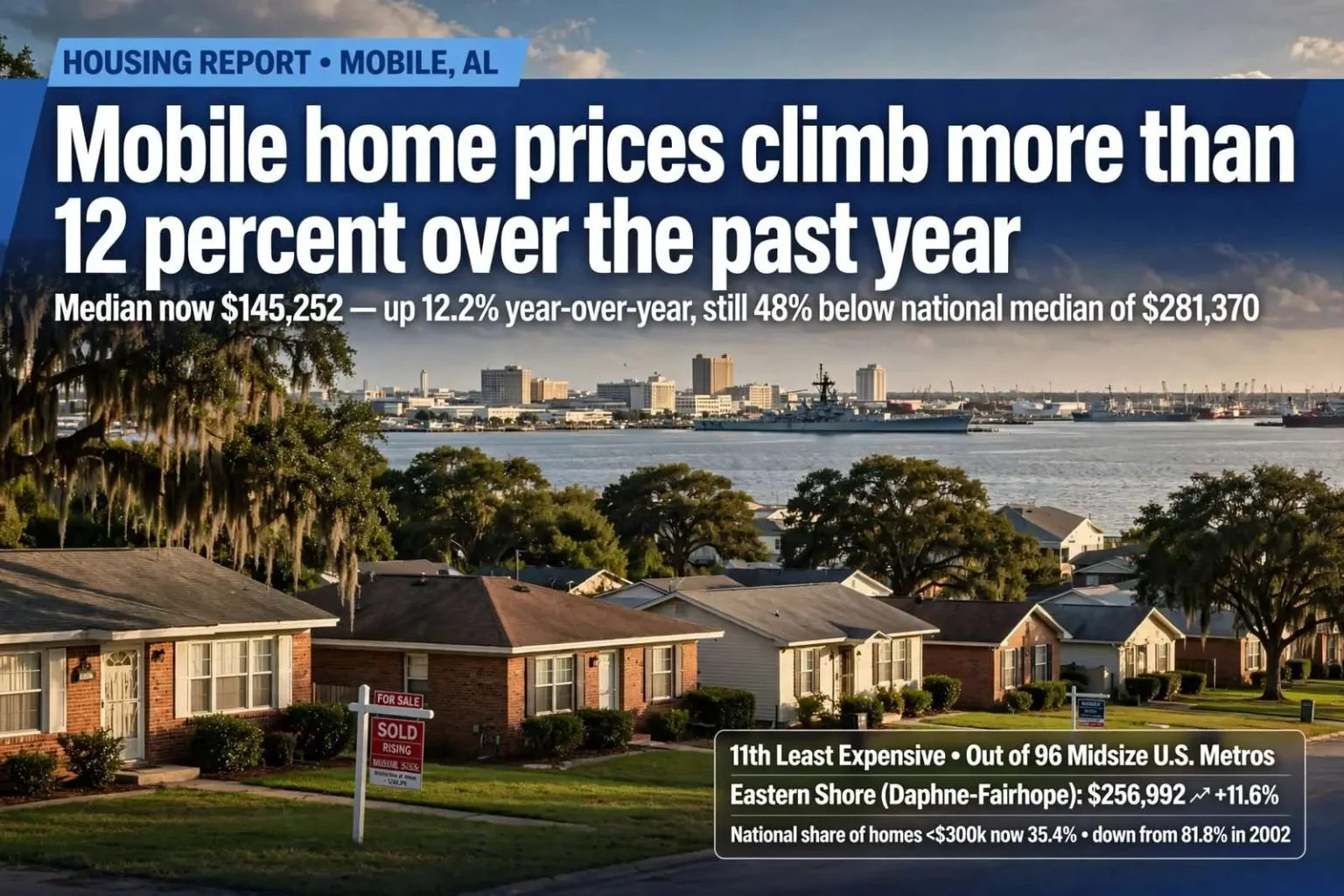
Home prices in Mobile jumped 12.2 percent over the last year, according to a new survey, yet the city still ranks among the most affordable midsize metros in the country. The median home price in the Mobile metro area is now $145,252, compared with the national median of $281,370. Out of 96 midsize U.S. metros, Mobile has the 11th least expensive real estate, a ranking that puts the city well below the national price line even after a year of rapid appreciation.
The study, conducted by the Inspection Support Network using U.S. Census Bureau residential sales data, found that nationwide the share of homes under $300,000 fell to 35.4 percent in 2021, down more than 46 percentage points from 2002. That collapse in affordable inventory is the backdrop for every local housing market in the country, and it reframes what a 12.2 percent annual jump means in a city where the median price is still barely more than half the national figure. Mobile buyers are feeling the same price pressure as everyone else, but they are starting from a much lower baseline.
Affordability as a regional calling card
Mobile’s affordability ranking is not an accident, and it has been a consistent feature of the local market for years. The metro area has a housing stock that includes large volumes of midcentury homes, established neighborhoods with modest lot sizes, and new construction priced for first-time buyers, all in a metro whose overall cost of living runs below the national norm. For families relocating to the area for work, the price gap between Mobile and national medians is often the first thing they notice.
That gap has consequences beyond individual purchases. Employers recruiting workers to the Gulf Coast can point to housing costs that allow single-income families to buy homes, and the region’s relatively low cost base has long been part of its economic development pitch. At the same time, rising prices in a historically affordable market can be harder on local incomes than the same increases are in wealthier metros, because wages in the region have not historically moved as quickly as home values have in recent years.
The Eastern Shore runs hotter
Just across Mobile Bay, the Daphne-Fairhope area saw prices rise 11.6 percent to a median value of $256,992, a figure that is nearly $112,000 above the Mobile metro median. The Eastern Shore of Baldwin County has for decades been one of the region’s most desirable places to live, with top-ranked schools, a historic small-town feel in Fairhope, and easy commuting access into Mobile across the bay. Demand from both local buyers and relocating families has pushed prices there steadily upward, and the pandemic-era migration toward smaller cities accelerated it further.
The contrast between the two sides of the bay shapes the region’s housing market in practical ways. A buyer priced out of Fairhope or Daphne looks at Mobile’s western neighborhoods, and a buyer priced out of Mobile altogether looks farther out into the county. Rental demand follows the same pattern, with investors purchasing homes in more affordable areas and renting them to households that can no longer bridge the jump to Eastern Shore prices.
The Panhandle next door
Across the state line, Pensacola prices climbed 12.5 percent to a median of $218,789, while the Destin/Fort Walton Beach area reached $327,297, up 12.4 percent. The comparison is instructive, because it shows the full gradient of Gulf Coast housing markets in a single stretch of coastline. Pensacola, with its naval installations, hospitals and historic districts, sits in the middle of the range, while the Destin and Fort Walton Beach market reflects the extraordinary demand for homes near some of the country’s most famous beaches, where vacation rentals and second homes compete with full-time residents for a limited supply.
Every market along that corridor recorded double-digit annual appreciation in the study’s window, which tells residents something about the forces at work. Low interest rates, remote work flexibility, in-migration to Sun Belt cities, and a persistent national shortage of housing inventory all converged on the Gulf Coast at once. Markets that were already popular with retirees and tourists saw the steepest climbs, while traditionally affordable metros like Mobile saw fast growth from a low base, which is how a 12.2 percent jump still leaves a city among the cheapest in its class.
What the numbers mean for buyers
For a first-time buyer in Mobile, the gap between the local and national medians is the difference between a market that is difficult and one that is mathematically out of reach. A median-priced home in the Mobile metro still falls within the borrowing range of many moderate-income households, particularly with two earners, while the national median has drifted well beyond what the typical American family can comfortably finance. That reality has made cities like Mobile a destination for remote workers and retirees comparing costs across states, and it has kept local demand strong even as prices rise.
The squeeze shows up most clearly at the entry level. When the national share of homes under $300,000 drops below half of what it was two decades ago, the least expensive tier of every market gets bid up fastest, because that is where the most buyers are competing for the fewest listings. In Mobile, entry-level homes in established neighborhoods have been selling quickly, often with multiple offers, and appreciation at the low end has outpaced the metro-wide figures in many months.
What it means for renters and wages
Rising home prices eventually transmit into the rental market, as landlords who bought at today’s prices need higher rents to cover their costs and as would-be buyers stay renters longer, swelling demand for apartments and single-family rentals alike. Mobile’s rental market has historically been more forgiving than those of larger Southern metros, but the same dynamics that lifted sale prices have been felt in rents, and tenants on fixed incomes have had the hardest adjustment.
Employers feel it too. A region that markets itself on low living costs cannot afford to let housing prices detach from local pay scales without eroding the advantage that attracts businesses in the first place. The 12.2 percent one-year increase is sustainable for a metro like Mobile only if incomes grow alongside it, and economists watching Sun Belt markets have warned repeatedly that affordability is the resource that fast-growing regions can spend down fastest without noticing.
How Mobile compares nationally
Ranking 11th least expensive out of 96 midsize metros places Mobile in a cohort of mostly Southern and Midwestern cities where housing remains within reach of median earners. The metros Mobile competes with for jobs and residents generally publish similar statistics, which means affordability alone will not differentiate the city; it functions more as a floor than a magnet. What makes the difference for relocating households is the combination of low housing costs with the region’s other assets, including the port, the medical community, cultural institutions and the coastal location itself.
The coastal location cuts both ways, of course. Homes in the Gulf South carry insurance costs and storm risk that national affordability comparisons do not capture, and buyers moving to the area from inland markets are often surprised by wind insurance premiums and flood zone requirements. Those costs moderate the region’s apparent price advantage in the total monthly cost of owning a home, and they are worth weighing alongside the sticker price when comparing Mobile to metros in the interior.
Where the market goes from here
Forecasts for markets like Mobile generally call for slower appreciation than the torrid pace of the study year, as interest rates and affordability limits work against continued double-digit gains. A cooling market would be welcome news for buyers who have been priced out, though sellers who have grown accustomed to fast appreciation may not share the enthusiasm. What seems unlikely is a reversal of the region’s fundamental position: Mobile built its affordability on a deep supply of modestly priced homes and a cost of living below the national norm, and neither of those changes in a single year.
For now, the numbers confirm what residents have been living through. Prices in Mobile and across the Gulf Coast rose faster in a single year than they had in many years combined, yet a median price of $145,252 still leaves the city among the most affordable places of its size in America. In a national housing market where the share of attainable homes keeps shrinking, that is a position many growing metros would envy, and one Mobile’s leaders have every reason to protect.
Tips for navigating a fast market
Buyers entering this market benefit from preparation that would have been optional a few years ago. Getting pre-approved before touring homes tells sellers an offer is serious, and it sets a hard ceiling before emotions take over in a bidding situation. Working with a local agent who knows which neighborhoods trade close to asking price and which routinely fetch more helps buyers target their searches, and in a market where desirable listings move within days, saved searches and quick showings matter more than patience.
Sellers, meanwhile, are learning that presentation still matters even in a strong market. Small repairs, fresh paint and clean staging reliably return more than their cost, and pricing slightly below the obvious comparable figures can draw multiple offers that push the final number higher. Homeowners across the Gulf Coast have also seen rising appraisals translate into new insurance and tax considerations, which are worth reviewing before listing rather than after a contract is signed.
Whatever direction prices take next, the study’s central finding holds for the moment: Mobile remains one of the most affordable midsize metros in the United States, even after a 12.2 percent surge. For buyers, renters and employers weighing the Gulf Coast, that combination of rising momentum and low entry prices is exactly what has put the region on so many national relocation lists, and it is the number local officials will be watching as the market settles.


