Mobile Hosts Alabama’s Ten Largest Cities as Big 10 Mayors Convene
Mayors from Alabama's ten largest cities, including Mobile's Sandy Stimpson, gathered in Mobile for a quarterly meeting and press conference at the Battle House Renaissance Hotel to outline shared priorities for the year.
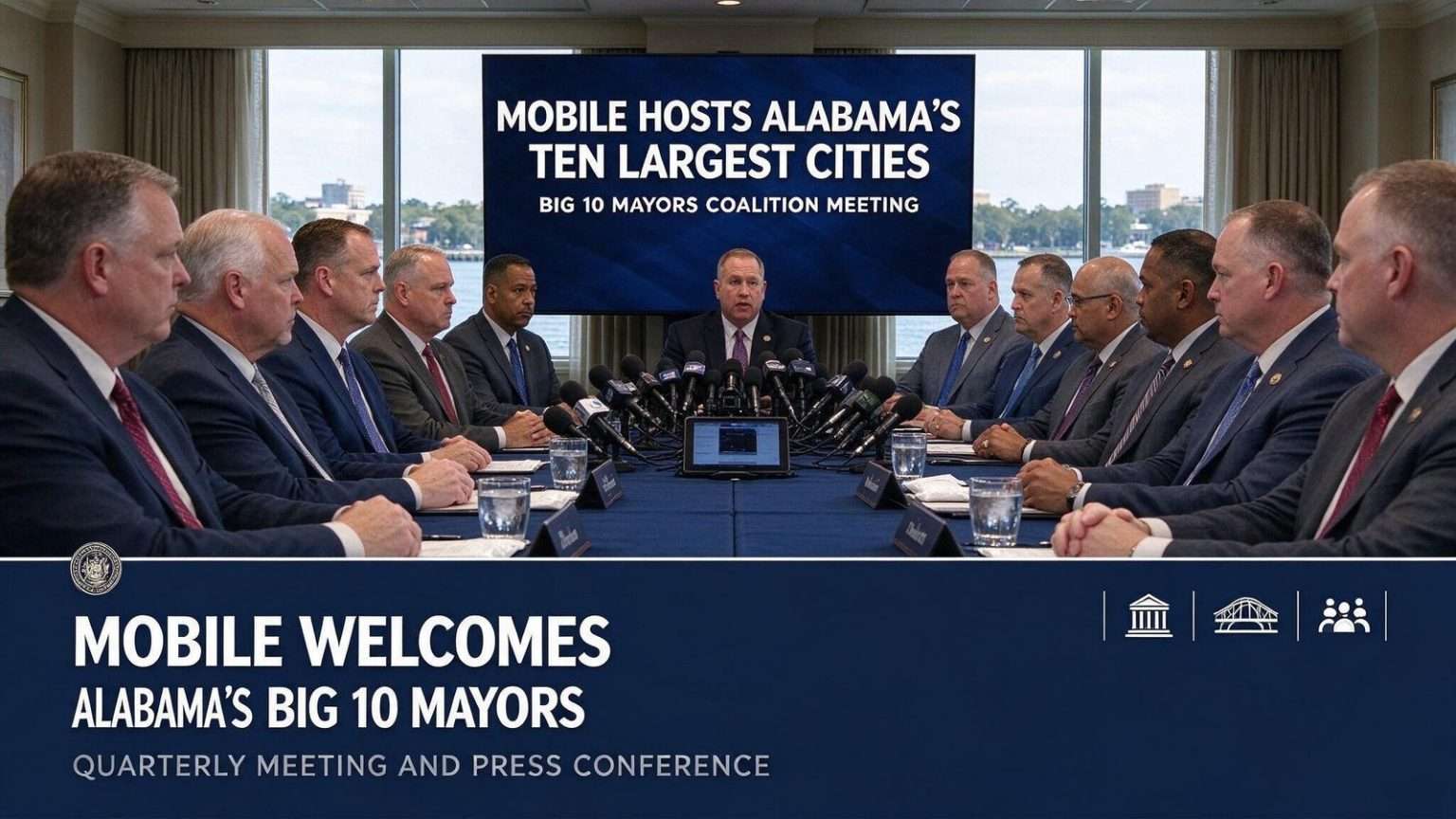
Mobile welcomed leaders from across the state Monday as the Alabama Big 10 Mayors coalition gathered downtown for its quarterly meeting, followed by a press conference at the Battle House Renaissance Hotel. The gathering put mayors representing hundreds of thousands of Alabamians in one room in the Port City, a rotating honor that gives each member city a turn at the center of the state’s municipal conversation. For a day, downtown Mobile served as the de facto capital of Alabama’s city governments.
The group, made up of the mayors of Alabama’s ten largest cities, used the session to lay out shared priorities for the year and to discuss issues affecting their communities and the state as a whole. Quarterly meetings allow the coalition to keep a running agenda — infrastructure funding, public safety, economic development, education and workforce — while responding to whatever the Legislature or the economy puts in front of cities in a given season. The press conference that follows each meeting is the coalition’s public face, an opportunity to speak with one voice rather than ten.
Mobile Mayor Sandy Stimpson hosted the gathering, joining Auburn Mayor Ron Anders, Birmingham Mayor Randall Woodfin, Decatur Mayor Tab Bowling, Dothan Mayor Mark Saliba, Hoover Mayor Frank Brocato, Huntsville Mayor Tommy Battle, Madison Mayor Paul Finley, Montgomery Mayor Steven Reed and Tuscaloosa Mayor Walt Maddox around the table. The roster spans the state’s geography — the Huntsville and Madison pair from the Tennessee Valley, Birmingham and Hoover from central Alabama, Montgomery from the River Region, Tuscaloosa and Auburn from the university corridors, Dothan from the Wiregrass and Mobile from the Gulf Coast — making the coalition one of the few bodies that regularly unites Alabama’s urban leadership across regional lines.
How the Coalition Works
The coalition meets on a rotating basis in member cities, giving local officials a recurring forum to compare notes on municipal challenges and to speak with a unified voice on statewide concerns. The rotation matters as much as the meetings themselves: hosting brings a dozen delegations, their staffs and media coverage into a member city’s downtown, showcasing local development and putting the host’s priorities on the agenda. Mobile’s turn gave the Port City an audience for its ongoing downtown revival and waterfront investments.
The Alabama Big 10 Mayors formed to give the state’s most populous cities a coordinated platform for tackling issues that cross city lines, from infrastructure and public safety to economic development and workforce needs. Organizers note that roughly three out of every four Alabamians live within the metro areas represented by the coalition, giving the group considerable weight when it speaks on issues before the Legislature and other state bodies. A resolution or joint statement from the ten largest cities carries more political weight than any one of them could generate alone, particularly on questions of state-shared revenue, transportation funding and municipal authority.
The cities represented are also Alabama’s economic engines. Huntsville’s aerospace and defense economy, Birmingham’s medical and banking sectors, Mobile’s port and shipbuilding, Montgomery’s military and government employment, and the university economies of Tuscaloosa, Auburn and Huntsville together generate the tax base that funds a substantial share of state government. When those cities’ mayors say a policy helps or hurts Alabama’s economy, legislators listen.
Mobile’s Turn in the Spotlight
Hosting the meeting in Mobile put a spotlight on the Port City’s downtown corridor, with the Battle House Renaissance Hotel serving as the venue. The Battle House — a rebuilt landmark of the city’s early twentieth-century boom, reopened as a hotel in 2008 after decades of vacancy — anchors the Royal Street business district that Mobile has spent years revitalizing. Choosing it for a statewide gathering was itself a statement about how far downtown Mobile has come since the waterfront and office core began their recovery.
During Monday’s press conference, the mayors reiterated their collective focus for the year ahead, emphasizing cooperation among Alabama’s biggest cities as a way to keep the state competitive and to improve quality of life for residents in urban and suburban communities alike. The message was deliberately cooperative rather than combative — a presentation of cities as partners in the state’s growth rather than petitioners at the Capitol. Mayors used the appearance to reinforce that the priorities of urban Alabama and the priorities of the state are largely the same: safe neighborhoods, functioning infrastructure, prepared workers and thriving business districts.
Officials framed the meeting as part of an ongoing effort to keep municipal leaders aligned on priorities heading into the new year, even as each mayor continues to manage issues specific to his own city. The balance between coalition unity and local autonomy defines every session — Stimpson’s waterfront and port agenda differs from Maddox’s Tuscaloosa growth management or Woodfin’s Birmingham neighborhood investments, but the funding mechanisms, state-local relationships and legislative policies that affect one big city almost always affect the rest.
What the Coalition’s Priorities Mean Locally
For Mobile residents, the visit of the state’s mayoral leadership underscored the city’s standing among Alabama’s urban centers. The quarterly meeting brought attention to projects the host city wants its peers and the press to see — the downtown entertainment district, the riverfront development stretching along the Mobile River, and the port infrastructure that positions the city for growth in international shipping. Hosting also gives a city’s delegation informal access to nine other administrations that have faced the same challenges, from pension costs to blight removal to recruitment of new employers.
The coalition’s emphasis on workforce development resonates across all ten cities, which together educate the majority of Alabama’s urban students and employ much of its urban workforce. Mayors have consistently pointed to the gap between the jobs their cities are recruiting and the skills of the local labor pool, a challenge that requires coordination among school systems, community colleges and employers. Collective advocacy gives the cities leverage in pushing state workforce programs toward the metros where most jobs actually are.
Public safety cooperation is another shared agenda item with direct local meaning. Big-city police departments across Alabama face similar pressures — violent crime patterns that cross jurisdictional lines, recruitment and retention struggles, and the rising cost of equipment and technology. A coalition that can advocate for state support of municipal policing speaks for departments that protect the majority of Alabama’s population.
A Unified Urban Alabama
The meeting closed with the mayors repeating the themes that have come to define the group: that Alabama’s cities rise together or struggle together, and that the state’s future increasingly runs through its metros. The mayors departed for their home cities — Birmingham, Huntsville, Montgomery, Mobile and the rest — with the next quarterly host set to carry the rotation forward, and with a shared agenda that will follow them to the Statehouse when legislators return.
For Mobile, the day added another entry to its recent run of statewide and national spotlights, and for the coalition, it demonstrated again why the ten largest cities bother to gather four times a year: because the issues that will decide Alabama’s next decade — transportation, workforce, public safety and growth — are already sitting on ten mayors’ desks at once, and they are easier to lift together.
The Battle House venue carried its own history lesson for visiting delegations. The original Battle House hotel opened in the early 1850s and burned, was rebuilt in 1908 in the grand style of the era, and then stood vacant for decades before a meticulous restoration returned it to service in 2008 as the anchor of Mobile’s downtown revival. Mayors whose own cities have renovated landmarks or chased downtown reinvestment would have recognized both the challenge and the payoff embodied in the building around their table.
Mobile’s hosting duties also came at a moment when the city’s profile within the coalition has been rising. Port expansions, shipbuilding growth and the relocation of major employers have made Mobile one of the Gulf Coast’s fastest-moving economies, and Stimpson’s administration has paired those wins with quality-of-life investments downtown. Showing nine peer mayors that progress in person is worth more than any presentation at a neutral venue — cities learn from cities, and the Big 10 format exists to make that learning routine.
The Legislative Dimension
Behind the press conference smiles lies the coalition’s practical work: a shared legislative agenda carried to each session of the Alabama Legislature. Big-city priorities routinely collide with rural-centered majorities in Montgomery, and issues such as municipal annexation authority, state-shared gasoline tax distributions, local occupational tax questions and criminal justice funding all land differently in cities than in small towns. A bloc of ten mayors speaking for three-quarters of the state’s population is the cities’ best counterweight in those debates.
The coalition’s regular meetings also serve as an early-warning system. When one city encounters a new problem — a blight crisis, a recruiting incentive war, a state policy shift — the others learn about it months before it reaches their own doorsteps. Several mayors have credited those conversations with shaping their responses to challenges their city had not yet faced, a quiet benefit that never appears in a press release but shapes policy across Alabama.
As the mayors left the Battle House for their respective cities, the takeaway from Mobile’s turn as host was the same one every rotation produces: Alabama’s biggest cities share more challenges than differences, and their collective voice — organized, quarterly and deliberate — has become a fixture of state policy conversations. The next meeting will move the rotation onward, but the agenda laid out in the Port City will travel with the group all year.