Mobile Jewish Film Festival Marks 10th Year Starting January 9
The 10th annual Mobile Jewish Film Festival runs Jan. 9-16 with five films, an educator workshop and tickets from $6.
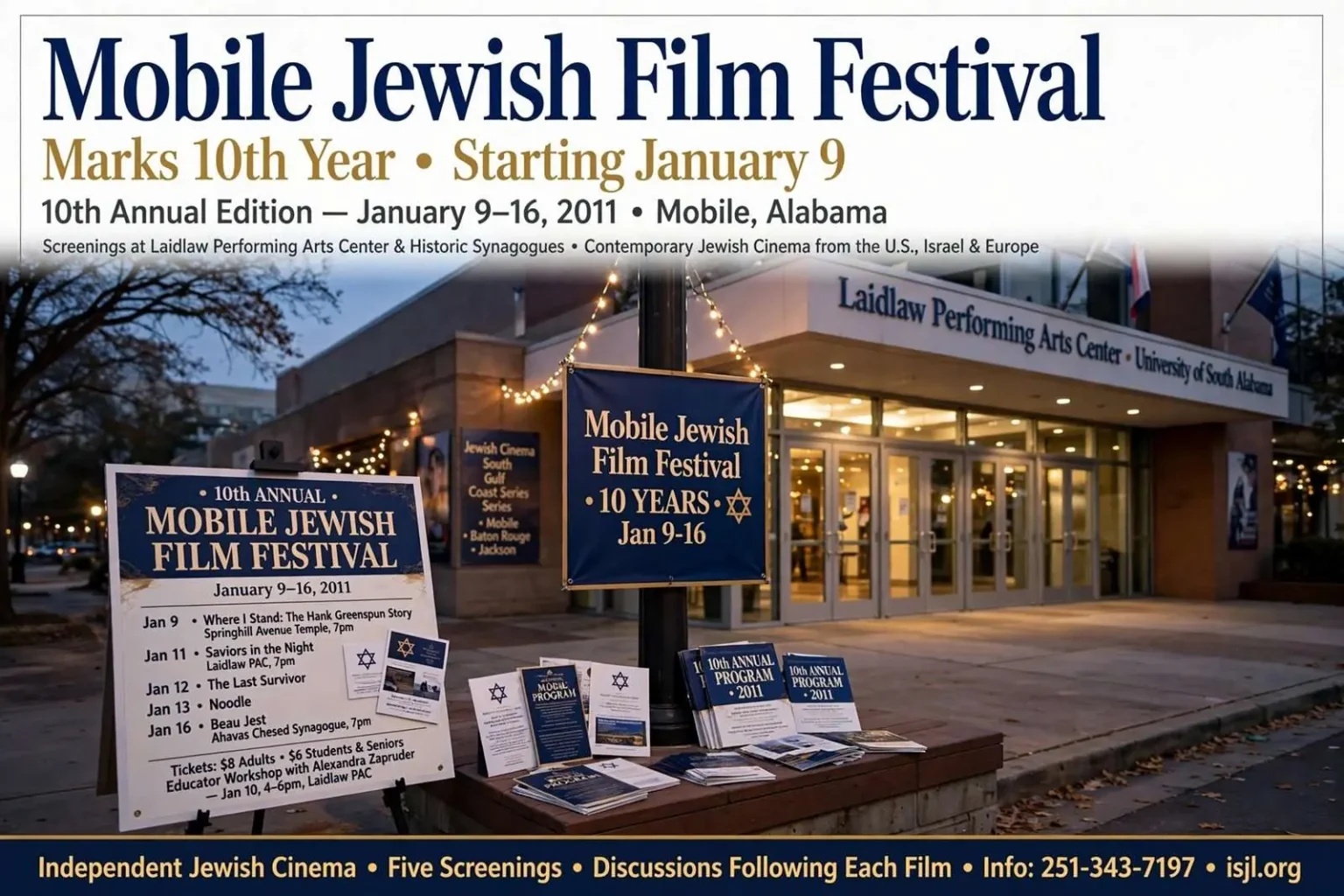
The Mobile Jewish Film Festival reaches a milestone this month, opening its tenth annual edition on January 9 and running through January 16 at the Laidlaw Performing Arts Center and other venues across the city.
A decade is a notable run for any cultural festival, and the Mobile event has grown into one of the Gulf Coast’s steady winter fixtures — a week each January when local audiences can see contemporary Jewish cinema from the United States, Israel and Europe without leaving the region. The tenth-anniversary lineup mixes documentary and narrative features across five screenings, hosted this year at venues that range from the University of South Alabama’s performing arts hall to two of the city’s historic synagogues.
The festival is part of a broader regional effort to bring independent Jewish film to Southern audiences, connecting Mobile with sister festivals in other Southern cities and giving the local community a shared cultural event that draws both Jewish residents and the wider public. Screenings have traditionally been followed by discussions, giving attendees a chance to talk through the history and themes raised on screen.
The 2011 Lineup
The festival opens Sunday, January 9 with Where I Stand: The Hank Greenspun Story, screening at 7 p.m. at Springhill Avenue Temple (1769 Springhill Ave.), followed by four more features:
Saviors in the Night — Tuesday, January 11, 7 p.m., Laidlaw PAC. The Last Survivor — Wednesday, January 12, 7 p.m., Laidlaw PAC. Noodle — Thursday, January 13, 7 p.m., Laidlaw PAC. Beau Jest — Sunday, January 16, 7 p.m., Ahavas Chesed Synagogue, 705 Regents Way.
The opening-night documentary traces the life of Hank Greenspun, the colorful journalist and publisher whose career ran from an unlikely start through wartime arms dealing to a decades-long role as the conscience of Las Vegas through his newspaper. The film’s subject — a man who fought for civil rights, took on powerful interests and documented an era — sets a typically ambitious tone for a festival that has made a habit of pairing serious historical documentaries with lighter closing features.
Tuesday’s Saviors in the Night is a German drama drawn from a true story of a Jewish family hidden from the Nazis by a German farmer’s family through the final years of the war — the kind of quiet, fact-based survival story that has anchored festival lineups across the country. Wednesday brings The Last Survivor, a documentary that follows survivors of genocide across generations and continents, connecting the Holocaust’s legacy to the realities of more recent atrocities and the work of remembrance.
Thursday’s Noodle shifts the week’s tone. The Israeli feature follows a Tel Aviv airline steward who, after the death of a domestic worker, discovers the woman’s young son — sent from China to be with his mother — is now alone, and finds herself drawn into an unlikely journey to reunite the boy with his family. The film is representative of the contemporary Israeli cinema that festivals like Mobile’s have helped introduce to American audiences: human-scale stories that step outside the region’s politics to focus on ordinary people.
The festival closes Sunday, January 16 with Beau Jest at Ahavas Chesed Synagogue, 705 Regents Way. The comedy, adapted from the long-running stage play of the same name, centers on a young woman who hires an actor to pose as her Jewish boyfriend for her traditional parents — a crowd-pleasing choice for a closing night that gives the week an upbeat finish after several heavier features. Ending on comedy is a deliberate pattern for Jewish film festivals, which often balance Holocaust history and genocide remembrance with warm, accessible stories about contemporary Jewish life.
Tickets are $8 per screening for adults and $6 for students and seniors, sold in advance or at the door. The pricing keeps the festival within reach of students and fixed-income attendees, and the door-sales option makes it easy for first-timers to decide on an evening and show up. For many attendees, the value lies less in any single film than in the chance to sample a genre of independent cinema that rarely plays commercial theaters on the Gulf Coast.
Educator Workshop
A companion workshop for educators runs 4–6 p.m. Monday, January 10 at the Laidlaw Performing Arts Center, presented by Alexandra Zapruder, director of the film I’m Still Here and author of Salvaged Pages.
Zapruder is a significant figure in Holocaust education. Her book Salvaged Pages collects the diaries of young people who lived — and often died — during the Holocaust, a body of writing that has become an important teaching resource because it presents the era through the immediate, day-to-day voices of teenagers rather than through retrospective history. Her documentary work extends that mission to film, and her workshops train teachers to use these materials in classrooms, with particular attention to how students absorb and discuss difficult history.
Hosting such a workshop alongside the screenings reflects the educational mission the festival has built over its ten years. Local teachers receive practical tools they can carry back to their classrooms, and the Monday-afternoon timing allows educators to attend without missing the evening screenings. For Mobile-area schools, which include a substantial number of students studying the Holocaust as part of their coursework, access to a presenter of Zapruder’s standing is the kind of opportunity that usually requires travel to New Orleans or Atlanta.
Part of a Regional Series
Mobile is one of three sites hosting Jewish Cinema South’s 2010–2011 series, joining Baton Rouge, Louisiana (January 19–23) and Jackson, Mississippi (January 22–25) — a circuit that gives Gulf Coast audiences access to contemporary Jewish cinema without leaving the region.
Jewish Cinema South is the festival network program of the Goldring/Woldenberg Institute of Southern Jewish Life, the Jackson-based organization that supports Jewish communities and cultural programming across a multi-state Southern region. By coordinating bookings, scheduling and shared film selections among cities like Mobile, Baton Rouge and Jackson, the network allows mid-sized Southern cities to mount festivals with the range and quality of films that larger metropolitan Jewish film festivals take for granted.
The regional model is a practical answer to a real problem. Booking quality independent and international films requires rights negotiations and minimum-audience economics that a single small city cannot always support on its own. Shared itineraries let a single print or digital booking serve multiple festivals in sequence, which is why the three 2011 festivals run back-to-back — Mobile first, then Baton Rouge, then Jackson — with many of the same titles moving up the circuit.
For audiences, the arrangement has a quiet bonus: a Mobile resident who misses a film during the local week can sometimes catch it in Baton Rouge or Jackson, and dedicated festival-goers along the Gulf Coast have been known to follow a favorite title across state lines.
The Venues and Mobile’s Jewish Community
The festival’s venues tell their own story about Mobile’s Jewish community, which dates to the early nineteenth century and counts among the oldest Jewish communities in Alabama. Springhill Avenue Temple, the opening-night site, is the home of one of the city’s longtime Reform congregations, a congregation whose history reaches back to the nineteenth century and whose building anchors the Springhill Avenue corridor. Ahavas Chesed, the closing-night site on Regents Way, is the city’s Conservative congregation, and its west Mobile location reflects the community’s gradual movement as the city itself grew westward.
The Laidlaw Performing Arts Center, which hosts the week’s midweek screenings, is the University of South Alabama’s music and performance venue on the USA campus, a modern hall with the projection and sound capabilities a film festival requires. Its use for the festival also brings university students into the audience, a connection the educators’ workshop reinforces.
That blend of venues — synagogue sanctuaries, a university hall — has characterized the festival throughout its decade, and organizers have long noted that the mix draws an audience that goes well beyond the Jewish community itself. Jewish film festivals in cities of Mobile’s size typically see significant non-Jewish attendance, particularly for documentaries and for films tied to school curricula, and the city’s festival has used that broader appeal to build its audience year over year.
Ten Years On
A tenth edition is a milestone worth marking for a volunteer-run cultural event. Festivals of this kind survive on the work of local committees, the support of community sponsors and the simple willingness of audiences to buy an $8 ticket on a cold January weeknight. Reaching ten years means the formula has held: serious films, accessible prices, welcoming venues and a week of programming that Mobile can call its own.
Screenings run January 9 through 16, with tickets available in advance or at the door. Information is available at 251-343-7197 or through the Institute of Southern Jewish Life at isjl.org, where attendees can find film details, the educators’ workshop registration and updates on any schedule changes.