Moon Pies, Marching Bands and a Word for the Trades at Mobile’s Labor Day Parade
Downtown Mobile filled with marching bands, moon pies and throws Monday for the city's annual Labor Day parade. Paradegoers talked about trade work, free family events and the student musicians who make the whole thing sound like something.
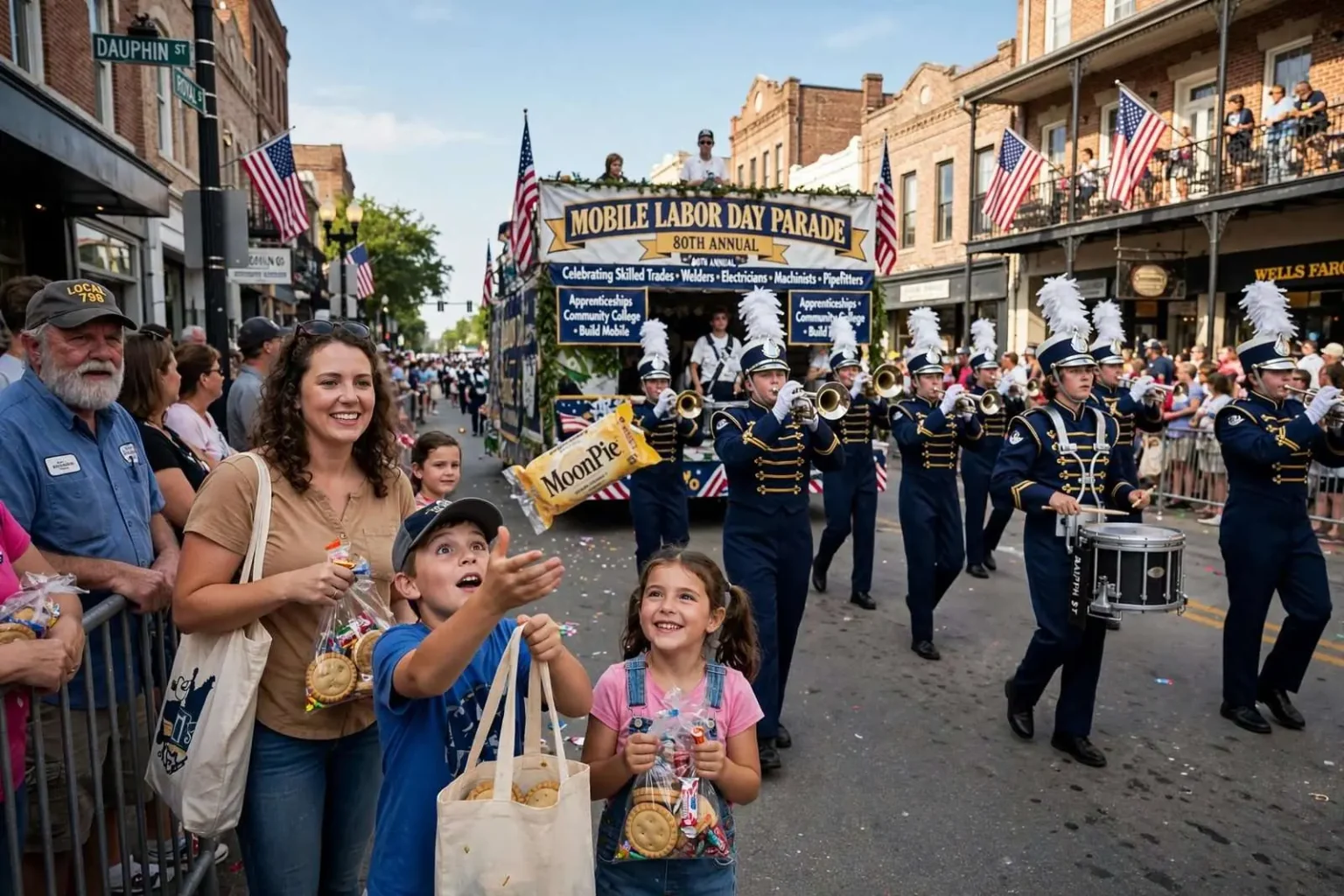
MOBILE, Ala. — Marching bands, moon pies and plenty of throws filled the streets of downtown Mobile on Labor Day as families gathered for the city’s annual parade.
For some of the youngest attendees, the highlight was easy to name.
“Probably the marching band,” one child said.
Another simply called the parade “really fun.”
A First-Timer and a Tradition
Morgan Fenner said the event gave her a chance to experience a Mobile tradition she had heard plenty about.
“I’ve heard all about it, but this is an absolute blast,” Fenner said. “It’s lots of fun to see everybody in the community come together.”
That reaction — heard about it, finally saw it — is a common one in Mobile, where parade culture is woven into the civic calendar more deeply than in most American cities. Mobile is the birthplace of Carnival celebration in the United States, and the mechanics that make a Mardi Gras parade work — floats, throws, marching bands, a route through the historic downtown grid — carry over to the rest of the year’s parades as a matter of course. A Labor Day parade in Mobile therefore looks like something a visitor from almost anywhere else would not expect: people arrive with bags to catch things.
‘We’re Trying to Push Everyone Toward College’
For Levi Wright, the day was about both fun and recognition.
“I’m out here today with the people celebrating Labor Day,” Wright said. “We have so many individuals throughout our city that are doing positive things and working and helping people in the community.”
Wright said the holiday shines a spotlight on workers and career paths that can get left out of the conversation.
“I think we celebrate them because a lot of times we’re overlooking,” he said. “We’re trying to push everyone towards college, four-year college, but we need to consider two-year college and trade schools.”
He put the point plainly.
“When you have a busted pipe, you have to call somebody with a trade to come and fix it and not someone with a Ph.D. or a doctor degree,” Wright said.
The argument has particular local weight. Mobile is a shipbuilding and aerospace town as much as anything else, with a working port, a shipyard and an aircraft final assembly line, and the region’s employers have spent years saying publicly that their constraint is skilled labor rather than demand. Welders, pipefitters, electricians, machinists and heavy equipment operators are the trades that keep the industrial waterfront running, and the training pipelines that produce them — community college programs, apprenticeships, craft training academies — have become a recurring subject of local economic development conversation.
Free, and That Matters
The parade also offered a way for families to spend the holiday together without spending money. Wright said that is not incidental.
“We need more activities family oriented where we can get out,” he said. “It didn’t cost anything to bring your kids out.”
He said the timing was right for children who were off school for the holiday.
“This was the day for the kids,” Wright said. “They’re out of school. They’re able to get throws, candy, moon pies.”
The moon pie detail is a Mobile signature. The snack became the city’s throw of choice generations ago for a practical reason: it is soft. Parade throws that hurt when they land are a liability, and a marshmallow sandwich cookie tossed from a float does not. The city leaned into it hard enough that its New Year’s Eve celebration is built around lowering a giant illuminated moon pie over Bienville Square.
The Bands
Wright said watching children catch items from the floats and take in the music from local school bands was the best part of the morning.
“Seeing the kids receive items — they’re able to hear the bands,” Wright said. “So it was a variety, a diverse of individuals, and I thought that was really beautiful.”
A retired blue-collar worker watching along the route made the same point from a different direction.
“I love the music, the bands,” he said. “These kids work hard in the bands, and a lot of people don’t know they start early for school practicing, and so they should be appreciated too.”
He is right about the schedule. High school marching bands in this region begin summer camp weeks before classes resume, rehearsing outdoors in August heat, and by the time a September parade comes around they have already put in more hours than most spectators would guess. Marching a full parade route in uniform, playing, in Gulf Coast humidity, is athletic work.
‘I Was a Blue-Collar Guy and So I Retired a Blue-Collar Guy’
The retired worker said Labor Day is an important chance to acknowledge people who do physical work outdoors.
“I was a blue-collar guy and so I retired a blue-collar guy,” he said. “So it’s nice to see the crafts represented at least once a year — guys and gals that work out in the heat.”
He added: “These people are building things and making Mobile grow.”
That is close to the original point of the holiday, which has drifted over the past century toward being a marker for the end of summer. Labor Day began as a labor movement observance — a parade, specifically, organized by trade unions — and the format Mobile used Monday is closer to the original than a backyard cookout is. Craft locals, employers and civic organizations moving down a public street in front of the community they work for is the form the day took when it started.
‘Today Everybody Was Representing It’
Wright said the turnout represented the kind of celebration he would like to see more of.
“A lot of times we say, ‘This parade is for this particular group or this particular culture,’” Wright said. “Today everybody was representing it, and I thought that was really beautiful.”
The parade wrapped up under the heat and humidity that has defined the past several weeks along the Gulf Coast. Families walked back to their cars carrying bags of throws. The bands loaded their instruments. And a downtown that spends much of the year preparing for one Carnival season or another had one more parade behind it.
The Parade’s Place on Mobile’s Calendar
Mobile hosts more parades in a year than most American cities of any size, and the Labor Day parade sits in a calendar that runs nearly continuously. Carnival season dominates the winter, with weeks of parades building to Fat Tuesday. The Moon Pie Drop closes out New Year’s Eve downtown. Holiday, heritage and civic parades fill in around them.
That density has practical consequences. The city has permanent infrastructure and institutional knowledge for closing streets, staging floats, coordinating public safety and cleaning up afterward — capabilities that a city holding two parades a year does not develop. Marching bands in the region are accustomed to parade routes as a routine part of their season rather than an occasional novelty. And the public knows how to attend one: where to stand, when to arrive, what to bring.
The 80th annual edition of this parade, as it was billed, places its origins in the years around the Second World War — a period when organized labor in Mobile was expanding rapidly alongside wartime shipbuilding. The city’s industrial workforce grew enormously in those years, and a Labor Day parade in Mobile has always been closer to its original meaning than the holiday is in most places.
The Trade Argument, in Numbers
Levi Wright’s point about two-year colleges and trade schools is one that regional employers have been making publicly for years, and the structure of the local economy explains why.
Mobile’s industrial base runs on skilled craft labor: shipbuilding, aerospace assembly, steel, chemicals, port operations and the construction trades that support all of them. Those employers need welders, pipefitters, electricians, sheet metal workers, machinists, industrial maintenance technicians and heavy equipment operators. The training for those occupations runs through community college programs, registered apprenticeships and craft training academies rather than four-year degree programs.
The persistent complaint from those employers is not that the jobs are unattractive — skilled craft positions in this market frequently pay well and offer benefits — but that the pipeline does not produce enough people. Some of that is capacity. Some of it is exactly what Wright described: a default assumption, communicated to students throughout high school, that a four-year degree is the only respectable path.
“When you have a busted pipe, you have to call somebody with a trade to come and fix it and not someone with a Ph.D. or a doctor degree,” Wright said.
Free Family Events and Why They Are Scarce
Wright’s observation that the parade cost nothing to attend touches something that surfaces repeatedly in community conversations about youth activity.
Most organized activity for children now carries a price: league fees, equipment, admission, transportation. For families operating on a tight budget, a three-day weekend can be difficult to fill without spending money. A parade is one of the few remaining large-scale community events that requires only showing up — and, in Mobile’s case, sends children home with a bag of throws.
“We need more activities family oriented where we can get out,” Wright said. “It didn’t cost anything to bring your kids out.”
What’s Next Downtown
Downtown Mobile’s event calendar continues through the fall, with festivals, museum openings and the run-up to the next Carnival season. Residents can find schedules through the city’s events listings and through the downtown business organizations that coordinate much of the programming.