MOBILE, Ala. — A man has been charged with arson in connection with two fires that broke out on the same west Mobile street.
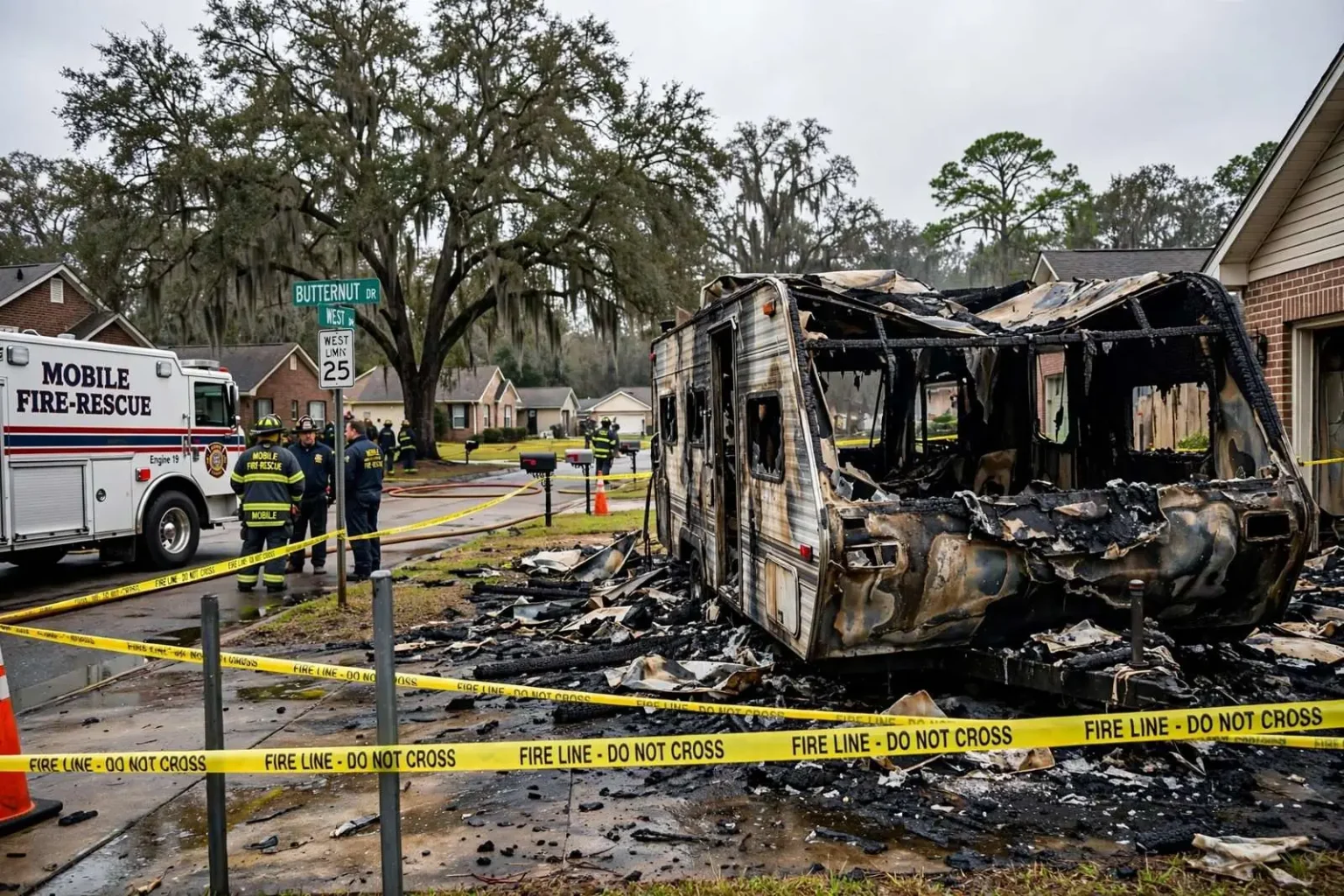
Mobile Fire-Rescue investigators arrested William Starling after fires were set Tuesday on Butternut Drive, a residential road near Mobile Regional Airport. The two blazes damaged property along Butternut Drive, including a camper trailer that was destroyed, according to photos shared by a resident of the area.
Jail records show Starling lives on the same street where the fires occurred. He was booked into Mobile County Metro Jail on an arson charge following the investigation by fire officials.
Two fires, one street
The fires were set on the same Tuesday along Butternut Drive, a detail that transformed what might have been treated as separate incidents into a single arson investigation. Fire crews responded to the blazes as they were reported, containing the damage where they could, and the pattern of two fires breaking out within a short span on one residential street immediately drew the attention of Mobile Fire-Rescue’s investigative personnel.
Among the losses was a camper trailer that was destroyed, an account documented in photographs shared by a resident of the area. Recreational vehicles and travel trailers parked at homes are particularly vulnerable in deliberately set fires, since they are often stored in driveways or side yards close to other property, and a fully involved trailer fire produces intense heat that can extend to vehicles, fences and nearby structures. The full extent of the property damage along the street was described through those resident accounts and the department’s own response records.
Butternut Drive sits in west Mobile near Mobile Regional Airport, in a residential pocket of the city that includes single-family homes and the kind of neighborhood infrastructure — schools, parks, churches — that defines the airport corridor’s older subdivisions. Residents there are accustomed to the noise of aircraft and the traffic of Airport Boulevard, not to fires deliberately set along their street, and the pair of blazes drew concern from people who live within a few blocks of both scenes.
The investigation
The arrest followed an investigation by Mobile Fire-Rescue’s own personnel rather than an outside agency. Fire departments in Alabama handle fire investigation as a core function, deploying trained investigators who determine where a fire started, how it spread and whether the cause was accidental, natural or intentional.
That determination is the foundation of any arson case. Investigators examine burn patterns, point of origin, the presence or absence of accidental ignition sources, and any physical evidence left at the scene. When the findings point to an intentionally set fire, the case moves from origin-and-cause analysis toward criminal investigation, with investigators working to identify who set the fire and building the documentation that prosecutors will need to obtain a warrant and sustain a charge in court.
In this case, that process led investigators to William Starling, whose residence on the same street where the fires occurred was confirmed through jail records following his booking. A person’s presence near a fire scene is not itself proof of involvement, but the combination of two fires on one street and an arrest arising from the fire investigation indicates that investigators found sufficient evidence to support the arson charge under Alabama law.
Fire-Rescue officials have not released additional details about a possible motive, and the specifics of what evidence connected the two fires to a single person had not been made public. Motive is often the last element of an arson case to be established publicly, since investigators prioritize the physical evidence first and leave the question of why to later stages of the case.
Arson law in Alabama
Arson cases in Alabama are felony offenses, and convictions can carry sentences of up to life imprisonment depending on the degree and whether anyone was endangered. The state’s arson statutes are graded by the circumstances of the fire and the risk it posed to human life.
Arson in the first degree, the most serious grade, applies when a person intentionally sets fire to a building and another person is present inside or the fire endangers human life — circumstances that carry the possibility of a life sentence. Arson in the second degree covers intentionally set fires to buildings or occupied structures where the endangerment element is absent, and lower grades reach fires to vehicles, personal property and other assets. A camper trailer, a vehicle, or property adjacent to an occupied home can each fall within the scope of the statutes depending on what the evidence shows about intent and risk.
Setting two fires rather than one is a factor that prosecutors weigh in arson cases, since it demonstrates a course of conduct rather than a single act. Multiple fires also increase the potential exposure a defendant faces, because each fire can support its own count. The charge filed against Starling at booking was described as an arson charge, with the degree to be settled as the case moves through the court process and formal charging decisions are made.
The Mobile County District Attorney’s Office reviews arson cases developed by fire investigators before presenting them for indictment. Prosecutors rely heavily on the technical findings of the fire investigation — the origin analysis, the elimination of accidental causes and the physical evidence — because juries deciding arson cases must be persuaded that a fire was deliberately set and that the accused was the person who set it.
Where the case stands
Starling was booked into Mobile County Metro Jail following the arrest, joining the daily intake of people arrested across the city and county at the Union Avenue facility. Booking records establish the charge, the arresting agency and the custody status, and subsequent release or continued detention depends on bond determinations made through the court system.
From booking, an arson case proceeds through Mobile County District Court for initial appearances and preliminary proceedings, and a felony arson case ultimately moves to a grand jury for indictment before any trial in Circuit Court. The timeline for that process typically runs over months, during which investigators may continue to develop the case and prosecutors may refine the charges.
For the residents of Butternut Drive, the arrest provides a measure of resolution to a frightening stretch of days in which fires broke out along their street twice on the same afternoon. Deliberately set fires in a residential neighborhood threaten more than the property directly damaged; they put every home within reach of the flames at risk, and the uncertainty of not knowing whether more fires would follow weighs on a community until an arrest is made.
Fire officials’ decision to withhold details about motive is standard practice in cases under active investigation, and further information, if released, would generally come through court filings or the department’s public information channels as the case advances. What is established at this point is that two fires damaged property on Butternut Drive on a Tuesday, that a camper trailer was destroyed, and that a man who lives on that street has been charged with arson in connection with the blazes.
Fire risk in west Mobile’s neighborhoods
The incident is a reminder of the role fire investigators play in a growing city. Mobile Fire-Rescue operates stations across west Mobile and responds to structure fires, vehicle fires and brush fires across the airport corridor, and its investigative unit works the small share of those fires that show signs of being intentionally set. Deliberately set fires account for a meaningful fraction of fire losses nationally, and departments that identify serial fire-setting quickly — as the response to two fires on one street on a single day enabled here — prevent the escalation that unchecked fire-setters often show.
Life on the affected street
For the people who live on Butternut Drive, the aftermath of the fires extends past the burned property itself. A deliberately set fire changes how a street feels: residents watch parked vehicles and empty lots differently, question who is moving through the neighborhood at odd hours, and wait for information that investigators cannot yet share. The photographs shared by a resident documenting the destroyed camper trailer circulated as neighbors pieced together what had happened along their block.
The neighborhood’s location adds context to how residents responded. The roads surrounding Mobile Regional Airport include a mix of established subdivisions and undeveloped tracts, and the airport’s presence imposes its own rules on the area — height restrictions, sound exposure and the regular passage of commercial aircraft. Fires burning in that environment draw immediate attention, both from neighbors and from passersby on the connecting thoroughfares, and the response times from fire stations serving west Mobile are among the shortest in the city because of the station network built around the corridor.
Damage from an intentionally set fire is also financial in ways that go beyond the destroyed property. Insurance claims following arson involve additional scrutiny, cleanup costs fall on property owners while investigations proceed, and neighboring homes can suffer smoke and heat damage that shows up weeks later in siding, seals and ventilation systems.
How fire investigations conclude
The arrest on Butternut Drive represents the midpoint of an arson case, not the end. The work that produced the charge — scene documentation, cause analysis and the identification of a suspect — is followed by the slower machinery of prosecution: formal charging, arraignments, pretrial motions and, in many cases, plea negotiations. Cases sometimes conclude without trial when the evidence developed by investigators is strong enough that a defendant chooses to resolve the charge by plea.
Fire investigators’ findings carry significant weight throughout that process. Origin-and-cause analysis is a discipline with its own certification paths and professional standards, and investigators routinely testify about burn patterns, ignition sources and the sequence of a fire’s spread. In cases involving two separate fires, investigators must also establish a connection between the incidents — a common method, a common accelerant signature or other evidence linking the scenes — before both can be attributed to the same person.
The absence of a publicly stated motive in the Butternut Drive case is therefore unsurprising at this stage. Motive in arson cases ranges from personal disputes to vandalism to attempts at concealing other crimes, and investigators typically keep such assessments internal until they are supported by evidence that can survive courtroom scrutiny.
What the case demonstrates for west Mobile residents is the speed with which a fire investigation can move from response to arrest when the circumstances are clear. Two fires on the same street on the same day presented an obvious pattern, the department’s investigators pursued it, and within days a man who lives on that street was in custody facing an arson charge. The rest of the case now belongs to the courts, and the residents of Butternut Drive will follow it the way neighborhoods always do — by paying attention as it moves through the system, and by getting back to the ordinary rhythms of a street where fires, deliberately set or otherwise, are not part of daily life.