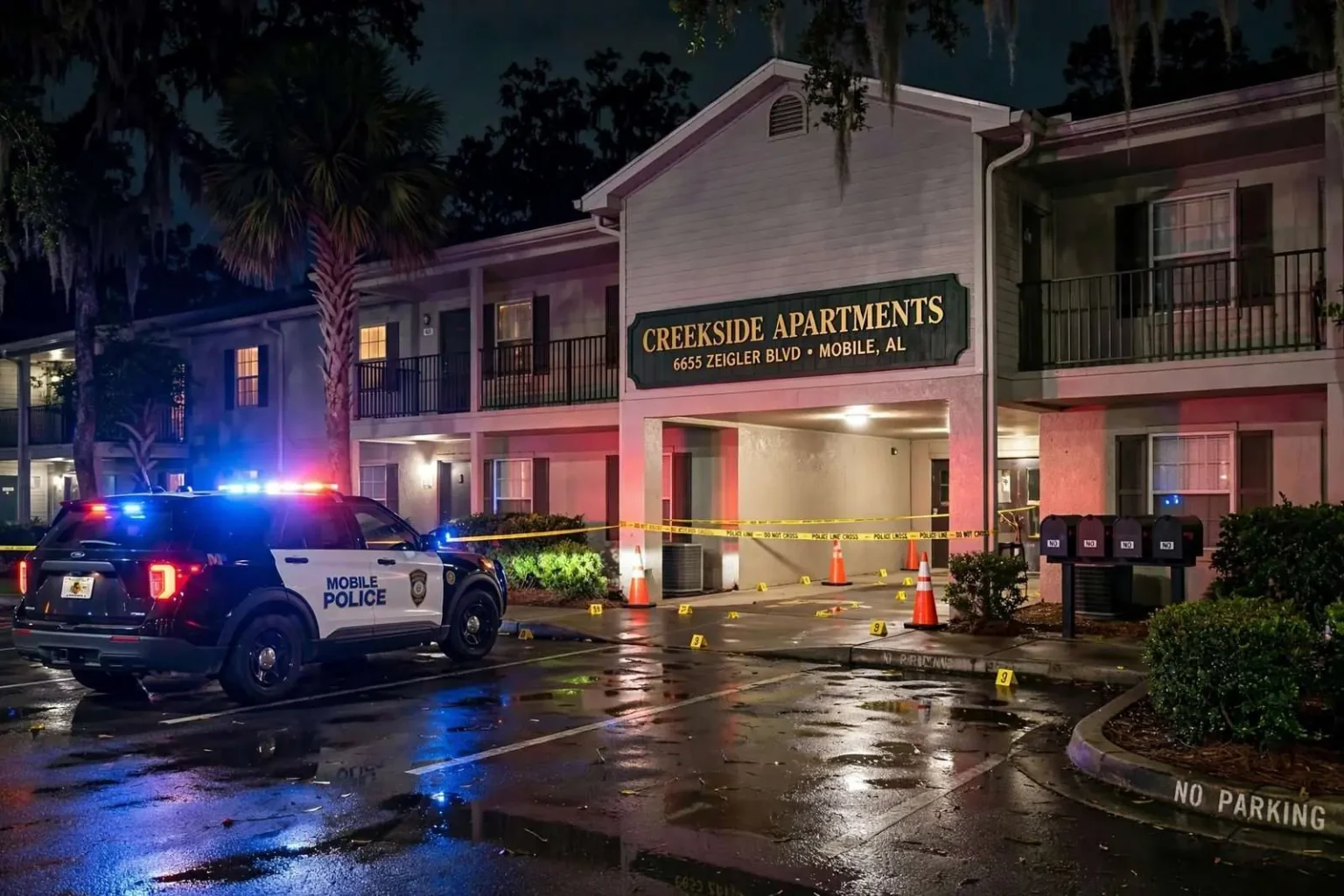
MOBILE, Ala. — The Mobile Police Department has arrested a man accused of attacking a woman at a city apartment complex. According to an MPD news release, officers responded to a domestic incident at 8:27 p.m. Tuesday, Aug. 18, at the Creekside Apartments, located at 6655 Zeigler Boulevard. When officers arrived, they said they found a man with minor injuries. They said the man reportedly attacked the woman, who then used scissors to cut him. As a result of the investigation, Tashawn Laffiette, 20, was arrested and charged with third-degree domestic violence strangulation, third-degree domestic violence with criminal mischief, and third-degree domestic violence harassment. Laffiette is scheduled for a bond hearing on Wednesday, Aug. 26, at 8:30 a.m.
The sequence described in the release — an arriving officer finding one party injured, followed by an arrest of the other — reflects the structured approach Alabama requires in domestic violence calls. Responding officers separate the parties, determine the primary aggressor, document injuries, and either make an arrest or submit a warrant request based on what the evidence supports. In this case, police said the man found with minor injuries was the reported attacker and that the woman cut him with scissors during the encounter, a detail that underscores how quickly a domestic incident can leave more than one person hurt even when the charges land on one side.
Creekside Apartments sits on Zeigler Boulevard in west Mobile, a corridor of apartment complexes and commercial strip developments between Airport Boulevard and Cottage Hill Road. Complexes along Zeigler house a mix of students, working families and longtime residents, and the area sees steady MPD patrol traffic like any densely populated part of the city. Domestic calls are among the most frequent and most dangerous runs officers make anywhere in Mobile, accounting for a substantial share of the department’s call volume year after year.
The Charges Explained
Alabama’s domestic violence statutes grade offenses by severity, and strangulation was added to the code specifically because it frequently leaves no visible injury while being one of the strongest warning signs of future lethal violence in a relationship. Research on intimate partner violence has consistently identified strangulation as a red-flag behavior that sharply raises the statistical risk of later homicide, which is why prosecutors treat it differently than other misdemeanor-level assaults. A third-degree domestic violence charge is the entry level of the state’s scheme, typically a misdemeanor, but the strangulation designation within it signals the specific conduct alleged.
The criminal mischief and harassment counts attached in this case cover the remaining alleged conduct — property damage and threatening or abusive behavior — under the same domestic violence framework. Charging multiple counts from a single incident is standard practice, giving prosecutors flexibility to present the full pattern of what allegedly happened rather than a single act in isolation. Each charge will be handled as Laffiette’s case moves through Mobile County Municipal Court and, depending on how it proceeds, the county circuit court.
The bond hearing scheduled for 8:30 a.m. Wednesday, Aug. 26 is the next procedural step. At such a hearing, a judge sets the conditions under which Laffiette could be released while awaiting trial. In domestic violence cases those conditions commonly include no-contact orders covering the alleged victim, stay-away provisions for the residence where the incident occurred, and weapons restrictions. Violating release conditions is itself a separate offense, and judges in domestic cases frequently set conditions specifically to keep the parties apart while the case is pending.
Domestic Violence Response in Mobile
Mobile police handle thousands of domestic-related calls each year, and the department’s written policy follows the state’s mandate that officers take reports, assess danger, and provide victims with information about their legal options. Alabama’s protective order process allows a person subjected to abuse to petition a court for an order barring contact, and advocates point out that such orders work best when combined with a safety plan developed before a crisis point.
Resources for victims in the Mobile area include municipal and nonprofit victim services offices, county prosecution-based victim advocates who guide people through protective order paperwork, and regional shelters that provide emergency housing. The National Domestic Violence Hotline, reachable around the clock, connects callers to local resources and safety planning help. Advocates across the region emphasize that strangulation allegations deserve particular urgency: medical evaluation after a strangulation event is recommended even when the person feels fine, because internal injuries can develop or worsen hours later.
What Happens Next in the Case
After the bond hearing, the case enters the standard track for misdemeanor domestic violence prosecutions. An assistant district attorney reviews the police file, decides whether the evidence supports the charges as filed or requires adjustment, and the case proceeds through arraignments and motion hearings toward either a plea agreement or trial. The alleged victim’s participation matters in these cases, but prosecutors can and do proceed without a victim’s cooperation when the evidence supports it, a policy rooted in the recognition that victims of intimate partner violence often face pressure to recant.
The man who was cut with scissors, per the release, sustained minor injuries. In domestic incidents where both parties show injuries, investigators work to establish the primary aggressor rather than defaulting to mutual charges, and the account in the MPD release reflects that determination: the woman’s use of scissors was described as a response to being attacked. Self-defense questions in such cases are ultimately resolved in court, but the initial charging decision is where officers’ report of the encounter first takes legal form.
Laffiette, at 20, faces charges that will follow him well beyond any sentence imposed. A domestic violence conviction carries consequences that extend into housing applications, employment background checks, and firearms eligibility under federal law. For young defendants, the bond hearing and early court dates are also the point where the magnitude of the situation typically becomes concrete, and where court-appointed or retained counsel first enters the picture to begin shaping the defense.
For neighbors at Creekside Apartments, the incident was a late-August evening interrupted by police lights and the questions that follow a visible arrest in a residential complex. For the wider community, the case is a routine entry in the city’s domestic violence docket — which is itself the point. Incidents like this one occur daily across Mobile County, and the machinery that processes them, from the 8:27 p.m. dispatch to the Wednesday morning bond hearing, is the framework the state has built to intervene early in the relationships where violence most often repeats.
Anyone in immediate danger from a domestic violence situation should call 911. Residents seeking non-emergency help can contact Mobile police, the Mobile County District Attorney’s victim services office, or the National Domestic Violence Hotline for confidential assistance with safety planning, protective orders and shelter resources.
Inside a Domestic Violence Call
A domestic call at 8:27 p.m. on a Tuesday follows a script officers know by heart and dread in equal measure. Dispatch sends at least two units to any domestic violence run, both because of the risk to the parties and because of the documented danger to officers themselves. On arrival, the first tasks are physical separation of the parties and a check for injuries. Only after the scene is stable do officers begin the slower work of the investigation: interviewing each person separately, noting injuries and their consistency with the accounts given, photographing damage, identifying witnesses in nearby units, and checking for prior calls to the same address and prior charges involving the same parties.
That history matters. Alabama officers document the scene under the framework of the state’s mandatory arrest guidance, and prior domestic incidents at an address are among the factors that inform the charging decision. Apartments complexes like Creekside generate a particular pattern: close quarters mean neighbors hear and see more than in detached housing, and witness accounts from adjoining units frequently become part of the file. Officers also run a lethality assessment in serious cases, a structured set of questions designed to identify victims at the highest risk of being killed and to connect them immediately with advocacy services.
The strangulation charge in this case emerged from that assessment process. Because strangulation often leaves no visible mark, officers are trained to ask specific questions — pressure, duration, loss of consciousness, difficulty breathing — and the answers determine whether the enhanced charge applies. Medical documentation, when the alleged victim seeks care, becomes central evidence in such prosecutions, which is another reason advocates urge strangulation victims to be examined promptly even when they feel unharmed.
The Court Process Ahead
If the case proceeds as charged, the movement through Mobile’s courts will be measured in months rather than weeks. Misdemeanor domestic violence cases typically resolve through negotiated pleas, and sentencing can include jail time, probation, mandatory batterer intervention programming, and fines. Alabama also allows courts to order defendants to complete treatment programs as a condition of release or sentence, and compliance with no-contact orders is monitored throughout. A dismissed or reduced charge remains possible as evidence develops, and every element of the state’s case must be proven before a conviction attaches.
Meanwhile the release conditions set at the Aug. 26 bond hearing will govern contact between the parties. Courts in domestic cases take violations seriously precisely because the period between arrest and trial is statistically the most dangerous stretch for a victim. Shelter and advocacy organizations in the Mobile area work with victims during this window, helping with relocation, protective order enforcement and the practical logistics of living apart from a partner who has been charged.
The case, in the end, will be resolved on its evidence, and Laffiette is presumed innocent unless and until proven guilty. What the record already shows is the response itself: an evening 911 call from a west Mobile apartment complex, officers who documented injuries on both sides, a charging decision that distinguished between an attack and a reaction to it, and a court date set to begin sorting out what happened at 6655 Zeigler Boulevard.