
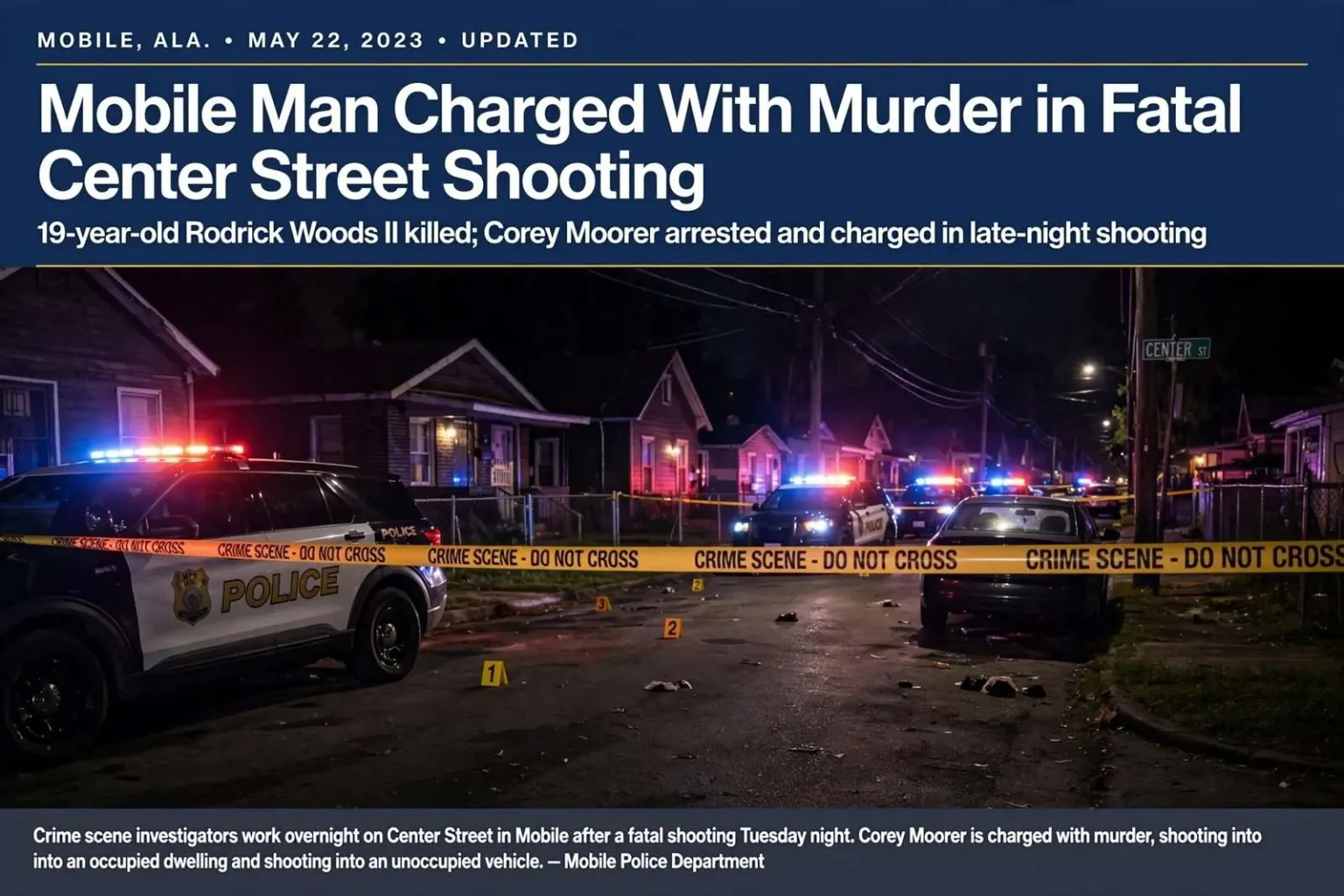
MOBILE, Ala. — A Mobile man has been charged with murder and other crimes in connection with a late-night shooting on Center Street that left a 19-year-old man dead, police said. Corey Moorer was arrested and faces charges of murder, shooting into an occupied dwelling and shooting into an unoccupied vehicle, the Mobile Police Department announced. Rodrick Woods II was found dead at the scene. The additional charges reflect what investigators say happened during the encounter, with evidence that gunfire struck both a home where people were present and a vehicle that no one was inside at the time.
Officers with the Mobile Police Department responded to the scene on Center Street around 10:45 p.m. Tuesday after reports of gunfire in the area. When they arrived, they found Woods suffering from multiple gunshot wounds. He was pronounced dead at the scene. Investigators secured the block as a crime scene, and the hours that followed involved documenting shell casings, speaking with neighbors who may have heard or seen something, and working to establish a timeline of the events that led up to the shooting.
Center Street runs through a residential section of Mobile just east of downtown, an area of older neighborhoods where houses sit close to the street and to one another. That density matters in shooting investigations, because gunfire that strikes a person can also strike occupied homes and parked vehicles, which is what prosecutors allege happened here. The charges of shooting into an occupied dwelling and shooting into an unoccupied vehicle are separate felonies under Alabama law, and each carries its own potential prison sentence in addition to the murder charge.
The case moves to a grand jury
Updated May 22, 2023: The case is now headed to a grand jury, according to court documents. Moorer appeared in court Monday, where a judge found probable cause in the shooting. The finding means the judge determined there is enough evidence to justify continuing the prosecution, a standard step that moves a felony case from the municipal level toward the county system.
In Alabama, felony prosecutions proceed by indictment. The preliminary hearing before a district judge is not a determination of guilt — it exists to establish whether probable cause exists to bind the case over. Once it does, the file goes to a Mobile County grand jury, a panel of citizens that hears evidence presented by the District Attorney’s Office and decides whether to issue an indictment. If indicted, the case moves to Circuit Court for arraignment and eventual trial.
The court also ordered Moorer to have no contact with the victim’s family. Such orders are standard in homicide cases, where emotions run high and any contact between a defendant and the victim’s relatives could complicate both the prosecution and the family’s ability to grieve. The order remains in effect while the case works its way through the court system.
What investigators still do not know
Investigators have not yet disclosed what led to the shooting or released additional details about the events that preceded the deadly encounter. Police have not said whether the men knew each other, what prompted the gunfire, or whether any weapon has been recovered. In the early stages of a homicide case, detectives typically hold back details that could compromise witness interviews or the eventual trial, releasing only what is necessary to keep the public informed and to seek help from anyone with information.
That restraint can frustrate neighbors looking for answers, but it serves a purpose. Statements made publicly early in a case can become evidence, and inconsistencies between early accounts and trial testimony are often exploited by defense attorneys. Detectives with the department’s investigative units will continue working the case as it moves toward the grand jury, and additional charges or details could emerge if the evidence warrants them.
Community impact
Fatal shootings on Center Street have at times heightened concerns about violent crime in residential areas of Mobile. The city has worked for years to address gun violence through a combination of policing, community outreach and intervention programs, and each fatal shooting renews the conversation among residents about safety in their own neighborhoods. Community groups in the affected area have repeatedly stressed that solutions require both enforcement and investment in young people.
The loss of a 19-year-old underscores the toll that gun violence takes on the city’s youngest residents. Homicide remains a leading cause of death for young Black men in Mobile and in cities across Alabama, a pattern that community leaders, clergy and families of victims have pushed officials to confront with sustained attention rather than short-term responses. Each case also leaves a ripple effect: a family planning a funeral, classmates and coworkers grieving, and a neighborhood left to process the violence that happened on its block.
How residents can help
Any residents who witnessed the shooting or saw anything unusual in the area around the time of the incident are asked to call Mobile police or leave an anonymous tip with CrimeStoppers of the Gulf Coast. CrimeStoppers allows tipsters to submit information without revealing their identity, and rewards may be available for tips that lead to an arrest in felony cases. Anonymous tips have historically played a decisive role in closing homicide cases in Mobile, where witnesses are sometimes reluctant to come forward publicly.
Police stress that even small details can matter — a description of a vehicle, a direction of travel, a sound heard at a specific time. Information can be provided to the Mobile Police Department directly, or to CrimeStoppers of the Gulf Coast, which forwards tips to the investigating detectives while keeping the tipster’s name confidential. For the family of Rodrick Woods II, that kind of cooperation could ultimately determine whether the person responsible for the 19-year-old’s death is held accountable in court.
The arrest and charges came after what police describe as a rapid investigative push in the hours and days after the shooting. Homicide detectives typically canvass the surrounding blocks for security cameras, since doorbell cameras and surveillance systems have become a major source of evidence in Mobile investigations. Footage from homes and businesses near the scene can establish who was present, how many people were involved and in which direction any vehicles left the area. Detectives also rely on forensic analysis of evidence collected at the scene to connect a suspect to the gunfire.
The charges against Moorer were filed through the Mobile County court system, which handles felony prosecutions for incidents inside city limits. Murder in Alabama is a Class A felony, the most serious category short of capital murder, punishable by decades in prison. The wounding offenses — shooting into an occupied dwelling and shooting into an unoccupied vehicle — carry penalties of their own, and prosecutors often present the full set of charges to the grand jury so that the indictment reflects everything the evidence supports.
Center Street is among the older residential corridors in the city, within reach of downtown’s restaurants and offices but distinct from them in character. Residents there have long dealt with the spillover of violence that occasionally moves out of busier commercial strips into side streets after dark. Neighborhood associations in the area have pushed for better street lighting and more consistent police patrols, and they track incidents like this one closely when they report concerns to City Hall.
The Mobile Police Department investigates homicides through dedicated investigative units staffed by detectives who specialize in violent crime. Once an arrest is made, the department’s work shifts toward supporting the prosecution: preparing case files, coordinating with the District Attorney’s Office and tracking down additional witnesses who may have held back in the early days after a shooting. Cases headed to a grand jury continue to develop even after the initial court appearance, and families of victims are typically updated as major milestones approach.
For neighbors on Center Street, the court proceedings mark a step toward resolution, though the underlying questions remain. What led two men to a fatal confrontation late on a Tuesday night, and whether anything could have interrupted the chain of events, may never be fully answered publicly. What the community can do in the meantime, police say, is share what they know — because the difference between an arrest and an unsolved case in Mobile often comes down to a single phone call from someone who was there.
The grand jury review is the next major milestone in the case, and it will take place in the months ahead rather than in a matter of days. Grand jury proceedings are not open to the public, and no schedule for the panel’s review of this case has been announced. Until an indictment is returned, the case remains at the district court stage, and the charges against Moorer are accusations that the state will have to prove in court.


