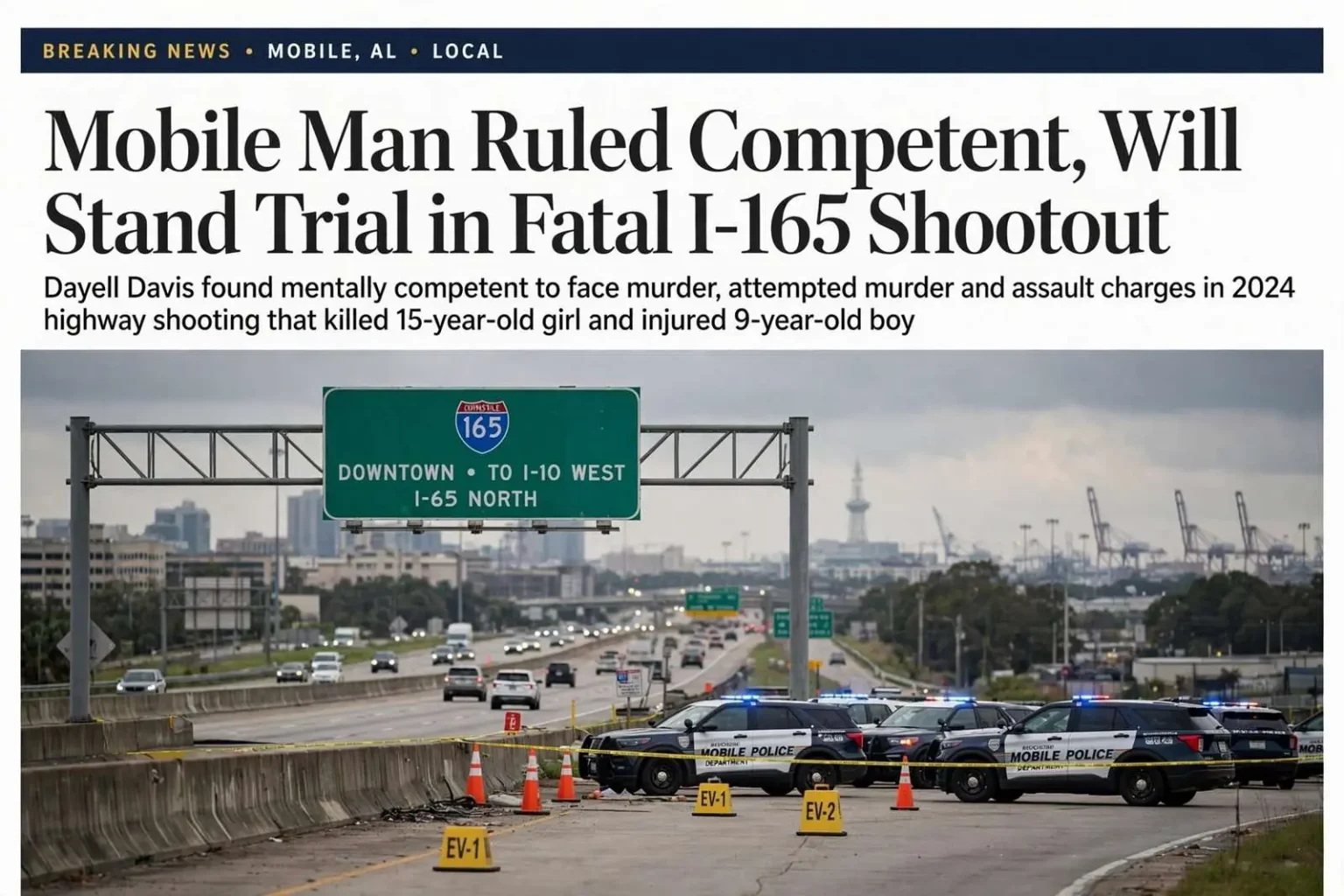
A Mobile man accused of opening fire during a rolling gun battle on Interstate 165 that left a 15-year-old girl dead will stand trial on murder, attempted murder and assault charges after his defense team agreed he is mentally competent to face the case. A judge had previously ordered a psychiatric evaluation for Dayell Davis before the case could move forward. That evaluation has now cleared the way for the prosecution to proceed, with both sides agreeing on the finding of competency.
The competency determination removes the last procedural obstacle between the case and its trial date, and it did so without the contested hearing that competency questions sometimes require. When a defense team joins the prosecution in accepting an evaluator’s findings, judges routinely accept the determination on the papers, sparing the court the delay of a separate hearing and sparing witnesses and victims’ families the uncertainty of another proceeding before the trial itself.
What happened on I-165
The shooting happened in 2024 and was described by investigators as an act of road rage. According to law enforcement, Davis and a teenager riding in another vehicle exchanged gunfire while both vehicles were moving along Interstate 165 in Mobile. Prosecutors allege that gunfire from the encounter killed a 15-year-old girl and wounded a 9-year-old boy, who were both in the second vehicle.
The setting matters to understanding how the danger unfolded. Interstate 165 is Mobile’s downtown spur, the short but heavily traveled connector that links Interstate 10 to Interstate 65 and carries commuter and freight traffic through the city’s core at highway speeds. Gunfire exchanged between moving vehicles on that roadway put every motorist in the corridor at risk — drivers, passengers and children in car seats — before a single bullet found its intended target. That two children in the second vehicle were struck, one fatally, is the outcome prosecutors say flowed directly from that choice to open fire on a public interstate.
The case has drawn attention as an example of how quickly a roadway dispute can turn deadly for bystanders who have no part in the initial conflict. Road rage confrontations escalate in seconds, and when firearms enter the exchange the people most likely to be hurt are rarely the drivers trading threats — they are the passengers beside them, the children behind them, and the strangers in the surrounding lanes. The girl killed here was 15. The boy wounded alongside her was 9. Neither was driving, and neither, by every account, had any role in starting whatever began the confrontation.
Prosecutors have charged Davis with murder for the girl’s death, attempted murder for the attack on the vehicle’s occupants, and assault charges covering the remaining conduct. The murder count reflects Alabama law’s treatment of deaths caused during a armed attack — the shooter does not need to have intended to kill the specific person who died, only to have caused the death through the deadly force he initiated.
Charges and next steps
Davis faces charges of murder, attempted murder and assault in connection with the shooting. With the competency question resolved, the case is now set to move to trial. Davis is scheduled to go on trial on Oct. 5.
The runway between now and trial will be filled with the standard work of a major felony case: motion practice over evidence and experts, witness preparation, and the scheduling conferences that determine whether the October date holds. Cases of this profile in Mobile County often draw continuances, but the competency agreement removes the most common structural source of delay — the fight over whether the defendant can participate in his own defense at all.
Understanding a competency evaluation
A court-ordered psychiatric evaluation is a routine step in serious criminal cases when a defendant’s mental fitness to understand the charges and assist in their own defense is called into question. If both the prosecution and defense agree with the evaluation’s findings, as happened in this case, the court can accept the determination without a separate competency hearing, allowing the case to proceed toward trial.
The legal standard is specific and often misunderstood. Competency does not ask whether a defendant was mentally ill at the time of the offense — that is the separate question of criminal responsibility, raised as an insanity defense at trial. Competency asks only whether the defendant, right now, understands what he is charged with and can work with his lawyers in a rational way. The distinction matters: a finding of competency clears the case for trial without saying anything at all about what happened on the interstate, or why.
The evaluation process itself typically involves a mental health professional appointed or approved by the court, interviews with the defendant, review of records, and a written report to both sides. When the report’s conclusion satisfies defense counsel as well as prosecutors, the finding enters the record without contest. That both sides agreed here suggests the evaluation was thorough and its conclusion straightforward — and it means the trial, when it begins, will be about the shooting itself rather than the defendant’s mental state.
The wider stakes
For Mobile County prosecutors, the case is a statement about how road-rage shootings will be charged when children are harmed. Firing into another vehicle at interstate speed is, in legal terms, conduct that jeopardizes everyone in its path, and charging the death of an unintended victim as murder reflects the view that a shooter takes responsibility for every bullet he releases — not just the ones that land where he aimed.
For the community, the trial will revisit an afternoon that has stayed with the families involved since 2024. The girl who died was a teenager riding in a car; the boy wounded was a second-grader’s age. Their families will sit through testimony about the mechanics of the encounter — who fired first, how many rounds, what each vehicle did — because that evidence is what the law requires to prove the charges. It is the part of a trial that is hardest on the people the case is really about.
The October trial date will arrive with Davis facing the most serious charges Mobile County can bring for conduct of this kind, and with the competency question that could have consumed months already settled. What remains is the question the case has always turned on: what happened between two vehicles on Interstate 165, and what accountability the law requires for the life lost and the child wounded because of it.
Road rage incidents with firearms remain a persistent danger on Gulf Coast highways, and law enforcement agencies across the region have urged drivers to disengage from confrontations, avoid gestures and eye contact, and call 911 rather than respond when another driver escalates. The I-165 case is the local illustration of why: a traffic dispute that ended with two children shot, one of them fatally, and a young man now headed to trial on murder charges.
The competency agreement also illustrates how the adversarial system handles questions both sides agree on. A competency hearing can consume days, with dueling experts, testimony about the defendant’s history and behavior in jail, and a judge’s ruling that either side can appeal — delays measured in months. When the evaluator’s report lands in a place both parties can accept, all of that machinery is bypassed. The savings matter not just for the court’s calendar but for the case’s witnesses, whose memories of the shooting are now several years old and will age further with every continuance.
Legal observers of the case have noted that the murder charge does not depend on proving Davis aimed at the girl who died. Under Alabama’s transferable-intent principles, a person who fires a gun at another person with intent to kill is criminally responsible for a death that results — even if the bullet strikes someone else entirely. That doctrine is precisely what allows a road-rage shooting aimed at one driver’s vehicle to be charged as the murder of a passenger inside it, and it will likely be a central theme of the prosecution’s case.
The defense, for its part, has not publicly detailed its trial strategy. In shootings between moving vehicles, defenses often turn on questions of sequence and identity — who fired first, whether the shots that struck the children can be attributed to a specific shooter, and what the physical evidence from the vehicles and roadway shows about the exchange. Reconstructing a rolling gun battle is among the more demanding tasks in forensic work: bullet paths, vehicle damage and witness accounts must be reconciled into a narrative a jury can follow.
Whatever the outcome at trial, the October proceedings will give the victims’ families their most complete public accounting of what happened on the interstate that day. Grand jury proceedings, arrest affidavits and prosecutors’ statements provide fragments; a trial assembles them into a whole. For the family of a 15-year-old girl killed on a Mobile freeway on an ordinary day in 2024, that accounting is a form of answer — not the one anyone would have chosen, but the one the process provides.
The case remains scheduled for trial on Oct. 5. Mobile County court records will carry the pretrial schedule in the weeks ahead, and any change to the trial date would be reflected there first.