
Mobile Murder Arrest Prompts New Look at 10-Year-Old Cold Case
Kenny Lee Campbell's arrest in Lelia Smith's death led Mobile police to reopen the unsolved 2008 killing of Shannon Campbell.
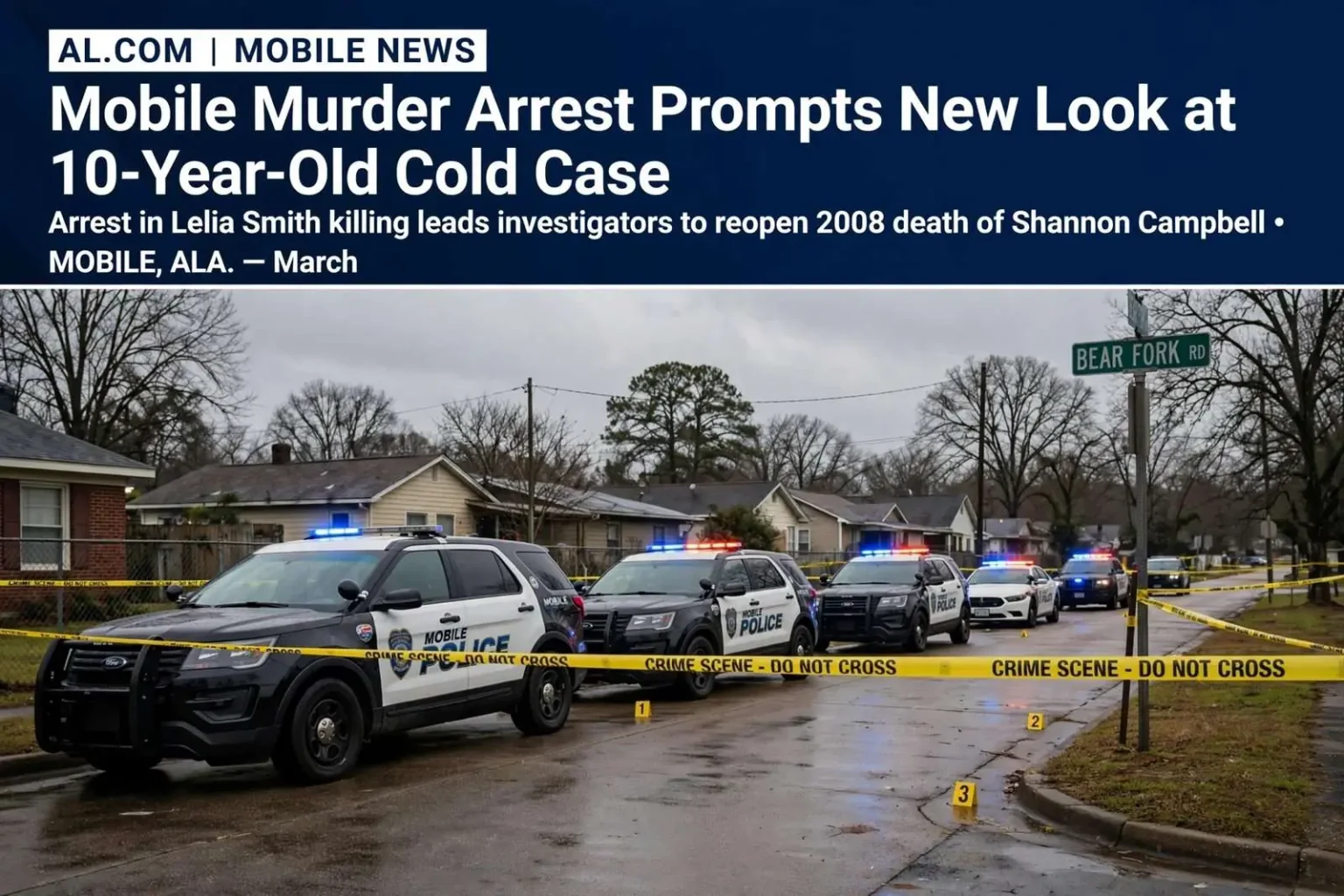
MOBILE, Ala. — The man charged this week in the death of Lelia Smith has a connection to a decade-old Mobile killing that was never solved, and investigators are now taking another look at the cold case. Kenny Lee Campbell was arrested Wednesday evening and charged in the death of Smith, with whom he had fathered a child, according to Mobile police. Her body was discovered in a car on Bear Fork Road in March.
The arrest closes one chapter for Smith’s family while reopening another. Mobile police confirmed that detectives are now re-examining the February 2008 death of Shannon Campbell in light of the new arrest, a development that cold-case investigators say illustrates why unsolved homicides are never formally closed in the eyes of a major department’s homicide unit.
Bear Fork Road winds through a residential area of the city where the discovery of Smith’s body inside a vehicle drew an immediate response from patrol officers and detectives. The circumstances of the March discovery formed the backbone of the case that led to Wednesday evening’s arrest, which came after what police described as an active investigation into her death.
The 2008 Shannon Campbell case
The arrest has drawn attention to the February 2008 death of Shannon Campbell, whom county marriage records show married Kenny Lee Campbell in 2005. She was found shot to death in front of her home, her toddler at her side. No one was ever charged in her death, and the case has stood for years among the region’s unsolved killings.
Court and jail records show that in early February 2008, weeks before her death, Shannon Campbell applied for a domestic abuse restraining order against her husband. The filing placed her among the hundreds of Mobile County residents each year who seek judicial protection from domestic violence, a process that requires a sworn petition detailing the abuse and can result in temporary and then final protective orders.
Two days later, on February 7, 2008, Kenny Campbell was arrested and charged with domestic violence. Jail records indicate he was released less than two hours later. The speed of that release has drawn retrospective attention from advocates who study how the system handles domestic violence arrests, particularly when a protective order petition is on file.
On February 23, 2008, officers responding to Woodley Road found Shannon Campbell’s body. The killing occurred in a residential neighborhood near Prichard’s border, and despite the prior filings and arrest that preceded it by a matter of weeks, the case went unsolved. Detectives at the time worked the leads available to them, but no arrest followed.
Why cold cases get a second look
Mobile police confirmed that detectives are now re-examining the Shannon Campbell case in light of the new arrest. The practice is standard in homicide work: when a suspect is taken into custody in a related case, investigators pull the files on any unsolved deaths connected to that person, re-interview witnesses whose memories have matured, and test physical evidence with forensic methods that did not exist when the original investigation ran.
Forensic advances have transformed cold-case work over the past two decades. DNA analysis techniques now succeed on samples far smaller and more degraded than the technology of 2008 could process, and genealogy-based identification has solved cases nationwide that sat unsolved for decades. Evidence preserved from an old scene can yield answers that were simply unavailable to the original detectives.
Witness recollections change as well. People who declined to talk in 2008 — out of fear, loyalty or uncertainty about what they saw — may be willing to speak years later, particularly when circumstances have changed. Cold-case units are built around exactly that dynamic, revisiting files on a rolling basis and moving quickly whenever an outside event, such as a new arrest, gives them a reason to return.
Domestic violence and homicide risk
The sequence of events recorded in 2008 — a protective order petition, an arrest for domestic violence, a release within hours, and a killing sixteen days later — matches a pattern that domestic violence researchers have documented repeatedly. Studies consistently identify a prior history of abuse, including estrangement and court involvement, as among the strongest predictors of intimate partner homicide.
Alabama’s protective order system allows a petitioner to seek an order through the circuit court, with emergency provisions available when danger is imminent. Enforcement, however, depends on arrest, prosecution and judicial follow-through, and gaps at any stage — including rapid release from jail after an arrest — remain a persistent concern for advocates in Mobile County and across the state.
Local resources exist for families in danger. The Lifelines Counseling Services crisis line in Mobile, the National Domestic Violence Hotline, and district attorney victim service officers all provide pathways to safety planning, shelter and legal help. Advocates stress that a protective order is one tool among several, most effective when combined with a safety plan and support network.
For Shannon Campbell’s family, the re-examination of her case brings a renewal of hope that has survived nearly fifteen years. Families of unsolved homicide victims in Mobile County have long pressed for answers, attending annual vigils and keeping cases in front of the public through anniversary appeals and reward offers funded by private donations.
The Lelia Smith case
The case that triggered this week’s developments began in March, when Smith’s body was discovered in a car on Bear Fork Road. Police have said she and Kenny Lee Campbell had a child together, a relationship detail that placed the killing among the intimate-partner cases that make up a significant share of homicides nationally. Smith’s death left behind family members and a child now facing life without a mother.
Wednesday evening’s arrest came after weeks of investigative work following the discovery. Detectives assembled the case through interviews, evidence collection and coordination with prosecutors, culminating in the charge filed against Campbell. He remains in the custody of Mobile County Metro Jail pending judicial proceedings, and the case now moves into the court system, where prosecutors will present the evidence gathered.
Intimate partner homicides present distinct investigative and prosecutorial challenges. The relationships involved complicate witness accounts, and the cases often hinge on patterns of prior abuse, digital records and physical evidence rather than eyewitnesses. Mobile County prosecutors have specialized units that handle violent crime, and judges in the local system have access to protective order histories when considering bond conditions.
How Mobile handles its unsolved killings
The Mobile Police Department’s homicide unit carries forward its unsolved cases indefinitely. Detectives reassign and re-review files periodically, and the department participates in regional task forces that share information across jurisdictional lines — a necessity in a metro area where victims, witnesses and suspects move constantly among Mobile, Prichard, Chickasaw and the surrounding communities.
The department also encourages the public to come forward in cold cases, operating its tip line at (251) 208-7211 and supporting anonymous submissions through Crime Stoppers of Mobile, which offers cash rewards for information leading to arrests. Investigators note that even fragments of memory — a vehicle seen on a street, a conversation overheard years ago — can unlock a dormant case.
Community organizations keep the pressure on as well. Annual vigils for homicide victims, mothers’ groups formed around unsolved deaths, and church-based anti-violence programs all contribute to keeping cases visible. That visibility matters: investigators say public attention frequently generates the fresh tip that breaks a case open.
What comes next
For now, two cases move on parallel tracks. In the Lelia Smith case, the criminal process will unfold through arraignment, bond hearings and eventual proceedings in Mobile County circuit court. In the Shannon Campbell case, detectives return to a file that has waited since February 2008, armed with new forensic tools and, perhaps, new willingness from those who knew something to finally speak.
Neither the Smith family nor the Campbell family has received the full accounting they have sought, but this week changed the trajectory of both. A case that stood unsolved for nearly fifteen years now has an active investigative path, and a March killing has its accused. Mobile’s prosecutors, detectives and the families involved now carry the work forward — slowly, methodically, and in the hope that both cases end with the answers the families have waited for.
Anyone with information about either case is urged to contact Mobile police at (251) 208-7211 or to leave an anonymous tip through Crime Stoppers of Mobile.
The dual investigation also underscores the workload behind every arrest. Detectives assigned to the Smith case will spend the coming months preparing for trial — writing reports, testifying before grand juries and responding to defense discovery requests — even as colleagues reopen a 2008 file. Major departments budget their homicide staffing around exactly this reality: an arrest does not end the work, it transforms it.
Advocates for domestic violence victims in Mobile County say the week’s developments should renew attention to the warning signs that preceded both deaths. Protective order petitions, prior arrests and rapid releases are all visible markers in court records, and victims’ families and service providers continue to push for earlier intervention before patterns of abuse turn lethal.


