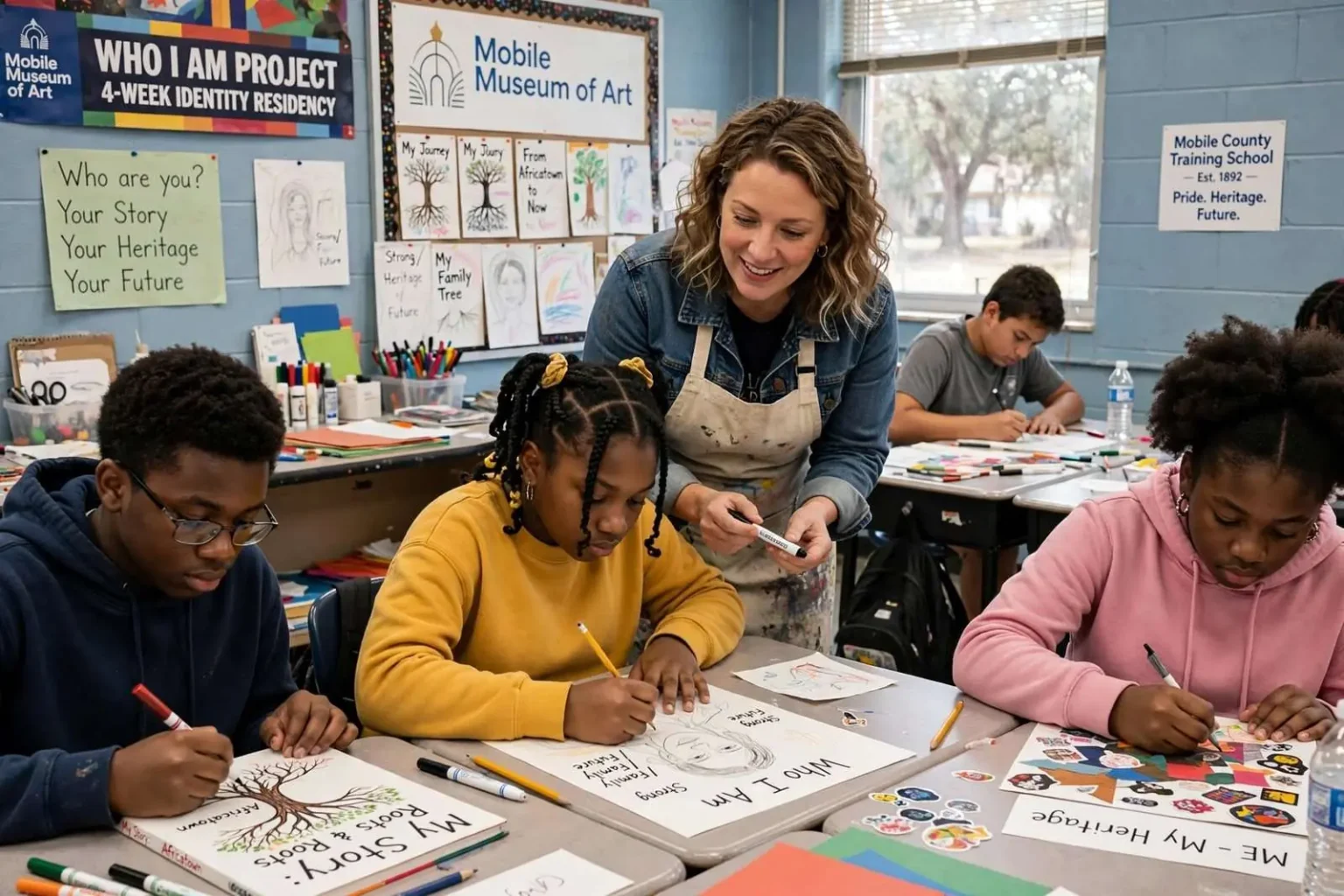
Visual artist Colleen Comer recently spent an hour and a half with eighth-graders at Mobile County Training School in Prichard, leading a single session in a four-week arts series built around one question: who are you? The class is part of the Mobile Museum of Art’s “Who I Am” project, a residency that rotates through visual art, creative writing, music and multimedia before wrapping up with student-designed final projects. For the students in the room, the visit meant a hands-on art lesson of the kind that has become increasingly rare in public classrooms. For the museum, it was another step in a deliberate effort to bring working artists to schools where art instruction has all but disappeared.
Elizabet Elliott, the museum’s curator of programs and a Fairhope native, said the curriculum was deliberately aimed at early adolescents. “A program about identity is really a lot more powerful in early adolescence,” Elliott said. Decisions about clothes, haircuts and taste carry enormous weight at that age, she noted, and the program tries to give students who are already wrestling with those choices a broader perspective on meaning and identity. The design reflects a belief that the middle school years, often treated as a holding period between elementary and high school, are actually the moment when students begin deciding who they want to be.
Mobile County Training School was selected from among Mobile County schools that have trimmed or eliminated their art programs for lack of funding, and Elliott pointed to the school’s setting near Africatown as central to the choice. In a neighborhood where family history and heritage carry deep weight, she said, questions of identity are especially meaningful for the students. The school sits just a few miles north of downtown Mobile, in one of the most historically significant communities on the Gulf Coast. That setting turns an abstract classroom exercise into something far more personal.
A Neighborhood Built on History
Africatown, also known as Plateau, was founded by survivors of the Clotilda, the last known slave ship to reach the United States, arriving in Mobile Bay in 1860 more than half a century after the importation of enslaved people had been outlawed. After the Civil War, the ship’s survivors purchased land, built homes and churches, and established a self-sufficient community that endured for generations. Their descendants remain in the area today, and the story of the Clotilda has drawn national and international attention, particularly after the wreck of the schooner was located in the Mobile River in 2019.
For students at Mobile County Training School, that history is not a chapter in a textbook but a family inheritance. Many local families can trace their roots directly to the community’s founders, and stories of the Clotilda survivors are passed down through churches, neighborhood organizations and household memory. Elliott said the school’s surroundings make questions of heritage concrete rather than theoretical. The “Who I Am” sessions lean into that context, asking students to see themselves as part of a continuing story rather than starting from nothing.
The school itself is a historic institution. Mobile County Training School traces its roots to the 19th century and grew into one of Alabama’s leading public schools for Black students during the segregation era, producing generations of graduates who went on to careers in education, medicine, the ministry, the military and public service across Mobile. That legacy is a source of pride in Prichard, a city that has weathered decades of economic change while its institutions continued to anchor the community. A school with that kind of history makes a natural setting for a program about where students come from and who they might become.
Built on Identity and Autobiography
The four-week sequence moves logically toward autobiography. Students begin by designing book covers as though they had already written the stories of their lives, an exercise that forces them to summarize themselves in a single image and title. From there, the residency moves into creative writing, giving students room to put their own experiences and family histories into words. A music unit follows, framed around the question of what would appear on the soundtrack of “the movie of your life,” and the series closes with student-designed final projects that draw on everything the students have produced along the way.
Four working artists were hired to lead the sessions alongside museum staff — Comer as the visual artist, writer and performer Alfred Ward, and multimedia artists Duane Knight and Rufus Ducote. Museum officials said the decision to hire practicing artists rather than relying solely on staff was intentional, because it puts students in front of people who make their living through creative work. Each artist brings a different discipline to the residency, so students encounter visual art, performance, writing and digital media as living professions rather than school subjects. The rotation also keeps the program fresh across four weeks, since each session is built around a different way of answering the same question.
The project builds on groundwork laid the previous year, when the museum hosted the students for identity-themed tours of its collection. During those visits, students looked at how artists across eras and cultures have expressed identity, memory and belonging. The museum also assigned a summer reading project that asked students to research their own family histories through old photographs, a task that sent many of them home with questions for parents and grandparents. That preparation matters, staff said, because students arrive in the classroom sessions already thinking about their own stories.
Arts Education and the Funding Squeeze
The residency exists in part because of what has happened to arts instruction in public schools. Across Alabama, as in much of the country, art and music classes have been trimmed or eliminated at many schools as budgets tightened and instructional time shifted toward tested academic subjects. Mobile County, the state’s largest school system by enrollment, is no exception, and schools in older, lower-income neighborhoods have often felt the cuts first. A program like “Who I Am” cannot replace a full-year art curriculum, but it can give students a sustained stretch of creative work that they would otherwise not receive.
Educators who work with early adolescents often point out that this is precisely the age when students begin disengaging from school if they cannot see themselves in it. Programs that treat students’ own lives as worthy subject matter, museum staff said, tend to pull in students who may struggle in other classes. The format also gives students public proof of their abilities: at the end of the residency, their work is not simply graded and returned, but displayed and performed for an audience. That distinction between completing an assignment and producing something real is central to how the museum frames the project.
The choice of eighth grade is also practical. Students at that age are old enough to handle serious questions about identity and history but still young enough to be reached before the pressures of high school take over. Elliott said the curriculum was written with that window in mind, aiming to strengthen students’ sense of self at the point where it is most likely to wobble. The museum’s staff sees the residency as an investment in the years that follow, when those same students will choose courses, activities and eventually career paths.
A Closing Showcase for Student Work
When the classroom sessions end, the museum plans a closing reception where students can exhibit their work and perform. The event gives the four-week residency a destination, and it puts the students’ book covers, writing, music and multimedia pieces in front of families, teachers and museum visitors. For many of the students it will be the first time their creative work has been shown publicly. Museum staff treat the reception as the culminating moment of the project, the point at which the question “who are you?” produces an answer the students can point to.
The Mobile Museum of Art, located in Langan Park in west Mobile, is the region’s largest art museum and has increasingly taken its collection and programs out into the community, particularly to neighborhoods far from its galleries. Community-based residencies fit a broader pattern among museums nationally, which have worked in recent years to serve audiences who may rarely visit their buildings. By sending working artists into classrooms instead of waiting for students to come to the museum, the institution puts its resources where the need is most visible.
Funding for the project came through Mobile County Commissioner Merceria Ludgood, whose district includes Prichard and who has supported cultural and educational programming in the community. Elliott was direct about the program’s dependence on that support, saying that without Ludgood the project would not have been possible. County-level funding for arts education has grown scarce, which makes committed sponsors essential for programs that operate outside the school system’s core budget. The commissioner’s backing also signals the county’s interest in projects that tie cultural work to community history in areas like Africatown.
The stated goal, Elliott added, is for students to understand their heritage well enough to imagine themselves ambitiously — “something great and something important” — and take ownership of who they become. That framing turns the residency into more than an art class. Students are asked to research where they come from, express who they are now in several mediums, and then decide who they intend to be. For eighth-graders in a community defined by its founders’ resilience, the museum’s hope is that the question at the heart of “Who I Am” becomes a habit of mind they carry with them long after the final projects come down.
Museum officials have not announced where the residency will rotate next, but the model — four artists, four weeks, one school chosen for both need and history — is designed to be repeatable. If it continues, each participating school brings its own story to the program. In Prichard, that story is one of the deepest in Alabama, and the students who spent an hour and a half with Colleen Comer were asked to see themselves as its next chapter.