2007 Report: Police Made Arrest in Off-Campus Assault Investigation
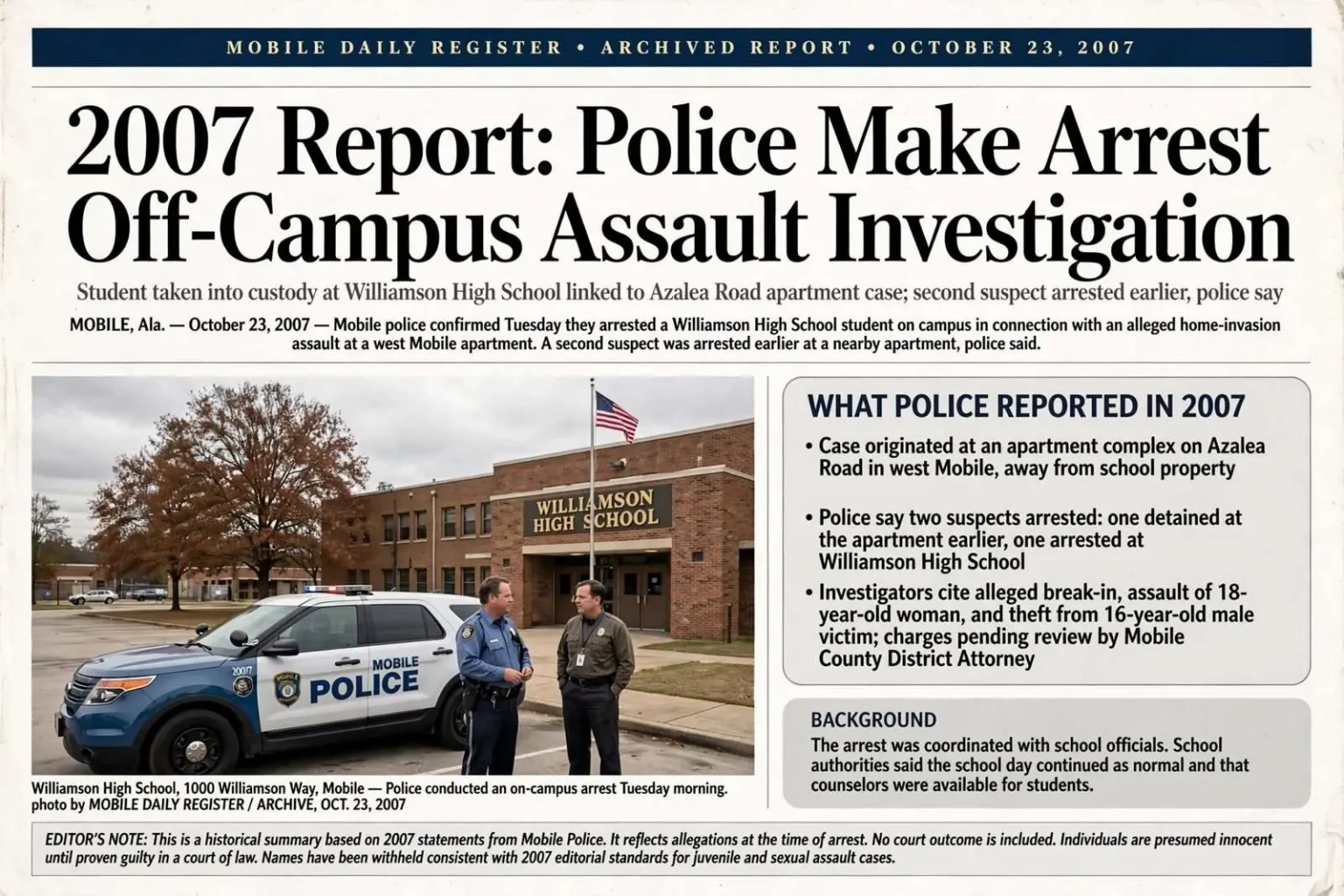
A historical WKRG report said Mobile police arrested a student at Williamson High School in connection with an off-campus assault and burglary investigation in 2007.
Content note: This historical report concerns allegations of sexual assault. It avoids graphic detail, omits names and reflects police statements from 2007 rather than any later court outcome.
Mobile police said in 2007 that they arrested a student at Williamson High School in connection with an off-campus assault investigation. The arrest connected a city school campus to a case that investigators said began at an apartment well away from school property, on the other side of Mobile’s west side.
According to the archived local news report, investigators alleged that two people broke into an apartment on Azalea Road, a busy commercial and residential corridor in west Mobile known for its strip centers, apartment complexes and steady traffic between Airport Boulevard and Government Street. Once inside, the intruders allegedly assaulted an 18-year-old woman who lived there, took money from a 16-year-old boy, and confined the boy while the apartment was searched for valuables.
The allegations described a home-invasion style crime of the kind that specially trained investigators handle differently from ordinary property cases. Detectives assigned to crimes against persons work such cases with attention to evidence collection at the scene, interviews conducted by officers trained for trauma victims, and coordination with prosecutors from the earliest stages, because the charges that eventually result depend heavily on how the initial investigation is documented.
The arrests
Police said one suspect was arrested at the school and another had been arrested earlier at a nearby apartment. Taking a student into custody at school is an unusual step that typically requires coordination between detectives and school administrators, and it generally happens when investigators believe the timing is necessary to secure the arrest before the student leaves campus for the day.
The second arrest, made earlier at an apartment near the scene, suggested investigators had moved quickly to locate both suspects once the initial interviews pointed in a direction. In cases involving multiple defendants, police often stagger the arrests so that no suspect has the opportunity to warn the other or coordinate an account of events, a practical consideration that shapes how these investigations unfold in their first hours.
How west Mobile cases move through the system
Once the arrests were made, the case would have passed from patrol officers and initial detectives to the units that prepare felony cases for presentation to a prosecutor. In Mobile County, that means assembling incident reports, witness statements, forensic documentation and any physical evidence into a file that the District Attorney’s office reviews before formally charging defendants. The gap between an arrest and formal charges can stretch for weeks, and coverage of these cases often ends long before the file reaches a courtroom.
For the victims, that timeline means months of uncertainty after the initial trauma. Advocates for crime victims in Mobile County note that support services — counseling, court accompaniment and assistance with victim compensation claims — exist precisely for this stretch of the process, when the urgency of the arrest has passed but the legal proceedings are still ahead.
The report described planned bond hearings for the two defendants. In Alabama’s court system, bond hearings come shortly after an arrest, where a judge sets the amount and conditions under which a defendant can be released while awaiting further proceedings. For serious felony allegations, those hearings give the court its first chance to weigh the nature of the accusations, the defendants’ ties to the community and any questions of public safety before deciding on release terms.
Williamson High and the community it serves
Williamson High School, a long-established public school serving students in Mobile, found itself linked to the case only because of where one suspect attended classes. Schools have no control over allegations against students that arise off campus, but an arrest on school grounds inevitably draws attention to the campus and raises questions from parents about safety and protocol during a police presence.
Under standard practice, school administrators cooperate with law enforcement during an on-campus arrest while working to keep the school day as ordinary as possible for the thousands of students who have no connection to the investigation. Counselors and administrators generally stand ready to address rumors that circulate quickly among students, and district officials typically defer questions about an active case to the police department handling it.
The 2007 case also illustrates the boundary between school authority and the criminal justice system. A student arrested for an off-campus felony faces a parallel track: the criminal proceedings handled by police, prosecutors and the courts, and the separate disciplinary decisions that fall to the school district under its own code of conduct. Neither track substitutes for the other, and outcomes in one do not determine the other.
Why historical cases get a second look
Years after the fact, reports like this one serve a documentary purpose. Local news archives are often the only public record of how a case began — the initial allegations, the response of police, the arrests — and they preserve that account for readers researching the history of their neighborhoods, schools and courts.
Reading them years later requires care. Details that seemed settled in the original coverage may have changed as cases moved through the system, and stories that ended without follow-up coverage leave the disposition unknown. That is why the boundaries of this report are stated plainly: it reflects what police said in 2007, nothing more, and it draws no conclusions the record cannot support.
For readers affected by topics like the ones described here, support resources remain available through crisis centers and victim service organizations that serve the Mobile area, which offer confidential assistance to survivors of assault regardless of when an incident occurred.
Allegations, arrests and the presumption of innocence
As the archived report emphasized, an arrest is the beginning of the judicial process, not its conclusion. Defendants are presumed innocent unless proven guilty, and the allegations summarized in news accounts represent what investigators said they believed at the time — an account that defendants and their attorneys have every right to contest at every subsequent stage.
This article preserves allegations and arrest information reported at the time. It does not establish guilt, identify the people involved or report any subsequent proceedings. Because the underlying case was never followed to its outcome in the source material available, no statement about convictions, acquittals, dismissals or sentencing appears here, and none should be inferred.
The decision to omit names reflects standard editorial practice for historical crime reporting of this kind, particularly when the record does not include the final court disposition. The people involved were young — one victim was 18, another was 16, and the arrested suspect was a high school student — and republishing their identities years later, detached from any verified outcome, serves no public interest the report can fulfill.
The Azalea Road corridor where the apartment break-in allegedly occurred has long been one of west Mobile’s commercial spines. Lined with shops, restaurants, offices and apartment communities, it carries commuters between some of the city’s busiest east-west routes, and the apartment complexes along and near the corridor house thousands of residents who live minutes from schools, churches and shopping.
Crimes in such corridors tend to draw wide attention precisely because the areas are so heavily trafficked. Residents who pass the same strip centers every day read about a nearby home invasion and recognize the block instantly, which is why police ask for the public’s help in cases like this one — witnesses, neighbors and anyone who noticed unusual activity are often the source of the details that complete an investigation.
The role of the schools during an arrest
When officers arrive on a campus to take a student into custody, the procedure is deliberately low-key. Detectives typically coordinate with the front office rather than approaching a student in class, and administrators arrange for the student to be escorted off campus with as little disruption as possible. Other students may not realize anything has happened until rumors begin, which is why districts treat communication carefully in the hours afterward.
For parents, the sight of police vehicles at a school is jarring even when the underlying case has nothing to do with the campus. School districts across Mobile County have protocols that govern law enforcement presence on campuses, designed to balance cooperation with police against the need to keep instructional time uninterrupted and to avoid alarming younger students unnecessarily.
Remembering the context of 2007
The case also stands as a reminder of how much coverage practices have evolved. Crime reporting in 2007 often followed arrest announcements closely and then dropped the story once defendants moved into the court system, leaving readers without answers about how cases concluded. Modern newsrooms have pulled back from naming young suspects and from publishing details of sexual assault cases, precisely because of the lasting consequences for victims and defendants alike when coverage outruns the verified record.
What can be said about the 2007 case is what the police said at the time: two arrests, allegations of a break-in and assault at an Azalea Road apartment, and bond hearings ahead for the defendants. Everything beyond that belongs to court records that this archive does not contain, and the report ends where the verified record does.