Mobile Official Says Viral Video Shows Officer Used ‘Excessive Force’ on 16-Year-Old Outside School
A city of Mobile official says video shows an officer using excessive force on a 16-year-old girl outside Accel Academy; the FBI joined the probe.
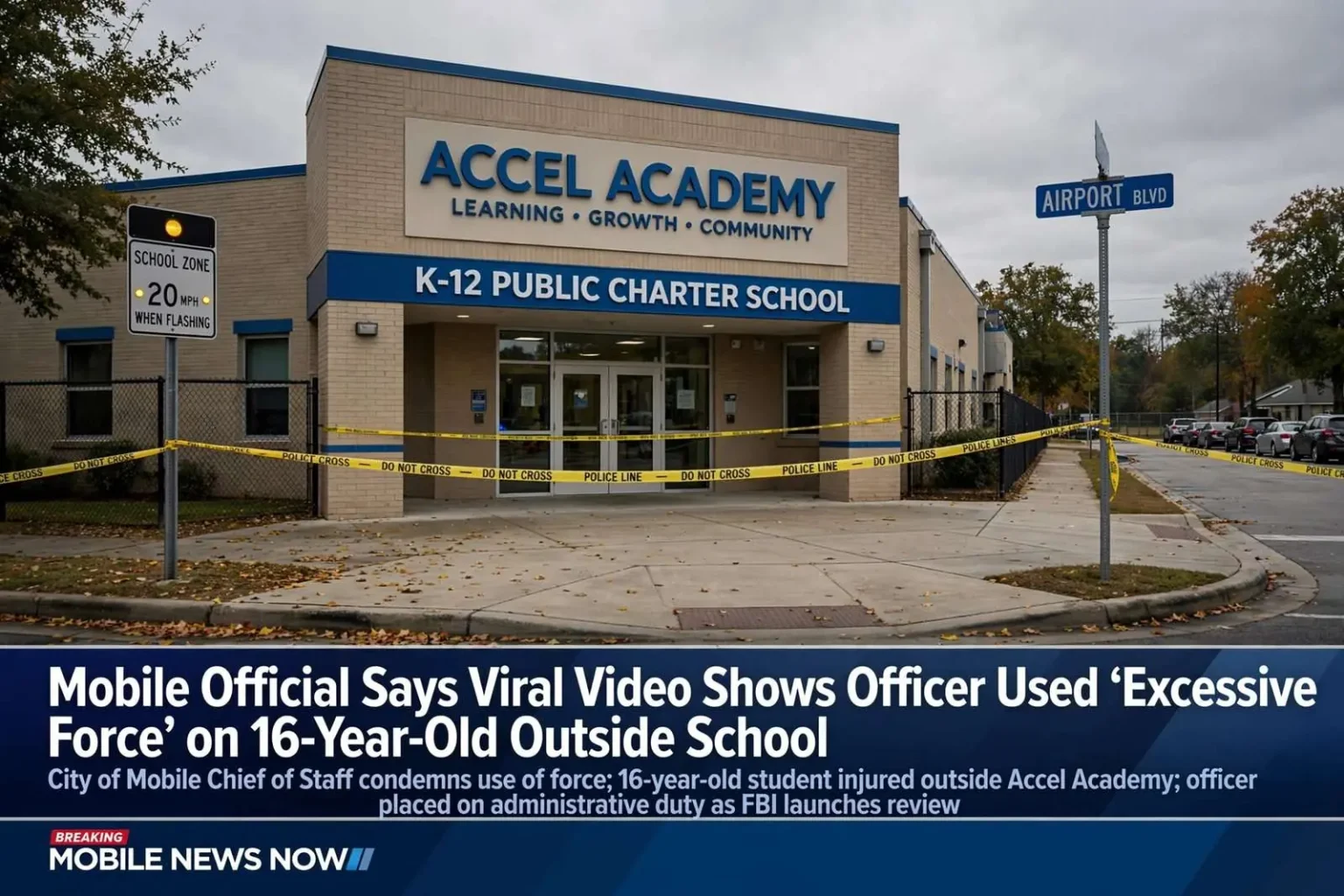
A City of Mobile official says a police officer seen on viral video throwing a teenage girl to the ground outside a school appears to have used too much force.
Chief of Staff James Barber’s assessment came after footage spread on social media showing an off-duty Mobile police officer throwing a 16-year-old girl to the ground outside Accel Academy on Airport Boulevard. The video’s rapid spread turned a campus disciplinary matter into a citywide controversy within hours, drawing reactions from parents, civil rights advocates and city officials long before the department’s own investigation could begin.
“I saw what appears to be excessive force used by the officer in this case against a fairly small female,” Barber said, noting that the relative sizes of the officer and the girl are factors in judging how much force is appropriate.
Barber’s statement is notable on several levels. Chief of staff is a senior policy position in City Hall, and a public assessment from that office — before the investigation concluded — signaled that the city’s leadership was not prepared to defend the conduct shown on the video reflexively. His reference to the relative sizes of officer and student points to a genuine principle in use-of-force evaluation: officers are trained to calibrate force to the subject’s size, age, resistance and the nature of the threat, and a large disparity between those factors weighs heavily against a technique that throws a person to the ground.
The mother’s account
The girl’s mother, Brittney Pettaway, said the episode began as an argument between a school administrator and her daughter. She described being on the phone with her crying daughter before the call cut off, then learning from another parent who witnessed it that an officer had slammed the girl to the ground.
Pettaway said her daughter suffered a broken toe, sore legs, scraped knees and a knot on her head, and she wants the officer fired. Her account of the phone call — a parent listening helplessly as the line goes dead during a crisis — became one of the most widely shared details of the episode, capturing for many viewers the powerlessness parents feel when their children face physical force at school and information arrives only in fragments afterward.
The injuries she described, while not life-threatening, are the kind that use-of-force investigators weigh carefully: a broken toe and a knot on the head indicate impact with the ground or surrounding objects, and documenting such injuries is standard in cases where the force used is contested. Medical records and witness statements from other parents and students will form part of the factual record the investigations rely on.
What the school has said
Accel Academy confirmed that “a student disciplinary incident” involving an officer occurred on campus but declined further comment, citing federal student privacy law. School officials said safety was their primary concern and that the incident was under investigation.
The school’s restraint reflects the Family Educational Rights and Privacy Act, the federal statute that protects the privacy of student education records — a category courts have interpreted broadly enough to limit what schools can say about individual students and disciplinary matters, even under heavy public pressure. That constraint leaves schools in incidents like this one able to confirm little, which in turn pushes the public conversation toward the police department and city government, whose own statements are not subject to the same restrictions.
The presence of an off-duty officer working at the school also raises questions the investigation will have to address: what the officer was told about the situation, what the school asked him to do, and where the boundary sits between a school administrator’s disciplinary authority and a police officer’s use of physical force. Those answers will determine not only how this case is judged but how the school contracts for and directs police presence in the future.
The officer’s status and the investigation
The officer has been placed on administrative duty and will not patrol while the inquiry proceeds. Administrative reassignment is the standard first step in American policing when an officer’s force is under review: the officer remains employed and available to investigators but is removed from situations where the pending allegations could affect public safety or public confidence. It is not a disciplinary outcome in itself, and its duration typically tracks the length of the investigation.
Barber said Mobile police criminal investigators are handling the case alongside the FBI — a standard step, he said, whenever there is a civil rights allegation. The FBI’s involvement means the incident is being examined under federal law as well as state law: federal civil rights statutes prohibit law enforcement officers from willfully using unreasonable force, and the bureau’s presence signals that prosecutors in Washington could review the case independently of whatever Mobile County authorities decide.
He declined to say whether the officer’s actions were justified while the investigation remains in its early stages. That caution reflects both the criminal stakes — statements made before an investigation concludes can complicate any eventual prosecution — and the parallel proceedings that follow use-of-force cases, where internal disciplinary review, criminal investigation and federal review each move on their own timelines and each has its own standard of proof.
How use-of-force reviews work
The case will now move through the layered review process that governs allegations against American police officers. Criminal investigators will gather the video, witness statements, medical records and the officer’s own account, then present findings to prosecutors, who decide whether charges are warranted. Separately, the department’s internal affairs function examines whether the officer violated departmental policy — a standard that differs from criminal law and can result in suspension, termination or retraining even where no crime occurred. The FBI’s civil rights review adds a third track with its own evidentiary standards.
Viral video has transformed how such cases unfold. Where use-of-force disputes once turned on conflicting testimony with little independent evidence, recordings made by bystanders provide a fixed record — though one that has its own limitations, since a short clip cannot show what preceded it or what the officer perceived. Investigators in Mobile will be working to establish the full sequence: the argument between the administrator and the student, how the officer became involved, what he was told, and what happened in the moments before the throw that the video captured.
What it means for Mobile
The incident lands in a city that has faced periodic scrutiny of police conduct, and the city government’s response — Barber’s early, public assessment — will shape how the community weighs the eventual findings. By stating on the record that the video appears to show excessive force, city leadership has effectively pre-committed itself to a serious review rather than a defensive one, a posture community advocates have long argued is the first step toward accountability.
For the student’s family, the demands remain concrete: answers about what happened, accountability for the officer involved, and attention to the injuries the mother described. For Accel Academy, the case forces a review of how disciplinary situations involving police officers on campus are handled. And for the Mobile Police Department, the outcome of a review that now spans its own investigators and the FBI will be measured against a video that thousands of residents have already watched and judged for themselves — with a senior city official among those who say it appears to show exactly what the girl’s family alleges.
Off-duty policing and school security
The case also spotlights the widespread practice of off-duty officers working at schools. Departments across Alabama allow officers to take secondary employment providing security at campuses, businesses and events, with the officers paid by the hiring institution while retaining their police authority. The arrangement gives schools a trained, armed presence and gives departments a way to extend coverage, but it also creates gaps in accountability and command: when an off-duty officer acts, questions immediately arise about whose directions he was following, what the school requested of him, and whether departmental policies on force apply with the same force as they do on patrol.
Those questions are now central to the Mobile review. Investigators will need to reconstruct the communication between school staff and the officer during the argument between the administrator and the 16-year-old, including whether he was asked to intervene physically or inserted himself into a situation that school personnel were managing. The answers bear directly on both the criminal and policy assessments of the force used, and on how the school structures any future arrangement for campus security.
Community response and the path ahead
Incidents captured on video outside schools tend to produce demands that extend beyond the individual case, and Mobile’s is no exception. Parents across the city have raised questions about how students are treated during disciplinary encounters, what training officers receive for interacting with teenagers, and how quickly families are notified when force is used against their children. Those questions will outlast this investigation regardless of its outcome, and they form part of the larger national conversation about the role of police in schools that has intensified in communities across the country in recent years.
The family, for its part, has options beyond the criminal and administrative tracks. Civil suits against officers and their employers are a common avenue in use-of-force cases, operating under a lower standard of proof than criminal prosecution and capable of producing monetary judgments as well as policy changes. Any such filing would be separate from the reviews now underway, but the findings of the criminal investigators and the FBI could shape it substantially.
What happens next will unfold on the timeline investigations require: evidence collection, interviews with the students and parents who witnessed the scene, a review of the officer’s training and disciplinary history, and consultation among local prosecutors and federal authorities. The officer remains on administrative duty in the meantime, the school has said safety is its primary concern, and the city has a chief of staff on record saying the video appears to show excessive force against a fairly small female — a statement that will stand as the benchmark against which Mobile residents judge whatever the investigations ultimately conclude.