Mobile Painter Susan Downing-White Brings ‘Songs for the Gulf Coast’ to New Orleans
Mobile painter Susan Downing-White showed nineteen post-oil-spill Gulf Coast landscapes at New Orleans' Cole Pratt Gallery in Songs for the Gulf Coast.
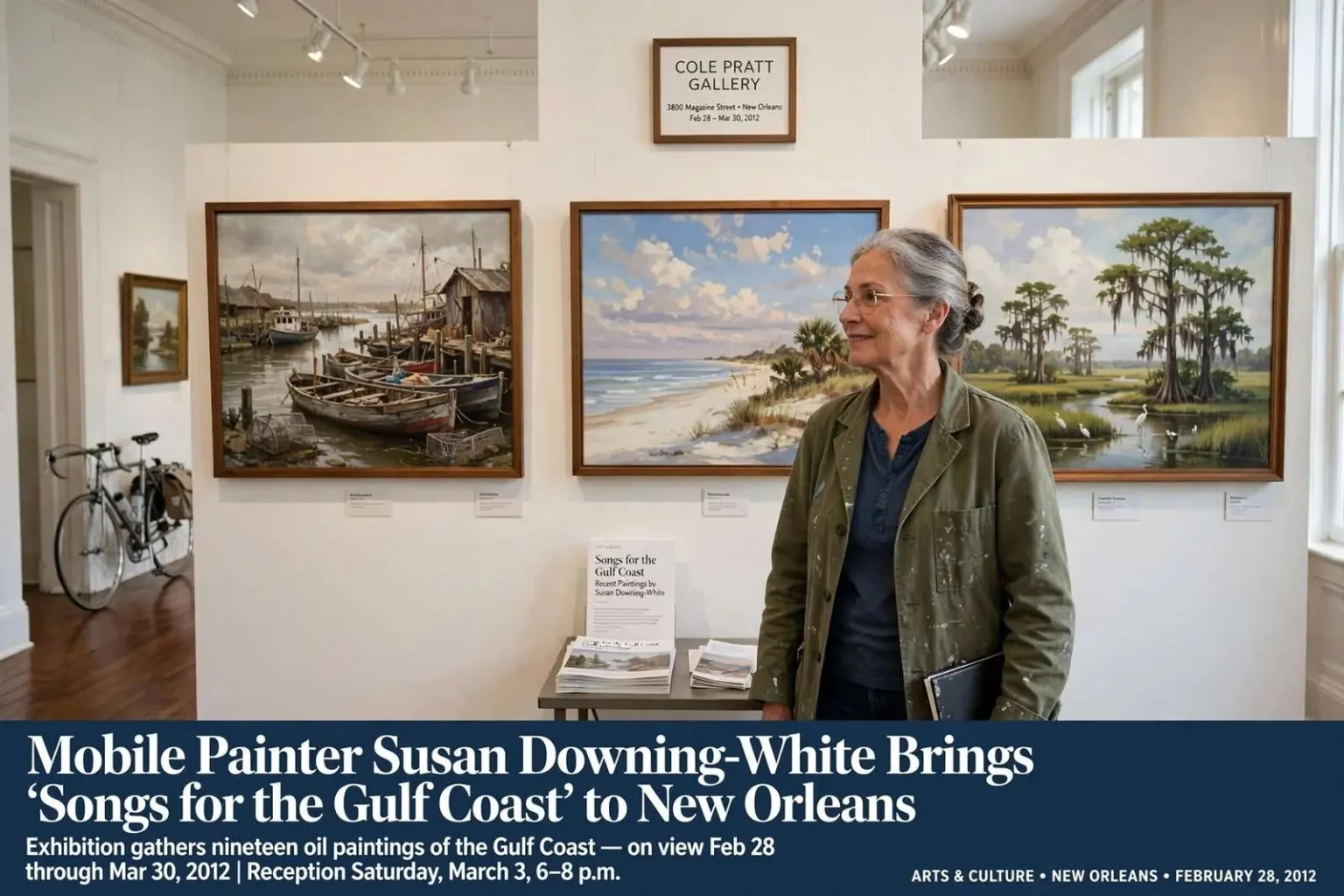
Mobile-based painter Susan Downing-White carried the Gulf Coast landscape to New Orleans with “Songs for the Gulf Coast: Recent Paintings by Susan Downing-White,” a show of nineteen oil paintings at the Cole Pratt Gallery, 3800 Magazine Street, running February 28 through March 30, 2012, with a reception Saturday, March 3, from 6 to 8 p.m. The exhibition gathers two years of work made after the deepest disruption in the region’s modern environmental history, and it reads like a love letter written in oil to the coastline that produced it.
Every canvas in the exhibition was painted after the 2010 oil spill, and the locations trace a route any coastal Alabamian would recognize — from a Bayou LaBatre shipyard to Navarre Beach and back over the Pascagoula Delta. The geography spans the ecosystem the spill touched: the working waterfront of Bayou LaBatre, where shrimp boats and fabrication yards have shared the same narrow bayou for generations; the white-sand strand at Navarre, just across the state line; and the delta marshes of the Pascagoula, one of the wildest river systems on the Gulf.
Views Downing-White enjoyed cycling the west shore of Mobile Bay with the Mobilians on Bikes group also made the cut, a product of a year spent logging miles on two wheels. The bicycle served as both sketching trip and subject: roadside vistas of the bay, the live oaks arching over Scenic Highway-style corridors, the long horizontal light that falls across the water in the late afternoon — views available only to someone moving slowly enough to see them.
A two-decade study of southern skies
In her artist’s statement, the painter described a two-decade practice of tracing her response to southern skies, from Mobile Bay across the Pascagoula delta to Louisiana’s Atchafalaya swamp — places of shore birds, diverse plants and vulnerable wooden structures she hopes to fix on canvas as lasting artifacts. The wording matters: “lasting artifacts” is a painter’s response to impermanence, a record of piers, cabins and bayou structures that hurricanes, termites and tides keep taking away.
The Atchafalaya connection is more than poetic. The great swamp basin of south Louisiana shares with coastal Alabama the same shallow water, the same cypress-and-palmetto palette and the same skies that dominate everything beneath them, and painters who work one landscape inevitably find the other. Downing-White’s route along the northern Gulf places her in a long tradition of regional landscape painting that treats the coast as a single, continuous subject.
The show also reflected personal upheaval. Since Hurricane Katrina in 2005, the oil spill in 2010, and a mild stroke in 2006 that required her to learn to paint left-handed, Downing-White had been watching for changes in her own work. Few artists face that kind of checklist — a devastating hurricane, a neurological setback that reordered the physical act of painting, and an environmental catastrophe unfolding in the waters she paints — and the exhibition is in part a record of how a painter absorbs such blows.
Her classical dark-to-light technique often mirrors her moods, she noted, and a palette that has lightened in recent years struck her as a hopeful sign. The observation is a technical one as well as a personal one: the old-master method she works in builds a picture from deep, dark undertones toward luminous surface layers, and the painter’s emotional state shows up in how far a canvas travels toward the light. A lightening palette, in that system, is optimism made visible.
The technique itself ties her to a lineage most casual viewers would not guess runs through Magazine Street. The dark-to-light method — the layering of transparent glazes over toned underpainting — descends from the studios of Renaissance and Baroque Europe, and it demands patience: each glaze must dry before the next goes on, and a painting develops over weeks rather than sittings. In a landscape of flat southern light and humid air, the method gives her skies their depth and her water its translucence.
Constable, the Dutch masters and the Gulf
Her influences run from English cloud-student John Constable to the great Dutch landscape painters, whose skies dwarfed them much as Gulf Coast skies do her. Constable spent his career painting the skies over rural England from observation, working outdoors and filling sketchbooks with cloud studies annotated by wind and weather; the Gulf Coast, with its towering summer cumulus and fast-moving frontal systems, offers an American stage for the same devotion.
The Dutch comparison is equally precise. Seventeenth-century painters like Ruisdael and van Goyen built whole landscapes around a sky that occupies three-quarters of the canvas, with human structures small and low against the weather. That is the compositional logic of the northern Gulf: a shrimp skiff under an enormous sky, a wooden pier running toward the horizon, a marsh that stretches flat until the clouds take over. Downing-White’s paintings inherit that proportions-of-humility — the region’s wooden structures and shore birds drawn small beneath weather that always wins.
Showing in New Orleans places the work in front of the right audience as well. The Cole Pratt Gallery, on Magazine Street’s long gallery stretch uptown, sits in one of the South’s most active markets for contemporary regional painting, where collectors have long supported landscapes of the Gulf. The two cities’ art scenes are close cousins — a two-hour drive apart, sharing collectors, critics and the same coastal subject matter — and a Mobile painter showing on Magazine Street is a crossing the region’s art world makes often.
The exhibition’s timing carries its own weight. By the winter of 2012, nearly two years after the Deepwater Horizon blowout, the coast was still arguing with itself about what had been lost and what had come back; fisheries were reopening, claims were being processed and beaches were officially clean. Against that backdrop, a show of paintings made entirely in the spill’s aftermath — with no tanker in sight, just water, sky and shoreline — made its own quiet argument about what the coast is and why it is worth recording.
The nineteen canvases function as a survey of that coastline’s ordinary days. A shipyard on Bayou LaBatre at work; a beach at Navarre under its afternoon light; delta marsh and open bay water; the roadside views of the west shore gathered from a bicycle. Together they amount to a painter’s atlas of the northern Gulf — assembled not from helicopter surveys or satellite images but from the slow ground-level attention of someone who spent a year riding the shoreline roads and two decades learning its skies.
Painting as a record of place
For Mobile, the show is also a reminder of the city’s contribution to the region’s visual record. Downing-White belongs to a lineage of Gulf Coast painters who have treated the local landscape as worthy of the same seriousness the Hudson River school gave the Northeast, and her work has helped make the case that Mobile Bay’s light and weather belong in that conversation. The paintings leave Mobile for New Orleans — and return, like most travelers between the two cities, with the argument for the hometown landscape strengthened.
“Songs for the Gulf Coast” ran through March 30, giving New Orleans audiences a month with a body of work that documents, celebrates and quietly mourns the same coastline the two cities share. For the painter, the exhibition closed a chapter that began with a storm, passed through a stroke and a spill, and ended — in a lighter palette — on a note of hope for the place she has spent twenty years learning to see.
The stroke’s aftermath, if the painter is right that it left the work unchanged in spirit, still changed its practice. Painting left-handed after decades of right-handed habits meant rebuilding brush control, relearning the mechanics of a glaze and adjusting the physical rhythm of a day at the easel — a reinvention conducted in the same years the Gulf itself was recovering from Katrina. That she describes watching for changes in her work rather than dwelling on the setback says much about how landscape painters process upheaval: the canvas records the weather, and the weather includes one’s own.
Katrina’s shadow falls across the subject matter too. The “vulnerable wooden structures” her statement names — the piers, camps and bayou buildings of the coast — are exactly the built environment Katrina erased along the Mississippi Sound and the oil spill economy unsettled in Bayou LaBatre. A painting of a weathered pier in 2011 is therefore never just a pier; it is a survivor, and both the artist and her audience know it.
The Mobilians on Bikes rides belong to that same documentary impulse. Cycling the west shore roads — the causeway-side stretches where the bay meets the marsh and the oaks open onto water — put the painter at eye level with the landscape at the speed of its details: ospreys on channel markers, foam lines on the shore, the way a winter front flattens the bay to pewter. Those observations, stored over a year of miles, became compositions; the bicycle, in effect, was her rolling studio.
With the reception on March 3 and a month-long run, the Cole Pratt show gave the Gulf Coast’s recent ordeal something rare: an art exhibition that neither dramatizes the disaster nor ignores it, but simply keeps painting the water, the light and the low wooden world beneath the biggest skies in America.