
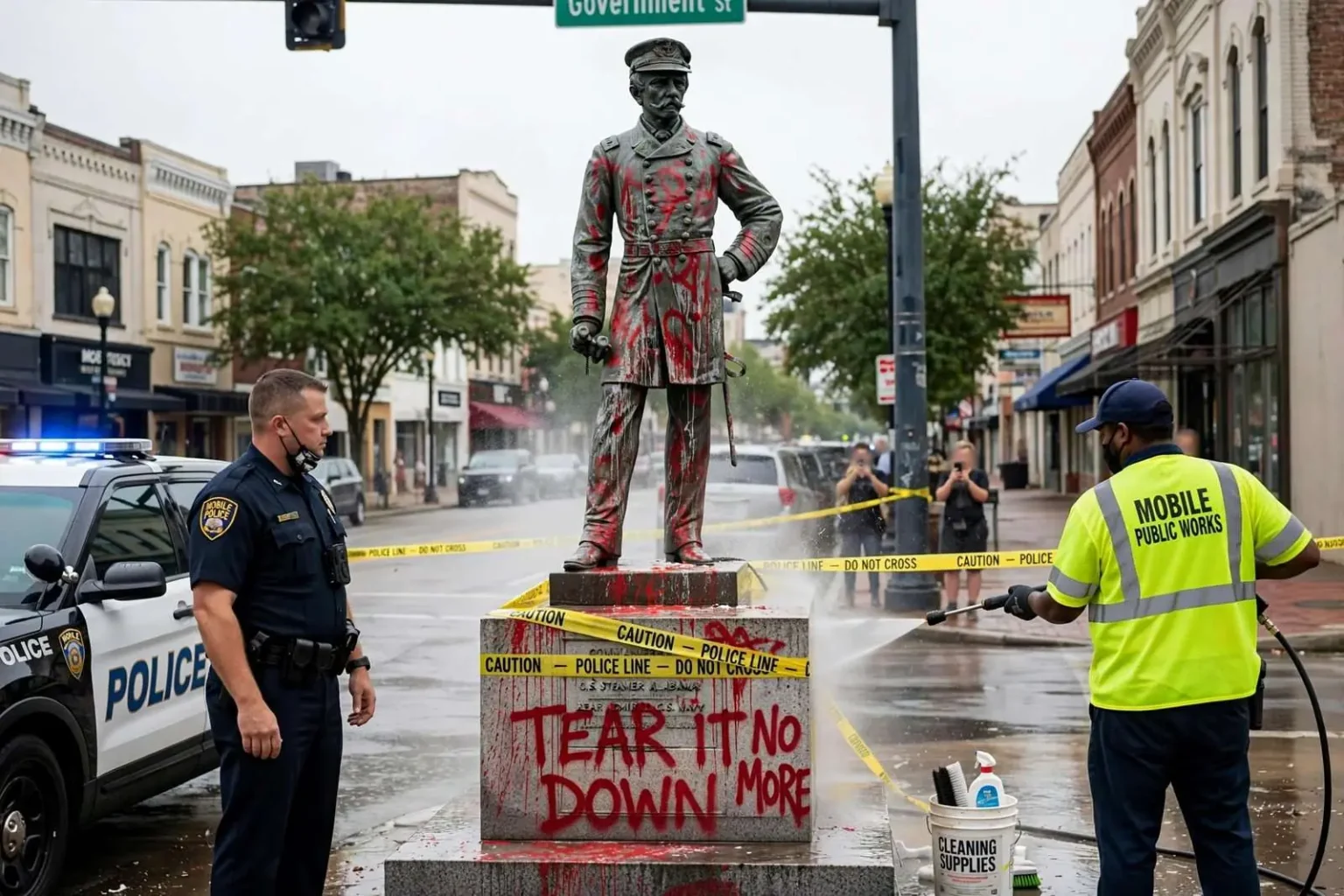
MOBILE, Ala. — Mobile police arrested and charged a 20-year-old man in connection with the overnight spray-painting of the Admiral Raphael Semmes statue in downtown Mobile, capping a day in which city crews worked to scrub the graffiti from the long-controversial monument. The arrest came as cities across the nation confronted protests and, in some places, vandalism aimed at Confederate symbols.
Police said Mitchell Bond faces a misdemeanor charge of defacing a monument. Officers transported him to Metro Jail on the afternoon of June 2, 2020. Asked by reporters whether he had spray-painted the statue, Bond answered yes and remained silent as he was placed into a squad car, according to reports from the scene.
The charge itself carries historical weight in Alabama. The state’s monument protection law, passed years earlier, was designed in part to prevent the removal of long-standing monuments, and defacing a monument has been prosecuted under state and municipal statutes in communities facing similar incidents. The misdemeanor designation means the case would move through the municipal process rather than as a felony matter.
Mobile Police Chief Lawrence Battiste connected the vandalism to weekend protests that had drawn crowds to the city. The chief said he supported the right to protest but drew a line at property destruction and violence — a distinction that defined the department’s posture throughout a week when downtown streets saw both peaceful demonstrations and isolated damage.
The Chief’s Answer
Battiste, who is Black, was asked whether he had any sympathy for a suspect accused of defacing what many consider a monument to slavery and oppression. He responded that his responsibility was to uphold the law for everyone in the city regardless of his personal feelings about the issue.
The answer captured the position police departments nationwide were forced to articulate that week: officers who personally hold varied views on Confederate symbolism nonetheless enforce the law as written. Battiste’s framing — empathy for the grievance, firmness on the conduct — reflected how Mobile’s leadership sought to keep protest and policing from colliding more violently than they did.
Earlier in the day, a two-person crew spent more than an hour power-washing the statue and its surrounding walkway, removing the spray-painted messages that had covered its sides. The cleanup drew its own onlookers, photographing the work as the monument returned to its prior appearance.
The vandalism was first documented by a local reporter who shared images of the defaced monument on social media the morning of June 2. Those images spread quickly, drawing both outrage and approval in comment threads and putting the statue at the center of the city’s day — a role it had played, in one form or another, for years.
Background on the Semmes Monument
The statue honored Raphael Semmes, a Confederate naval admiral whose wartime raider operated out of Mobile. Semmes commanded the CSS Alabama, the commerce raider that became the most successful of its kind during the Civil War, prowling shipping lanes across the globe and capturing dozens of Union merchant vessels before being sunk in battle off the coast of France in 1864. His connection to Mobile made him a local figure of lasting — and contested — significance.
The monument had been the subject of debate for years. Supporters viewed it as a piece of Mobile’s history honoring a sailor of international reputation; critics saw a statue of a Confederate officer, erected in the era of segregation, as a public endorsement of the cause he served. City leaders had fielded petitions, public comments and council debates over the statue’s fate long before the summer of 2020.
The statue stood in a prominent downtown location, where it was among the most visible Confederate monuments in Alabama — a state whose landscape includes more such markers than nearly any other. Across the South, the monuments have been debated on historical, moral and legal grounds, with questions of who erected them, when, and to what purpose at the center of most discussions.
What Came After
The monument was removed from its downtown site months after this incident as part of a settlement with the Alabama attorney general over the state’s monument protection law. The resolution ended a standoff between state statute and city preference: the law allowed the attorney general to sue municipalities that relocate monuments older than a threshold of years, and Mobile’s settlement with the state provided the legal mechanism for the statue’s removal while resolving the threatened litigation.
The removal came amid a broader national reckoning following the death of George Floyd in Minneapolis, which had sparked the weekend protests Battiste referenced. In city after city, monuments became flashpoints — some removed through official processes, some by court order, others toppled by crowds. Mobile’s path ran through negotiation rather than either extreme.
For Mobilians, the sequence — a weekend of protests, an overnight tagging, a morning of power-washing, an afternoon arrest and, months later, a negotiated removal — compressed years of debate into a single season. The statue that had stood over downtown through generations of argument was gone, and the case against the young man who painted it became a footnote to a much larger story about history, memory and the law in the American South.
The incident also left its mark on the city’s ongoing conversation about public memory. Officials and residents alike acknowledged afterward that Mobile’s commemorative landscape — street names, statues, school names — would continue to be examined, with the Semmes monument’s departure serving as the most consequential local example of that reassessment.
The June 2 arrest unfolded against a backdrop of national upheaval. The weekend protests Battiste referenced were part of demonstrations that spread to hundreds of American cities, and Mobile’s experience mirrored the pattern seen across the Gulf South: large, largely peaceful gatherings downtown, alongside isolated acts of vandalism that tested the city’s response.
Police departments everywhere faced the same double directive that week — protect the right to assemble and speak, and prevent the destruction that sometimes shadowed it. Battiste’s public comments laid out Mobile’s version: protest was welcome, property damage would be investigated and charged, and the department would treat both commitments as obligations rather than contradictions.
The arrest itself moved quickly. By the afternoon of June 2, officers had identified a suspect, taken him into custody and booked him at Metro Jail — a timeline that reflected both the statue’s prominence downtown and the department’s desire to show the investigation was progressing while cleanup crews were still washing the walkway.
Monuments and the Law in Alabama
The legal frame surrounding the statue made Mobile’s case unusual. Alabama’s monument protection law had been enacted to shield long-standing monuments from relocation, and it empowered the state attorney general to act against municipalities that moved them. That statute was the reason the statue still stood in June 2020 — and the reason its eventual removal required a settlement rather than a simple council vote.
Communities across Alabama faced variations on the same constraint. Birmingham, for example, had sought to remove a Confederate monument in a public park years earlier and found itself in litigation with the state. The statutes turned monument questions into legal questions, forcing cities to weigh removal against lawsuits, penalties and the political dynamics of a statehouse far more conservative than many city governments.
Mobile’s settlement with the attorney general resolved that tension locally. The agreement allowed the statue to come down while satisfying the state’s legal claims — a negotiated endpoint that avoided a prolonged court fight and gave both sides a resolution they could defend publicly.
For the misdemeanor case against Bond, the wider controversy had little bearing on the charge itself. Defacing a monument is a straightforward offense regardless of the monument’s symbolism, and the case would be adjudicated on its facts: spray paint, a statue, and an admission delivered to reporters at the scene. The city’s larger argument about the monument’s future proceeded on a separate track entirely.
The day’s events — tagging, cleanup, arrest — moved at a pace that made the statue the city’s most-watched story within hours. The images shared that morning had drawn statewide attention by noon, the power-washing gave downtown onlookers a live progress report through the afternoon, and the afternoon arrest put the story on every evening broadcast. For a single monument, it was a remarkable amount of attention compressed into one news cycle.
City officials declined to engage in a debate over the monument’s merits in the immediate aftermath, directing attention instead to the ongoing work: the cleanup, the investigation and the public safety posture downtown. Behind the scenes, though, the summer’s events accelerated conversations that had percolated for years about the statue’s place in the city — conversations that would conclude, months later, in the negotiated removal that resolved the state’s legal challenge.
For the department, the episode became part of Chief Battiste’s record leading through a difficult national moment. His insistence that day — sympathy for grievance, firmness on the law, and equal enforcement regardless of personal views — was quoted widely and set the tone the department maintained through a summer of demonstrations.
The Semmes statue’s departure later that year closed the chapter the June 2 incident had opened, but the questions it raised — about monuments, memory, protest and the laws that govern both — remained part of Mobile’s civic conversation. What June 2 made plain was that the status quo had an expiration date; what the settlement proved was that even a dispute wrapped in state statute could still find a local ending.


