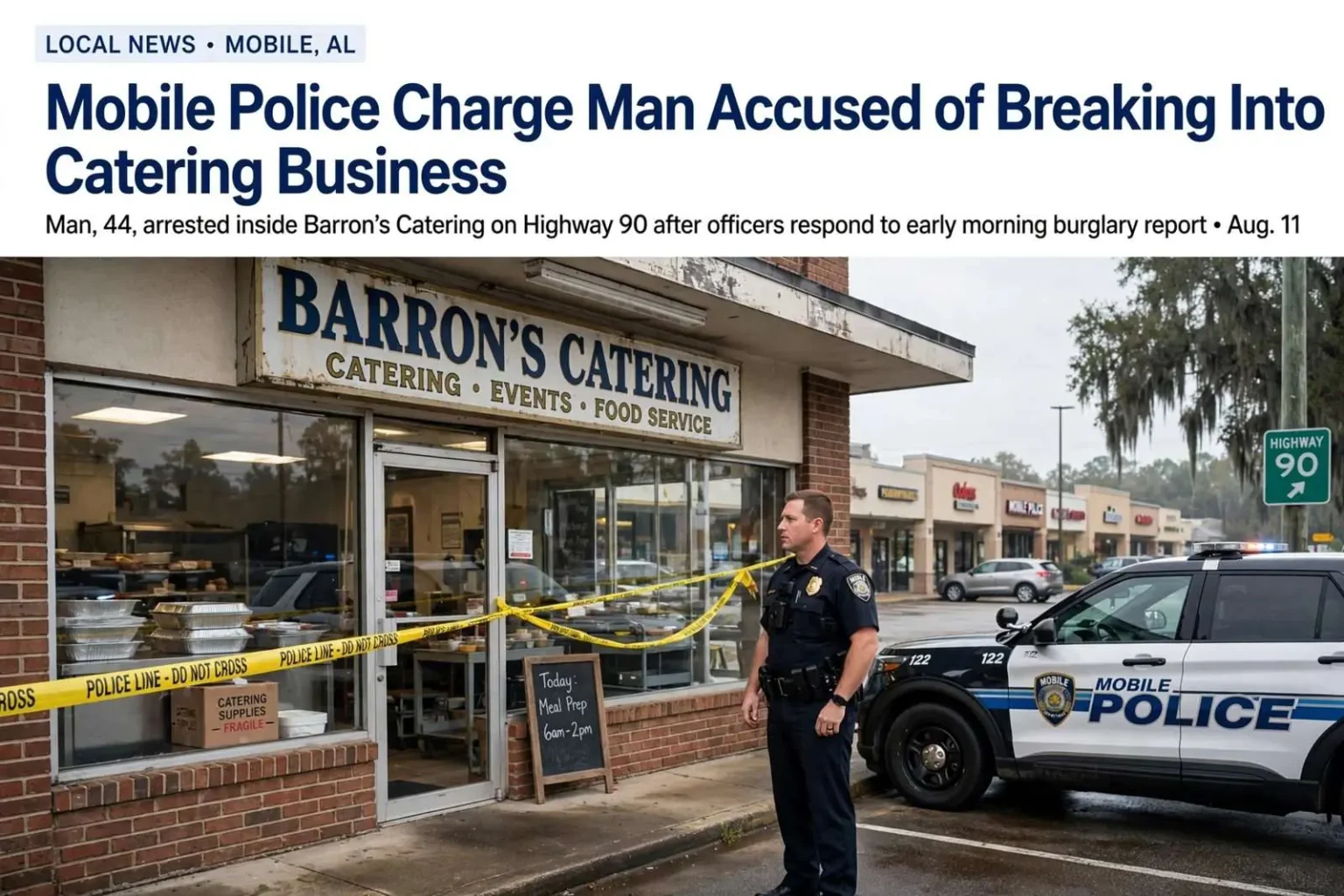
MOBILE, Ala. — Mobile Police Department officers have arrested a man accused of breaking into a catering business on Highway 90. According to an MPD news release, officers were called to Barron’s Catering just before 9 a.m. on Aug. 11 for a report of a burglary. The morning timing meant the call came as the business day was beginning, with staff arriving to prepare for the day’s work when the discovery was made.
When officers arrived, they found a man inside the business who was later identified as 44-year-old Jerome Moiren. Police said Moiren allegedly entered the business through an unlocked door and took an iPhone from one of the offices. The item — a phone belonging to the business or one of its employees — was the reported loss in the incident, and its recovery status was not detailed in the initial release.
Moiren has been charged with third-degree burglary. As with any criminal charge, he is presumed innocent unless and until proven guilty in court.
What third-degree burglary means in Alabama
Under Alabama law, burglary in the third degree is the charge applied when a person knowingly enters or remains unlawfully in a building with the intent to commit a crime inside. It is the least severe of the state’s three burglary classifications, distinguished from first- and second-degree burglary by the absence of factors such as injury to a person, presence of the occupants, or use of explosives. The entry itself — even without forced entry, as police alleged here — completes the offense when coupled with criminal intent, which is why an unlocked door does not shield a break-in from prosecution.
The charge is a felony, and its consequences reach beyond any sentence imposed: a felony record affects employment, firearm rights, and housing long after a case is resolved. Prosecutors evaluate third-degree burglary cases on the strength of the discovery — in this instance, officers finding the man inside the building shortly after the entry — which is among the strongest factual postures a burglary case can have.
The response at Barron’s Catering
Barron’s Catering operates along Highway 90, one of the older commercial corridors running through Mobile. Highway 90 through the city is lined with the kinds of businesses that anchor local food culture — restaurants, caterers, butcher shops, and storefront operations serving neighborhoods on both sides of the corridor. A catering business, in particular, runs on expensive kitchen equipment and early-morning schedules, with staff arriving well before service hours to cook, load vehicles, and stage events.
When staff encountered the situation that prompted the 911 call just before 9 a.m., responding officers had the advantage of speed: the suspect was located inside the business, and the timeline between entry and arrest was measured in minutes. Officers documented the scene, identified the man as Moiren, and made the arrest on the spot. Cases where officers catch a suspect inside the burglarized building typically proceed efficiently, because the elements of the offense — unlawful entry, presence, and the recovered or observed stolen property — are largely established by the time the report is written.
Commercial break-ins and the unlocked door problem
Police departments across the Gulf Coast repeat a seasonal refrain to business owners: lock your doors, including during business hours in areas customers do not use. An unlocked side or back door — common in kitchens and loading areas where staff move in and out constantly — is the most frequent point of entry in commercial burglaries. Opportunistic thefts through unlocked doors tend to be quick, targeted at items that are portable and valuable, and discovered only after the fact when something is missing.
Modern electronics sit near the top of that target list. Phones, tablets, and laptops combine resale value with data — contacts, photos, business records — whose loss can hurt as much as the hardware. Investigators also note the flip side: a stolen iPhone carries location features and serial numbers that make it easier to trace than most stolen goods, and recovery efforts often begin with the owner simply activating the device’s tracking tools and handing the information to officers.
The economics of a single stolen phone are worth noting as well. For the business, the device may hold client contacts, event schedules, and vendor communications, and replacing it means both hardware cost and the hours spent restoring accounts and data. For an offender, a stolen phone converts quickly to cash through resale channels that investigators monitor. Pawn shops and online marketplaces are required to keep records in Alabama, and detectives routinely work those records backward from a theft, matching serial numbers and listings to recent reports. That paper trail, combined with the phone’s built-in location features, is why some of the smallest thefts still end in arrests.
Community reaction to commercial break-ins tends to be practical rather than alarmed — unlike violent crime, these incidents rarely make residents fear for their safety, but they do erode the sense that a corridor is looked after. Business associations along Mobile’s commercial strips have historically responded to patterns of break-ins by sharing camera footage, alerting each other through group messages, and pressing for more patrol visibility during opening hours. That cooperative habit pays off for police, because a corridor of owners who talk to each other is a corridor where an unfamiliar person or vehicle gets noticed and reported.
The Aug. 11 entry through an unlocked door at Barron’s Catering will now be tested against the proof requirements of a courtroom, where the state must establish each element of third-degree burglary beyond a reasonable doubt. Whatever the resolution, the case ends the same way every morning burglary does for the business involved: a day’s schedule disrupted, a lock replaced or reinforced, and a reminder passed among neighboring shopkeepers along Highway 90 to double-check their doors before the coffee is finished brewing.
The arrest also illustrates the ordinary rhythm of property crime response in a city of Mobile’s size. Burglary calls are among the most frequent property crimes the department handles, and the outcomes vary enormously with timing: a suspect found in or near the building is usually charged quickly, while a break-in discovered hours later depends on video, fingerprints, and pawn and resale tracking. The Aug. 11 call landed in the favorable category, and the news release announcing the charge came together accordingly.
What happens after the charge
After an arrest on a felony charge, the case moves into the court system. A defendant is booked, a bond amount is set under the schedules and discretion that govern Alabama courts, and the case is presented for indictment. From there, arraignment, discovery, and motion practice precede either a plea agreement or trial. In burglary cases where the defendant was found inside the premises, plea resolutions are common, though the outcome in any individual case depends on the defendant’s record, the facts, and decisions by both sides.
The presumption of innocence that attaches to Moiren’s charge is not a formality — it is the operating principle of every criminal case, and it is why news reports of arrests describe allegations rather than conclusions. The charge is an accusation, and the courts, not the news release, will determine what the record ultimately says.
Commercial corridors and their policing
Highway 90’s commercial strips in Mobile present the department with a distinctive policing environment: long corridors of small businesses, easy vehicle access, and properties with side entrances and alleys that require attention. Officers assigned to these areas build familiarity with business owners, and that familiarity matters in cases like this one — a shopkeeper who knows the beat officer calls faster, provides better descriptions, and often helps officers identify repeat offenders whose methods match earlier cases.
Business watch programs and commercial security assessments, offered through police community-services units, walk owners through the basics: exterior lighting, camera placement at entries, alarm signage, and cash-handling routines. The bulk of commercial burglary prevention is exactly this kind of unglamorous infrastructure, and the unlocked door police said was used in the Aug. 11 entry is the textbook example of the vulnerability such assessments are designed to close.
The people behind the counter
For the staff of a catering business, a break-in is more than a police report. Catering operations run on tight schedules and trust among a small team, and discovering a stranger inside the building during the morning routine is a jarring start to a workday. Employees who encounter an intruder are advised by safety experts not to confront — to leave, call 911, and let officers handle the situation, exactly as the sequence in this case suggests occurred. Property can be replaced; an injured coworker cannot.
The iPhone taken from the office, meanwhile, represents the small scale that most property crime actually occupies — a single device, taken from a desk, through a door someone forgot to lock. Yet each such incident is treated by the department as a case to be worked and by the courts as a felony to be adjudicated, because the alternative to taking burglary seriously is a corridor where unlocked doors become open invitations. The charge against Jerome Moiren will now be tested in Mobile County’s courts, where the allegations will be examined and the presumption of innocence will govern until the process concludes.