
Mobile Police Investigate Shooting on Delta Street Near Dauphin Island Parkway
Mobile police taped off Delta Street and Windsor Avenue after a Tuesday evening shooting left a man hospitalized with serious injuries.
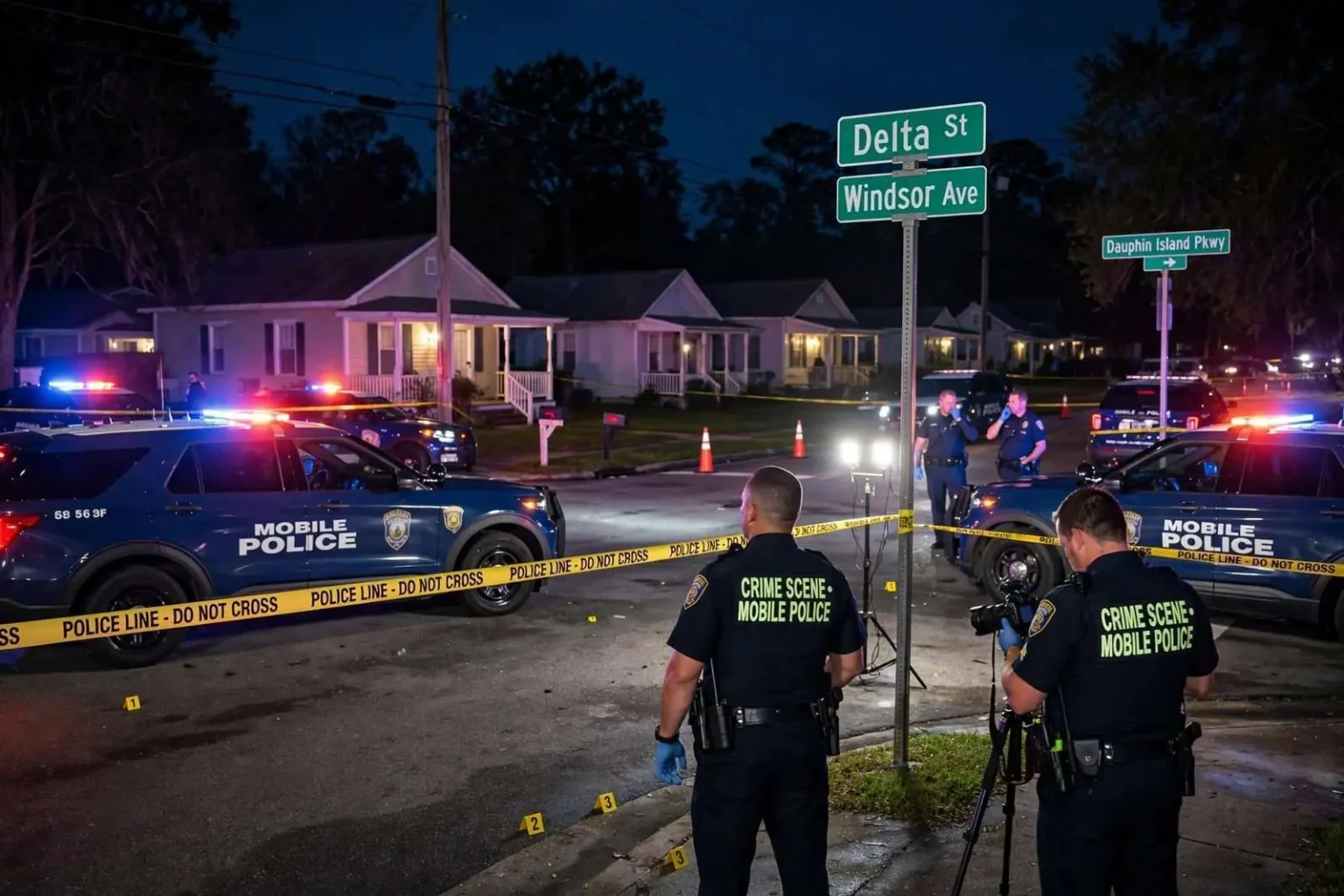
MOBILE, Ala. — Mobile police closed off part of Delta Street and Windsor Avenue Tuesday evening while detectives worked a shooting scene near Dauphin Island Parkway, turning the normally quiet residential intersection into an active crime scene. Officers were dispatched around 7:15 p.m. after a report came in of a person shot in the area, and the response brought patrol units, investigators, and crime scene personnel to the neighborhood as darkness settled over the street.
When units arrived and secured the block, investigators determined that a man had already been taken to a local hospital with serious injuries from a gunshot wound. The victim had been transported before officers reached the scene, either by private vehicle or by emergency medical crews, and his condition was the central fact detectives worked to establish as the evening progressed. Serious injuries from gunfire put the case among the department’s more urgent investigations from the outset.
Police kept the intersection area cordoned off with tape as officers canvassed the neighborhood for witnesses and evidence. The cordon allowed crime scene technicians to process the area under floodlights while patrol officers went door to door in the surrounding blocks, asking residents whether they heard gunfire, saw anyone running from the area, or noticed vehicles leaving quickly around the time of the reported shooting. No suspect information or motive was released at the scene, and the department did not immediately announce any arrests connected to the incident.
How a shooting scene unfolds
The sequence on Delta Street follows the standard playbook for a nighttime shooting in Mobile. A 911 report of shots fired or a person shot triggers an immediate patrol response, and the first officers on scene have two priorities: locating the victim and securing the area. In this case, the victim was already gone, having been taken to a hospital before police arrived, so the first units focused on the second priority, establishing a perimeter around the intersection and keeping onlookers and traffic out of the space where evidence might lie.
Detectives then take over. The canvass that followed — officers walking the neighborhood, interviewing anyone who might have seen or heard something — is the groundwork on which most shooting investigations are built. Residential streets near Dauphin Island Parkway are dense with homes facing the roadway, and evening gunfire in a neighborhood like this one often produces at least a few residents who heard the shots, though witness accounts in the first hours can be fragmentary and sometimes conflicting.
The neighborhood around Delta and Windsor
The scene sits in the grid of residential streets west of Dauphin Island Parkway, one of south Mobile’s principal commercial and commuter corridors. The DIP corridor, as locals know it, runs from the city’s core south toward the communities along the road to Dauphin Island, lined with businesses, schools, and neighborhoods on either side. Streets like Delta and Windsor sit just off the corridor, a mix of modest homes and longtime residents, the kind of blocks where a police cordon draws neighbors onto their porches and word of the incident travels quickly.
Shootings in the area are investigated by the Mobile Police Department alongside the many other violent crime cases the department handles across the city each year. The department’s pattern in such cases is consistent: secure the scene, identify the victim, canvass for witnesses, and release information to the public gradually as the investigation develops and the risk to the case allows.
What police released, and what they didn’t
By the end of the evening, the department had confirmed the essentials: a man shot, seriously injured, already at a hospital, and a scene being processed on Delta Street and Windsor Avenue. What investigators did not release was equally typical of an active case. No suspect description was provided, no motive was stated, and no arrest was announced. Early in a shooting investigation, releasing partial information can compromise the case — taint witness recollections, tip off suspects, or reveal details only the shooter would know — so departments hold back until they have a foundation under what they say publicly.
Authorities said additional details would be provided as the investigation moves forward, the standard commitment in cases like this one. That can mean an arrest announcement days or weeks later, an update on the victim’s condition, or a request for the public’s help identifying a suspect if the canvass and forensic work fail to produce a clear lead. For now, the case remains in the hands of the department’s detectives.
The public’s role in solving neighborhood shootings
Investigations like this one often turn on the canvass and on tips that come in after the news spreads. Residents who were home Tuesday evening and heard gunshots, saw a vehicle or a person leaving the area quickly, or have security camera footage covering the street are the most valuable sources detectives have. Mobile police routinely ask anyone with information about a shooting to come forward, and tips can be delivered directly to investigators or anonymously through the department’s tip lines and the area’s crime-stoppers program, which offers cash rewards for information leading to arrests in violent felony cases.
The reluctance some witnesses feel about coming forward in neighborhood shootings is a persistent challenge for investigators, and departments counter it with anonymity protections and follow-up interviews. In a close-knit residential grid like the streets off Dauphin Island Parkway, even small details — a car parked where it shouldn’t have been, an argument heard earlier in the day — can help detectives assemble a timeline of what happened and why.
Serious injuries and the stakes of the first hours
The victim’s condition — serious injuries from a gunshot wound — made the medical side of the case as important as the investigative side in the first hours. Gunshot victims with serious injuries are stabilized in emergency care, and hospitals notify police of firearm injuries as a matter of protocol, putting investigators at the victim’s bedside as soon as his condition allows. What the victim is able to tell detectives, if he is able to speak with them, often shapes the direction of the investigation in the first day.
If the victim’s injuries were to prove fatal, the case would escalate from a shooting investigation to a homicide investigation, with the department’s homicide unit taking over and the potential charges changing accordingly. That determination waits on the victim’s medical course, and the department’s public statements held open both possibilities in the hours after the shooting.
Waiting for the next update
By late Tuesday night, the tape across Delta Street and Windsor Avenue was the only visible evidence of the evening’s violence, and the neighborhood had returned to its usual quiet. Inside the investigation, the work continues: evidence processed from the scene, witness statements compared, hospital updates received, and the slow assembly of a case file. Mobile police committed to releasing more information as the investigation moves forward, and residents of the area will be watching for the next update on a shooting that left one of their neighbors in the hospital and detectives working their streets after dark.
Anyone with information about the Delta Street shooting is encouraged to contact the Mobile Police Department, where detectives continue to build the case, or to leave an anonymous tip through the department’s established channels.
Crime scene work after dark
Nighttime crime scenes carry particular challenges for investigators. Evidence such as shell casings, clothing fibers, and blood evidence must be located under portable lighting, photographed in place, and collected before weather or passersby can disturb it. The cordon on Delta Street and Windsor Avenue protected that work, giving technicians the time to walk the intersection methodically while patrol units diverted traffic around the block. Streetlights and porch lights, whatever their limitations for the residents, can also aid investigators in placing people and vehicles where they were seen when the shots rang out around 7:15 p.m.
The securing of the block also serves the canvass. With the intersection closed, residents were drawn outside by curiosity and by the presence of police, and officers moving door to door found an audience already talking about what they had heard. That first-hour window is when the most reliable recollections are gathered, before neighbors compare notes and memories begin to blend.
Dauphin Island Parkway and the city’s southern neighborhoods
The corridor near the scene is one of Mobile’s busiest southern arteries, connecting the downtown area to the residential communities and outlying towns that stretch toward the coast. Along and behind the commercial strip, neighborhoods of single-family homes line the grid streets, served by schools and parks within walking distance. When violence touches these blocks, the response is citywide in scale — patrol, investigators, and command staff — but its impact is intensely local, felt first by the families living within sight of the yellow tape.
Mobile, like comparable Southern cities, confronts a steady pattern of gun violence that keeps its police department investigating shootings throughout the year. Each case follows the same discipline seen on Delta Street: secure, canvass, process, and report to the public what can safely be shared. The department’s ability to close such cases depends heavily on that final step, when residents with information decide to share it.
What residents can expect next
In the days ahead, residents of the Delta Street area can expect follow-up from detectives — additional interviews, requests for camera footage, and possibly a public appeal if investigators need help identifying a suspect. Updates on the victim’s condition, when released, will signal whether the case remains a shooting investigation or becomes a homicide case, and any arrest will be announced through the department’s usual channels.
For now, the facts remain as they stood Tuesday night: a man shot and seriously injured near Delta Street and Windsor Avenue, found already on his way to a hospital when officers arrived around 7:15 p.m., with no suspect identified and no arrests announced. The investigation is active, the scene has been processed, and the Mobile Police Department has asked that anyone with information come forward as the effort to answer the neighborhood’s questions continues.


