Mobile Police investigating fatal shooting on Strange Street
Mobile Police are investigating after 41-year-old Michael Gibby was found dead from a gunshot wound on Strange Street Friday night.
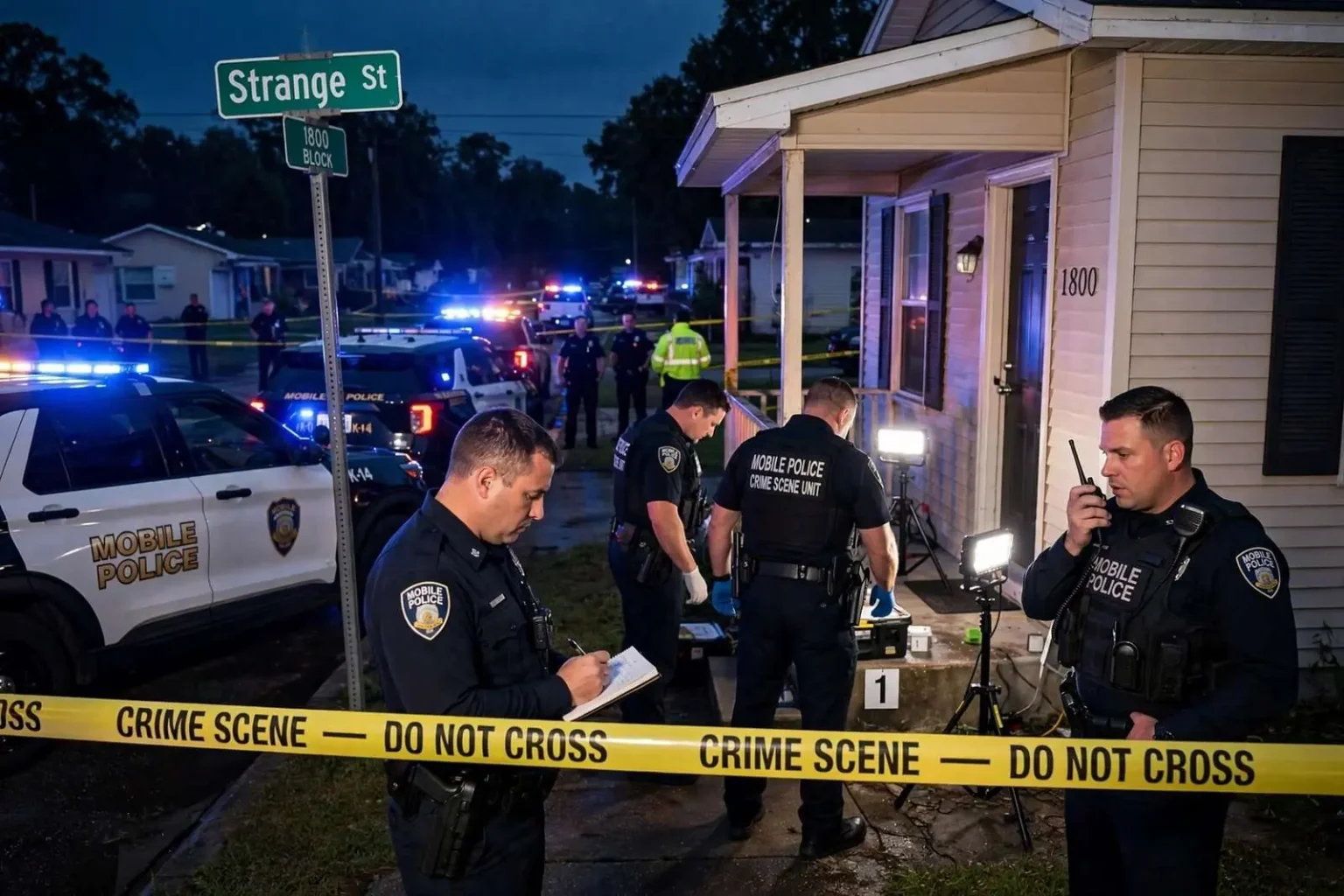
Mobile Police are investigating a fatal shooting on Strange Street. Officers responded to a report of a person down inside a home at 1800 Strange Street around 7:41 p.m. Friday, April 24. Inside, they found 41-year-old Michael Gibby dead. Authorities said the investigation is ongoing and no further information has been released at this time.
The call came in during the evening hours, when dispatchers routed officers to the 1800 block of Strange Street after receiving a report that a person was down inside a residence. Responding officers entered the home and discovered Gibby suffering from what authorities described as a fatal gunshot injury. He was pronounced dead at the scene, and investigators immediately began treating the location as a homicide scene, securing the residence and the surrounding area.
The identity of the victim was confirmed as 41-year-old Michael Gibby. Police released his name after confirming that next of kin had been notified, a step the department follows before publicly identifying homicide victims. No arrests were announced in the hours after the body was discovered, and detectives declined to discuss whether they were searching for a specific individual or whether they believed the shooting was a random act.
Evening Response on Strange Street
Strange Street runs through a working-class section of Mobile where modest homes sit close to the street and neighbors know one another’s routines. The 1800 block, where the shooting occurred, saw a significant police presence late Friday night, with patrol cars lining the roadway and crime scene tape cordoning off the residence. Detectives worked under portable lighting as dusk settled, photographing the interior of the home and marking potential evidence.
Mobile Fire-Rescue medics also staged nearby, but there was nothing for them to do once officers confirmed the man inside was beyond help. That outcome shifted the response from a rescue to an investigation. The Mobile Police Department’s Major Crimes Unit took charge of the scene, with crime scene technicians documenting the interior of the residence and detectives beginning the work of establishing a timeline for the final hours and minutes of Gibby’s life.
Homicide investigations in Mobile typically begin with the victim’s circle of acquaintances. Detectives will attempt to determine who was inside the home when the shooting occurred, who had visited in the days beforehand, and whether anyone heard an argument or other disturbance. Investigators will also canvass the surrounding blocks for surveillance cameras, both on homes and on vehicles parked nearby, since exterior cameras frequently capture comings and goings that prove critical to establishing a sequence of events.
The Investigation Is Ongoing
Authorities said the investigation is ongoing and that no further information has been released at this time. The department has been deliberate in what it discloses during active homicide cases, holding back details — including possible motives, the number of shots fired, and whether any items were recovered from the scene — that could compromise the investigation if made public too early. Detectives have also not said whether they believe Gibby was targeted or whether the shooting arose from an unplanned confrontation.
Residents of the Strange Street area described the block as ordinarily quiet on Friday nights, and several said they were unaware anything had happened until officers began knocking on doors. Detectives spent part of the weekend returning to the neighborhood, asking anyone who was home around the time of the 911 call to come forward with whatever they saw or heard, even if it seemed unimportant at the time.
The Mobile County District Attorney’s Office will ultimately review the evidence once an arrest is made, but that stage remains a long way off. In the meantime, the case will remain open and active, with detectives following leads as they develop. Homicide cases in the city frequently take weeks or months to resolve, and investigators emphasize that the early tips — the ones that arrive in the first days — are often the ones that matter most.
Homicide Response in Mobile
When a death is ruled a homicide in Mobile, the response involves multiple layers of the city’s public safety apparatus. Patrol officers establish the perimeter and protect the scene, crime scene technicians handle the physical evidence, and detectives from the Major Crimes Unit conduct interviews and run down leads. The Mobile County Forensic Sciences laboratory assists with evidence analysis, and the county coroner’s office conducts the autopsy that formally establishes the cause and manner of death.
That process takes time, which is why departments frequently release only skeletal information in the first days after a killing. Investigators must be certain that what they describe publicly cannot help a suspect anticipate what police know or lead witnesses to shape their accounts. In cases where a victim is found inside a residence, the interior evidence can be especially sensitive, because the condition and placement of items inside the home can narrow the pool of possible suspects to people who had a reason to be there.
Family members of homicide victims in Mobile are typically connected with victim services personnel who walk them through what to expect — the autopsy process, the timeline of an investigation, and the way media coverage unfolds. Advocates stress that families should not hesitate to share concerns directly with detectives, since relatives often hold pieces of information that outsiders never would: recent disputes, new acquaintances, changes in routine.
How Residents Can Help
Police departments across the Gulf Coast rely heavily on community cooperation in homicide cases, and Mobile is no exception. Witnesses sometimes hesitate to come forward out of fear of retaliation or reluctance to get involved, which is why the department maintains options for anonymous tips. Tipsters can provide information without giving their names, and investigators stress that anonymity does not diminish the value of a lead.
Detectives working a case like the one on Strange Street will spend their first days on three fronts: the victimology, meaning the study of who Gibby was and what his daily life looked like; the physical evidence from the home; and the witness canvass of the surrounding blocks. Each front feeds the others. A neighbor’s recollection of a vehicle can confirm a timeline suggested by the physical evidence, and a detail about the victim’s recent activities can point investigators toward interviews they had not planned.
As of the most recent update, no arrests had been announced, no suspect had been identified, and no motive had been disclosed. The investigation remains ongoing, and police have indicated that additional information will be released only when detectives determine that doing so will not harm the case. Anyone with information about the death of Michael Gibby is asked to contact the Mobile Police Department or to submit an anonymous tip.
The death marks another homicide investigation for the city, one that began with a single 911 call on a Friday evening reporting a person down inside a home at 1800 Strange Street. For the neighbors on that block, the reminder is a sobering one — that violence can arrive without warning, even in places where it feels far away — and for investigators, the work now turns entirely to answering the questions that remain: what happened inside that home, and who was responsible.
Friday Night in the Neighborhood
Friday evenings on streets like Strange Street usually follow a familiar pattern in Mobile — families finishing dinner, teens drifting toward friends’ houses, televisions and porch conversations carrying through the warm Gulf Coast air. The sound of sirens beginning shortly after 7:41 p.m. broke that pattern, and within minutes the block had transformed. Officers directed arriving units, held neighbors back from the tape line, and began logging everyone who approached, since early bystanders are often among the most useful witnesses.
The timing of the call matters to investigators. A person-down call at 7:41 p.m. means the shooting likely occurred shortly before, when daylight was fading, which limits how much a distant witness could have seen but increases the chance that porch cameras captured usable images. Detectives will map every camera within sight of the 1800 block and request footage covering a window of several hours, not just the minutes around the shooting, to track anyone approaching or leaving the residence.
Inside the home, technicians work slowly and methodically. A fatal shooting inside a residence generates a long list of questions about the scene itself: whether there were signs of forced entry, whether anything appeared disturbed, whether weapons were present and accounted for. Answers to those questions are rarely shared publicly, because they belong to the narrow universe of facts that police hold back precisely because only the person responsible would know them.
The Days That Follow
In the days after a homicide is discovered, detectives in Mobile balance two pressures. The first is the investigative clock: leads are freshest immediately, and witnesses’ memories decay quickly. The second is caution: announcing too much can tip off a suspect, while announcing too little can make a community feel that the case is being ignored. The department’s practice is to hold periodic updates as arrests approach or milestones are reached, and to say little in between.
For residents, the most useful contribution is often the smallest detail. A car that was parked on the block and later left quickly, a knock at the door earlier in the day, an unfamiliar voice heard through an open window — investigators have built cases on less. Detectives typically leave contact cards throughout a neighborhood, and follow-up visits continue for weeks after the initial canvass, since some witnesses come forward only after working up the courage or after realizing they saw something significant.
The death of 41-year-old Michael Gibby remains under active investigation. What began with a report of a person down at 1800 Strange Street around 7:41 p.m. on Friday, April 24, has become a case file that will grow for months — witness statements, camera footage, forensic reports, and autopsy findings — until detectives can answer the question at its center. Until then, police are asking anyone with information to come forward, and the neighborhood is left to wait for answers about what happened inside the home on Strange Street.