
Mobile Police Officer Arrested on Domestic Violence Charge, Placed on Administrative Leave
A Mobile police officer was arrested on a domestic violence charge and placed on administrative leave, the department confirmed.
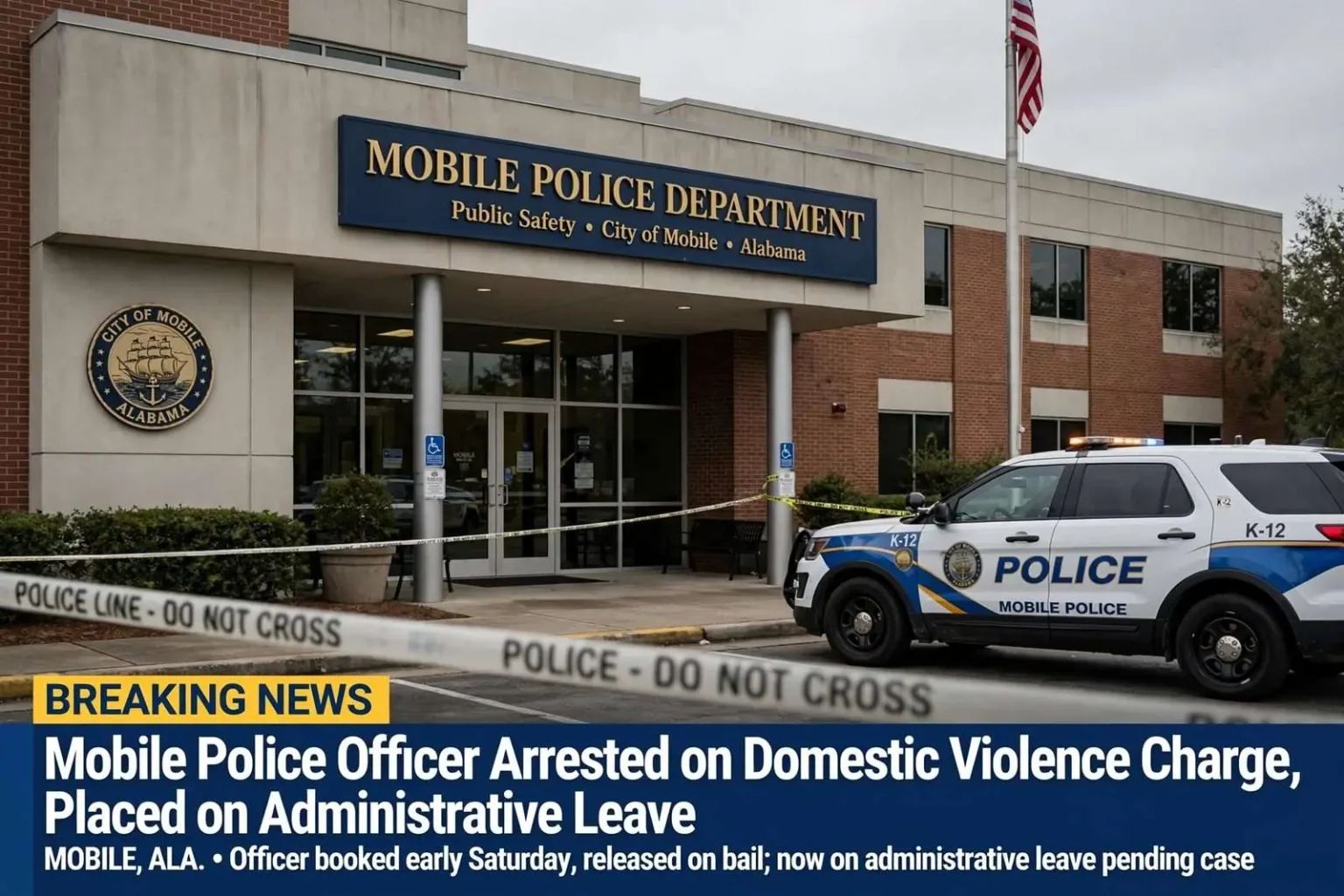
MOBILE, Ala. — A Mobile police officer was arrested over the weekend on a domestic violence charge, according to the Mobile Police Department and jail records, and has been placed on administrative leave pending the outcome of the case.
Jail records show that Jerry Burch, an officer with the Mobile Police Department, was booked into custody early Saturday morning, shortly after 3 a.m. He was released just after midnight Sunday after posting bail, according to the same records. The window between his booking and his release is typical of the processing timeline at the Mobile County Metro Jail, where arrestees are booked, appear before a judicial officer for bond conditions and are freed once bail is posted.
Police officials declined to release additional details about the arrest, saying a formal statement would follow on Monday. The department has not said where the alleged incident occurred, whether anyone else was injured, or what specific degree of domestic violence charge Burch faces. Under Alabama law, domestic violence offenses are graded from first to third degree, with the classification turning on factors such as whether a weapon was involved and whether the alleged victim suffered serious physical injury. The charge remains pending in Mobile County District Court unless and until it is otherwise resolved.
What administrative leave means
Being placed on administrative leave is a standard personnel step, not a disciplinary finding. When an officer is arrested on a criminal charge, departments across Alabama routinely relieve the officer of police powers while the criminal case and any parallel internal affairs review move forward. The officer typically remains employed but is not working patrols, answering calls or carrying a department credential in the field.
The leave also protects the integrity of the prosecution. Keeping the officer off the street reduces the risk that he would respond to domestic-related calls during the pendency of his own case, and it prevents defense counsel from arguing that the department influenced the proceedings. If the case is resolved without a conviction, the department can review the underlying facts through its internal process and decide whether any policy violations occurred independent of the court outcome.
An arrest is not a conviction, and the criminal charge remains pending in court. Like any defendant, Burch is presumed innocent unless the state proves the charge beyond a reasonable doubt. Prosecutors will review the evidence, and the case could proceed to trial, end in a plea agreement, or be dismissed if the evidence does not support it.
The department’s internal review track
Beyond the courtroom, the Mobile Police Department’s internal affairs function will typically track the criminal case and can open its own administrative inquiry. Internal investigations look at a different question than the criminal court does: not whether the officer broke a state law, but whether his conduct violated department policy, including any off-duty conduct standards written into the department’s rules and any applicable provisions of the officer’s labor agreement.
That two-track approach — criminal prosecution on one side, administrative review on the other — mirrors how large municipal departments in Alabama handle arrests of their own officers. Outcomes can range from reinstatement to full duty, to suspension or termination, depending on what the evidence shows and what policies were violated. The department’s formal statement, expected Monday, is likely to confirm the leave status and outline the next procedural steps rather than discuss the facts of the allegation itself.
The department has not identified the alleged victim, and the Mobile County Metro Jail booking record does not by itself establish what happened. Domestic violence case files in Alabama are also frequently sealed in part to protect victims, which limits the information that becomes public at the early stage of a case.
Domestic violence enforcement in Alabama
Alabama treats domestic violence as a distinct category of criminal offense rather than an ordinary assault. The state’s domestic violence statutes were enacted to recognize that violence between household or family members carries risks and dynamics that differ from stranger violence, and they carry sentencing enhancements compared to equivalent assault charges. First-degree domestic violence, the most serious tier, is a felony that can involve a term of imprisonment measured in years, while lower degrees can be charged as misdemeanors depending on the circumstances.
Alabama law also requires arrests in certain domestic violence situations when officers find probable cause, a policy intended to prevent situations from escalating after police leave the scene. Once a charge is filed, courts can impose no-contact orders as a condition of release, and violators face separate penalties. Victim advocacy resources, including the Alabama Coalition Against Domestic Violence and its local member programs, coordinate with law enforcement and courts across Mobile County to provide shelter, counseling and court accompaniment.
For the Mobile Police Department, the case arrives amid ongoing public attention to how area agencies handle allegations against their own personnel. Agencies across the Gulf Coast have increasingly published or confirmed arrest information quickly, in part because jail booking records are public and are widely reported within hours of a booking.
Officer-involved arrests and public accountability
Arrests of officers place municipal departments in an uncomfortable position. The agency must avoid appearing to shield one of its own while also avoiding prejudgment of an employee who has been charged but not convicted. The middle path most departments have settled on is what happened here: confirm the arrest, state the personnel action taken, and decline to comment on the facts while the case is pending in court.
Mobile is the largest municipal law enforcement agency in Alabama south of Birmingham, with several hundred sworn officers responsible for patrol, investigations and specialized units across the city’s neighborhoods. With a force that size, arrests of officers occur periodically, and each one tests the department’s stated commitment to accountability. Civil rights observers and neighborhood associations routinely watch how these cases are handled, both in the criminal courts and in the department’s internal discipline records.
The timing of the booking — shortly after 3 a.m. Saturday — suggests the arrest itself happened overnight, though the department has not said when the alleged incident occurred or where. Overnight and early-morning hours account for a disproportionate share of domestic violence arrests nationwide, and Alabama’s mandatory-arrest framework means officers responding to a qualifying call have limited discretion once probable cause exists.
Bail and release in Mobile County
Release after posting bail, without a detention hearing, indicates the charge was bondable under the county’s schedule. Mobile County uses a bond schedule that assigns standard amounts to common offenses, allowing most misdemeanor defendants to post bail at the jail shortly after booking rather than waiting for a judge. More serious domestic violence charges can carry higher bonds or require a hearing, particularly when allegations involve strangulation, serious injury or weapons.
Conditions of release in domestic cases frequently include no-contact orders covering the alleged victim and, where children are involved, restrictions around schools and residences. Judges can also order GPS monitoring, surrender of firearms and participation in intervention programs as bond conditions. Whether any such conditions apply in this case is not public, but they are standard practice in Mobile County’s domestic violence dockets and would remain in force through the pendency of the case.
A domestic violence conviction in Alabama also carries collateral consequences beyond sentencing. Federal law bars anyone convicted of a misdemeanor crime of domestic violence from possessing firearms, which would effectively end a sworn officer’s career even if the department took no action of its own. That reality shapes how officers charged with these offenses and their counsel approach the court process, and it is a factor the department’s administrative reviewers weigh as well.
What neighbors and residents can expect
For Mobile residents, the visible effects of the case will be minimal in the short term. The officer is off the street, patrol coverage is unchanged from the public’s perspective, and the criminal proceedings will unfold largely out of view unless hearings are attended or filings are requested. The department’s Monday statement is the next concrete update, and court dockets — searchable through the state’s judicial system — will show the case’s progress afterward.
Domestic violence cases in Alabama typically resolve within a few months at the misdemeanor level, though continuances are common and cases involving officer defendants sometimes take longer as both sides handle discovery carefully. Plea agreements frequently involve intervention programs and suspended sentences for first-time defendants, but prosecutors also weigh the public interest carefully when the defendant is a law enforcement officer.
The department has not indicated whether any additional officers were involved or whether the incident occurred on or off duty. Those distinctions matter for the internal review: off-duty misconduct is still subject to department policy, but the circumstances can affect which policies apply and what disciplinary options exist under the department’s rules and any applicable collective bargaining provisions.
The broader picture on the Gulf Coast
Across Mobile County and the broader Gulf Coast, law enforcement agencies have faced sustained scrutiny in recent years over how they handle domestic violence — both as crimes committed by residents and as allegations against their own personnel. County-level domestic violence courts and specialized prosecution units have expanded in Alabama over the past two decades, reflecting research showing that early, consistent intervention reduces repeat violence.
Advocacy organizations in the Mobile area continue to emphasize that the most dangerous window for victims is often the period immediately after an arrest or separation, which is why no-contact conditions and safety planning are central to how these cases are managed from the first court appearance onward. Shelters, hotlines and court advocates operate throughout the region, and Alabama’s coalition network coordinates services across county lines.
For now, the facts remain as the department and jail records present them: an officer arrested early Saturday on a domestic violence charge, booked shortly after 3 a.m., released on bail just after midnight Sunday, and on administrative leave while both the criminal case and any internal review move forward. The formal statement expected Monday should confirm the department’s position; everything beyond that will play out in Mobile County’s courts over the weeks and months ahead.


