
Mobile Police Say Dollar General Employee Helped Stage Robbery at Her Own Store
Mobile police say a Dollar General employee and a teen staged a robbery at the store; a third suspect is still being sought.
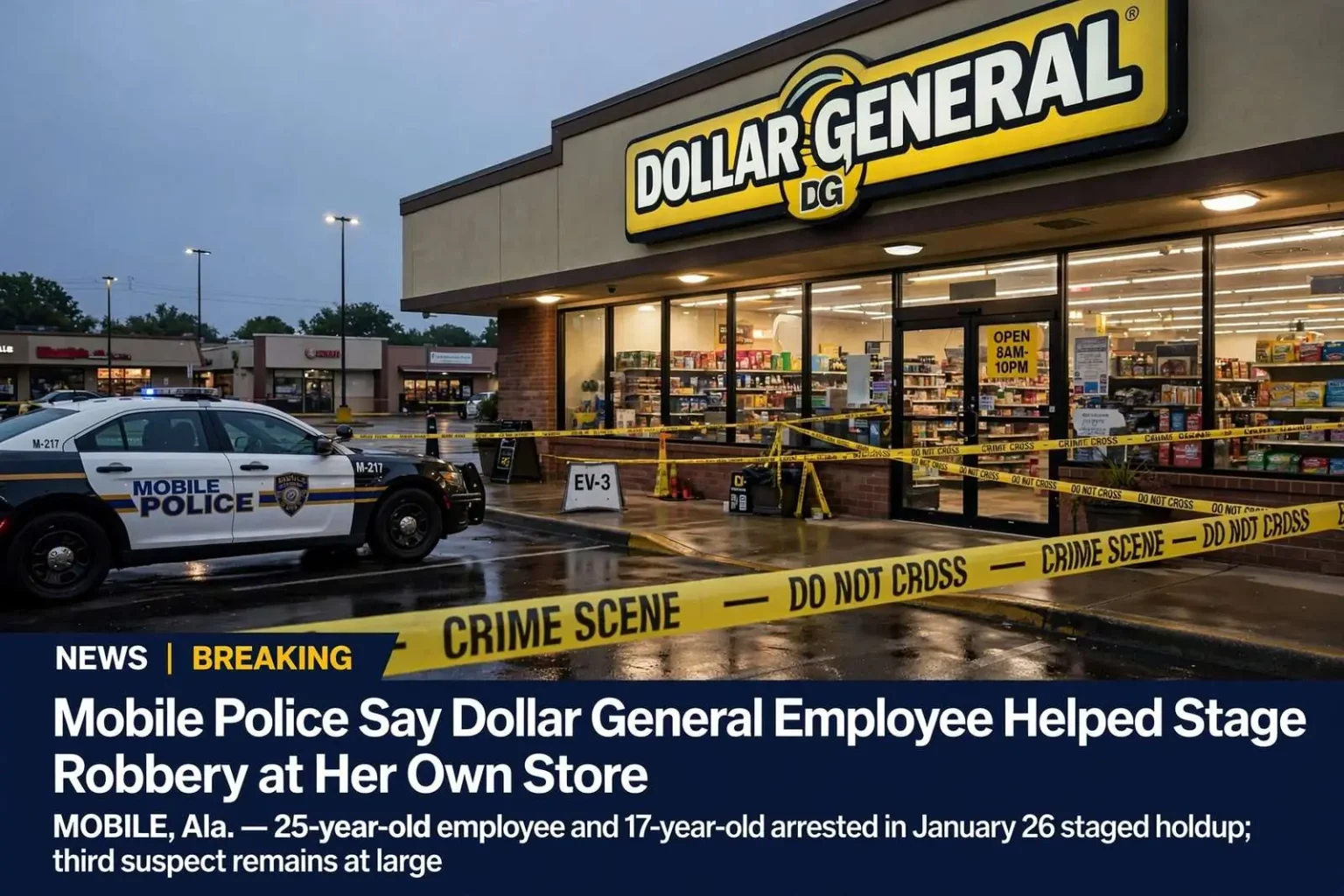
MOBILE, Ala. — Mobile police say a robbery at a Mobile Dollar General last month was staged with help from inside the store. The revelation, which came after weeks of investigation into a January holdup that initially looked like a random armed robbery, transformed the case from a search for armed strangers into an inside job — and led detectives to an arrest they never expected to make when the first call came in.
India Coleman, 25, and a 17-year-old were arrested after investigators determined the pair was behind the January 26 holdup. The arrests closed the book on the robbery itself but opened new questions about how the scheme was put together — and about a third participant police say is still out there.
Officers initially searched for two men in the case before concluding the robbery had been arranged with an employee’s assistance. The initial description sent investigators hunting for suspects who, it turned out, did not match what actually happened inside the store. That kind of pivot is not uncommon in retail robberies: witnesses under stress, combined with a staged scene designed to mislead, can send an investigation down the wrong path before evidence straightens it out.
According to police, two people entered the store, demanded money — one reportedly carrying a gun — and were handed cash by a cashier before leaving the scene. The mechanics of the robbery were ordinary: a demand, a weapon, a register emptied, and a quick exit. What made the case unusual was what investigators found when they dug deeper into who knew what, and when.
Coleman, who worked at the store, was involved in the theft on the other end. Her role as an employee — someone with knowledge of the store’s cash handling, its layout and its routines — gave the robbery its inside edge, police say, and placed her on the opposite side of the counter from the coworkers she worked alongside every day.
The charges and what comes next
Both Coleman and the 17-year-old have been charged with first-degree theft of property. Under Alabama law, first-degree theft of property involves property valued at $2,500 or more, or theft accomplished under aggravating circumstances, and carries prison exposure measured in years rather than months. The charge — rather than robbery — reflects how prosecutors assessed the evidence in the case, including the staged nature of the crime and the fact that an insider facilitated the taking.
Investigators said a third suspect connected to the robbery remains outstanding. Police have not described that person’s role in detail, but the acknowledgment means the case is not closed, and the two arrests made so far may not represent the full circle of people who planned or profited from the holdup.
Inside jobs in retail robbery
Robberies staged with employee help are a persistent problem for retailers like Dollar General, which operates thousands of small-format stores in neighborhoods across Alabama and the Gulf Coast. The discount chain’s stores handle cash in modest but steady volumes, and their staffing — often just a handful of employees on a shift, sometimes alone in the evening — makes them both a target for outside robbers and, in rare cases, a setting for inside schemes.
Detectives have a toolkit for spotting these cases. Inconsistencies in witness accounts, timing that doesn’t match the store’s cash flow, surveillance video that shows familiar behavior during an unfamiliar crime, and knowledge of the store that outsiders shouldn’t have — all of these can tip investigators that an insider was involved. In this case, the path from “two men robbed the store” to “an employee helped stage it” came from exactly that kind of detective work, according to police.
For the store’s employees, the aftermath of an inside-job robbery carries its own weight. Coworkers who handed over cash at gunpoint learn that a colleague helped arrange it — a betrayal that adds anger to the fear. Retailers typically respond to such incidents with a mix of personnel action and security review, examining camera coverage, cash handling procedures and staffing patterns to reduce the risk of a repeat.
How the investigation unfolded
The January 26 date placed the robbery in the middle of a month when Mobile police were investigating a steady string of commercial holdups across the city. Officers responded to the store that evening, took initial statements, and turned the case over to robbery investigators, who began with the assumption that the crime was what it appeared to be: an armed robbery by strangers.
The pivot to an inside job came as investigators compared the account of the robbery against the evidence — what was taken, how the demand was made, what the participants knew about the store’s routines. Staged robberies often unravel on small details: the timing of a register count, the way participants avoided certain cameras, or the fact that no one was hurt in a robbery that seemed designed to look dangerous.
The arrests of Coleman and the 17-year-old came after that reassessment, and both now face the charge in Mobile County’s court system. The juvenile’s case will proceed in the juvenile division unless prosecutors seek to transfer it to adult court, while Coleman’s case will move through the standard felony track — arraignment, preliminary proceedings, and ultimately a trial or plea.
Police have not said whether the outstanding third suspect is believed to have been inside the store during the robbery or involved only in planning or receiving the proceeds. Detectives continue to ask anyone with information about the case to come forward, and the investigation remains active as they work to identify and locate the person still at large.
The case adds to a body of law enforcement experience with staged retail crimes across the Gulf Coast. In these schemes, the inside participant typically provides the knowledge that makes the robbery efficient — when the safe is accessed, how much cash is on hand, which clerk will be working — while the outside participants supply the threat that gets the register opened. The combination lets planners take more money with less resistance than a random robbery would produce, and it explains why investigators treat any robbery with suspiciously good timing as a potential inside job.
Penalties in Alabama give prosecutors room to fit the charge to the conduct. Where a true armed robbery — a dangerous felony carrying lengthy mandatory exposure — is proven, the charge is robbery. But where the evidence shows a staged scheme in which property was taken with the cooperation of someone entitled to be there, theft charges can more accurately reflect what happened, and first-degree theft of property is the state’s most serious theft classification below the robbery statutes. The distinction matters for defendants: the charge still carries felony prison exposure, but it reflects the evidence investigators say they found.
Mobile police have emphasized community assistance in commercial robbery cases generally, and this case shows why: the initial description of two men had investigators canvassing for the wrong people until evidence — surveillance video, cash flow records, interviews — pointed the investigation back inside the store. Tips from the public, including anyone who noticed unusual activity at the store before or after January 26, remain the fastest route to locating the suspect still outstanding.
For Dollar General’s local operations, the incident lands amid broader challenges the chain has faced in the Mobile area, from theft and security concerns at individual stores to the competitive pressures of small-town retail. The company’s stores serve neighborhoods where a dollar store is often the closest option for groceries and household goods, making disruptions like a robbery — and the arrests that follow — felt in the community that depends on them.
The investigation remains open, police said, with detectives working to identify and locate the third suspect connected to the January 26 robbery. Anyone with information is asked to contact Mobile police, and tips can also be submitted anonymously through Crime Stoppers of Metro Alabama, which offers rewards for information leading to arrests in felony cases.
The human dimension of the case — a 25-year-old employee accused of arranging a robbery at her own workplace, a teenager now charged alongside her, and a third suspect still being sought — illustrates how these schemes tend to ensnare people who were already connected to the store or the neighborhood. Detectives note that inside jobs rarely stay contained: whoever helped plan the crime knows others who knew, and the outstanding suspect in this case is likely known to someone in the community.
Retail security experts recommend that stores caught up in such incidents review not just their cameras but their culture — who has access to cash routines, how shift schedules are set, and whether employees feel able to report suspicious talk before it becomes a crime. Anonymous internal reporting channels have become more common among national chains for exactly this reason, giving staff a way to flag concerns without facing coworkers directly.
For now, the case stands with two arrests, one outstanding suspect and a store whose January holdup turned out to be something very different from what it appeared to be on the night it happened. Mobile police say the investigation will continue until everyone connected to the staged robbery is accounted for.


