
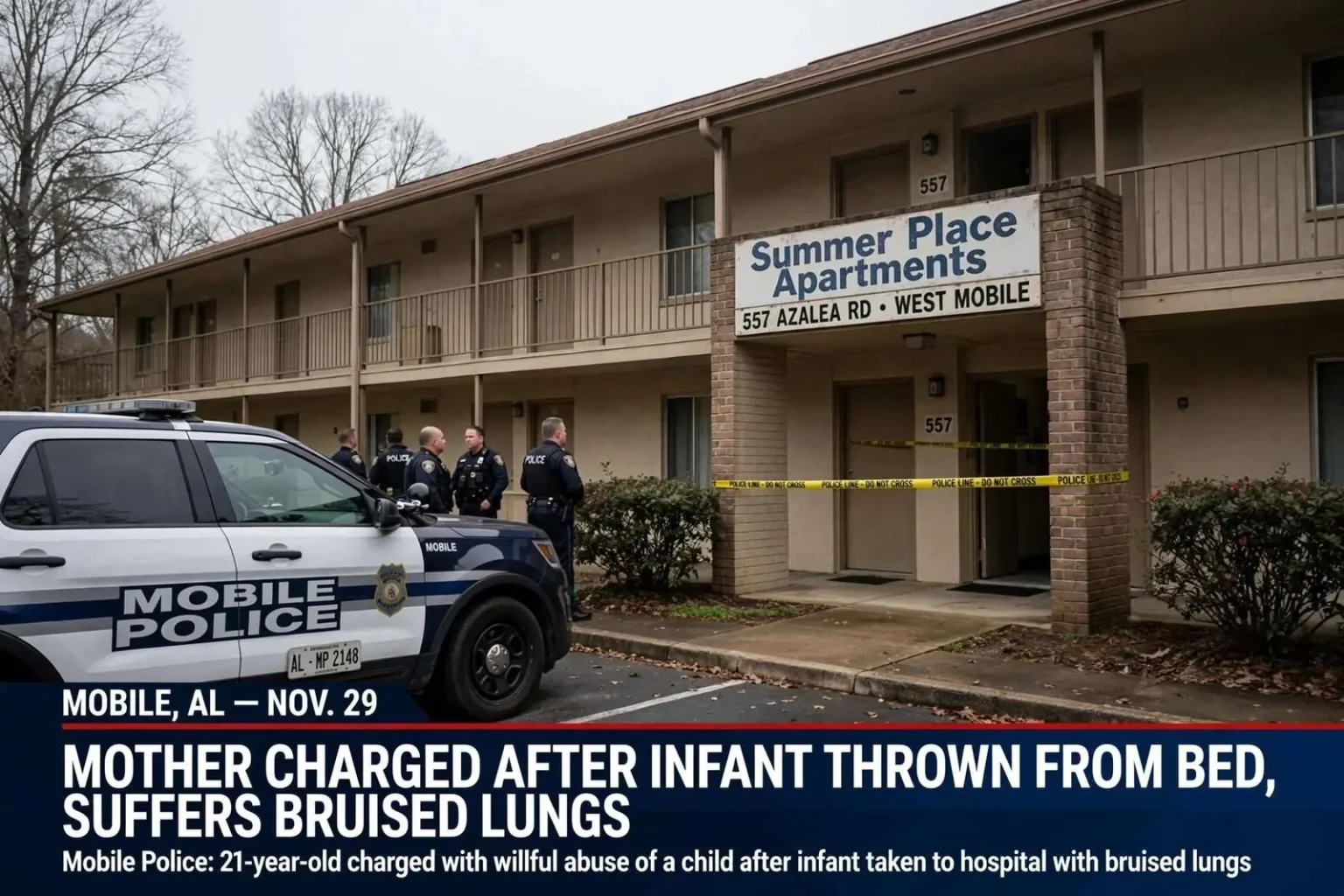
Mobile police have charged a 21-year-old woman with willful abuse of a child after investigators said she threw her infant son to the floor because she wanted him to stop screaming. The case, worked up by Mobile Police Department investigators in the days after the report, centers on one of the most serious categories of offense the department handles — violence against a child too young to speak for himself.
According to the Mobile Police Department, officers were sent to Summer Place Apartments in the 557 block of Azalea Road around 10:30 a.m. on Sunday, Nov. 29, after a report of an injured infant. The apartment complex sits in the Azalea Road corridor in west Mobile, an area of older apartment communities where MPD responds to a steady volume of calls. The report that brought officers there that Sunday morning began a chain that moved quickly from a single apartment to a police investigation and criminal charge.
In an interview with investigators, police said the mother admitted she threw the infant from a bed to the floor near a closet — a distance of about 11½ feet — in an effort to get him to stop crying. The admission, delivered in an interview with detectives, gave investigators the central fact of the case: an infant, a fall of more than eleven feet onto a floor, and a motive that reduced a baby’s crying to a problem to be solved by force.
She then called family members about what happened, and those relatives contacted police. That sequence matters. The family members who received the call did not absorb the information and move on; they called law enforcement, and their report is what put officers at the apartment and the infant in front of medical providers. In child abuse cases, intervention by relatives is often the difference between an injury discovered in time and one discovered too late.
What Investigators Said Happened
The infant was taken to a hospital, where he was treated for bruised lungs, according to MPD. Bruising to the lungs indicates significant blunt force to a small chest — injuries that in an infant carry real danger even before any longer-term damage is assessed. Police said additional testing was pending to determine the full extent of his injuries, and the pending results would determine both the medical prognosis and whether the legal picture expanded beyond the initial charge.
The charge, willful abuse of a child, is a felony under Alabama law covering the intentional abuse or mistreatment of a child under 18. Prosecutors treat infant cases with particular gravity, and the facts investigators described — a confession, a documented mechanism of injury, and hospital records — form the foundation a case of this kind is built on as it moves through the court system.
Police said additional testing was pending to determine the full extent of his injuries. Infants cannot describe symptoms, so the medical workup in these cases is thorough — imaging, observation, and specialist evaluations designed to find injuries a baby cannot report. Each finding can change both the treatment plan and the charging decision, which is why police note the testing status publicly while the medical work continues.
The case remains under investigation. Authorities have not released the name of the child or details about his current condition. The department likewise has not identified the mother beyond her age and charge, consistent with how MPD handles cases involving juvenile victims, and any further details will come through the court process rather than the initial police release.
Medical professionals who work with infant injuries describe a hard reality: a fall from adult height onto a hard floor is a mechanism that can break bones and damage internal organs in a body that weighs only a few pounds. An eleven-and-a-half-foot drop exceeds anything an infant experiences in ordinary life, even a fall from a changing table or a caregiver’s arms. Hospital teams in Mobile who treat these cases run evaluations designed to detect the full range of what such a mechanism can do — head injuries, fractures, internal bleeding — because what is visible on the surface is only part of the picture in a patient this small.
The Psychology of a crisis moment is something child abuse prevention workers return to often. Crying is an infant’s only communication, and it comes in waves that can push an exhausted, isolated caregiver past their limit. Prevention programs across Alabama teach the same message: it is safe to put a crying baby down in a crib and step away for a few minutes. Nothing that can happen from crying in a safe crib compares to what can happen in a caregiver’s arms at the wrong moment. The case on Azalea Road is the kind of outcome those programs exist to prevent.
The relatives who called police also demonstrated what officials describe as everyone’s responsibility under Alabama’s mandatory reporting framework. Certain professionals — teachers, medical providers, childcare workers — are legally required to report suspected child abuse, but any person can make a report, and family members who suspect abuse are often the only ones positioned to do it. A report to law enforcement triggers the response system: police, hospital evaluation, and the county department of human resources, which becomes involved in every case where a child’s safety at home is in question.
What happens after the charge
A willful abuse charge in an infant case moves through two systems at once. The criminal case proceeds on the evidence investigators gathered — the interview, the medical findings, the scene — while a separate dependency process through the courts determines where the child lives and what contact, if any, the accused caregiver may have pending the outcome. Those parallel tracks exist because the immediate question in every infant abuse case is the child’s safety going forward, independent of what the criminal case ultimately proves.
The hospital’s pending testing will matter in both systems. If imaging and specialist evaluations find injuries beyond the bruised lungs initially treated — fractures in various stages of healing, head trauma, internal injuries — both the medical treatment and the criminal exposure expand accordingly. If the workup finds the lung bruising is the extent of the damage, the case proceeds on those facts. Either way, the months of medical follow-up that infant head and chest injuries require continue regardless of the court calendar.
MPD’s child abuse investigators handle cases like this one with the special procedures that infant cases require — interviews conducted to be usable in court, medical evidence coordinated with hospital staff, and coordination with prosecutors who specialize in crimes against children. The department’s public accounting of this case, released through its standard channels, reflected those procedures: the charge, the admission, the mechanism, and the pending medical picture, with everything else left to the process.
For the neighbors and family members touched by the case, the outcome now rests with hospitals and courts. The infant’s recovery is measured first in medical findings over the coming weeks, then in the longer follow-up that determines whether a baby who survived an eleven-and-a-half-foot fall heals without lasting effects. The adults in his family — the relatives who made the call — ensured that he reached a hospital in time for those questions to be asked, which is more than many cases of this kind can say.
Children’s advocacy resources in the Mobile area operate on the front line of cases like this. The Gulf Coast regional child advocacy center system, the state DHR office, and hospital-based child protection teams coordinate on every serious infant injury case, conducting forensic interviews when children are old enough to speak, supporting medical evaluations, and connecting caregivers who are not the abuser with resources. The system exists because child abuse cases fail most often at the seams — when police, doctors, and social workers each hold part of the picture and no one assembles the whole.
The 10:30 a.m. timing of the call that Sunday put the response in daylight hours, with resources fully available — patrol officers, detectives on call, and hospital teams fully staffed. Timing matters in these cases; an injury discovered at night can face slower mobilization, and the difference can matter when an infant’s condition is deteriorating. The relatives who called did so as soon as they learned, and the system that answered was at full strength.
Summer Place Apartments and the surrounding Azalea Road corridor have seen steady residential use for decades, and MPD’s west precinct covers the area’s calls. For the officers who responded that Sunday morning, the run began as a report of an injured infant — one of the calls that patrol officers handle knowing the investigation will likely pass to specialized detectives and that the decisions made in the first hour will shape everything after.
The charge the mother now faces carries significant potential punishment under Alabama law, and prosecutors will weigh the full medical picture in deciding how to proceed. What the public record establishes so far — an admission, an eleven-and-a-half-foot throw, bruised lungs, and pending testing — describes a case that moved from a family phone call to a felony charge in a matter of days, and a baby whose survival now depends on hospital care, thorough testing, and the family members who made sure he got both.
Anyone who suspects a child is being abused in Mobile can report it to the Mobile Police Department, to the state’s child abuse hotline, or — in an emergency — to 911. The system that responded on Azalea Road that Sunday morning exists for exactly those calls, and the relatives who used it demonstrated the simple act that separates infants who are rescued from infants who are not.


