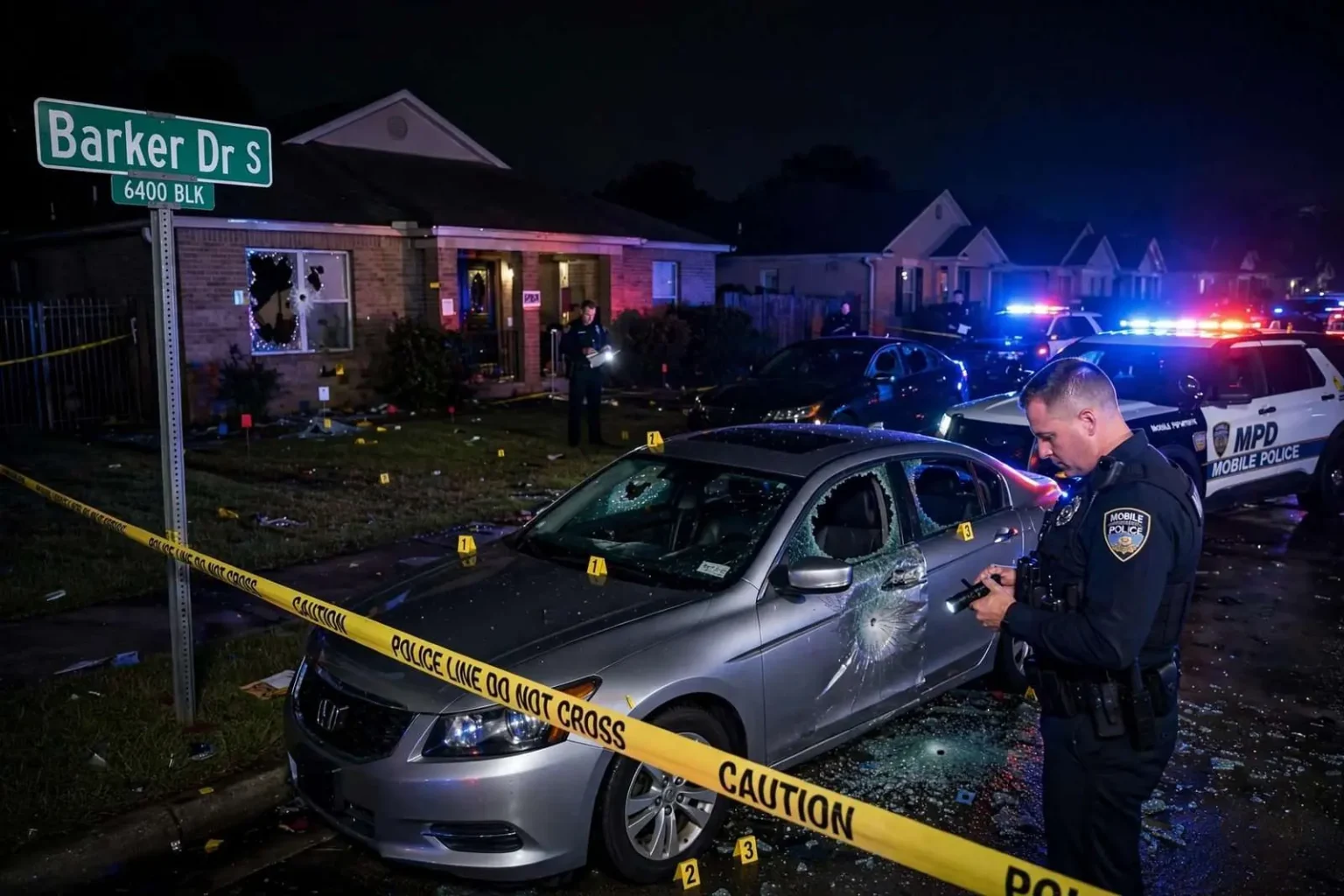
The Mobile Police Department is searching for a suspect believed to have fired shots that struck an occupied house and an unoccupied car late Monday night in west Mobile, and no one was reported injured in the incident. According to an MPD news release, officers responded to a report of shots fired in the 6400 block of Barker Drive South around 10:40 p.m. Monday, Aug. 10.
When they arrived, officers found a house that had been hit by gunfire; people were inside at the time, but no one was injured. Officers also discovered a nearby car had been struck by gunfire, though no one was inside it. No suspect remained in the area when officers arrived, and the investigation was continuing as of Tuesday morning.
Anyone with information is asked to contact MPD at 251-208-7211.
What Investigators Face in Shots-Fired Cases
Incidents like the one on Barker Drive South present investigators with a familiar and difficult set of challenges. When shots are fired at night at a residence and the shooter has left the scene, the first responding officers secure the location, check whether anyone inside was hurt, and begin documenting where rounds struck the house and the vehicle. Each impact point is photographed and logged, because the geometry of bullet holes and spent casings can indicate the direction and approximate position from which the shots were fired.
Detectives then work through the neighborhood. Shots fired in a residential block are rarely silent events — neighbors hear the cracks, see vehicles leaving quickly, or notice someone on foot moving through yards — and door-to-door canvassing in the days after the incident is often where the first useful leads come from. Investigators also collect shell casings, which can be checked against databases that link firearms to other shooting scenes, potentially connecting one incident to a pattern of violence that individual victims never see.
The fact that a house was occupied when it was struck raises the stakes of the case considerably. Rounds fired into an occupied home are among the most dangerous forms of gun violence, because families sleeping inside have no ability to anticipate or avoid them. A bullet that passes through a wall does not distinguish between an empty room and a child’s bedroom, which is why police departments treat these cases as priorities even when no one is hurt.
How Residents Can Help
In cases with no injured parties and no suspect in custody, the public is often the decisive factor. The department’s request for information — directing tips to 251-208-7211 — is the standard channel through which witnesses can pass along what they saw or heard, including descriptions of vehicles, the direction anyone fled, or the timing of events in the minutes around 10:40 p.m. Even details that seem minor to a witness, such as a car that was parked somewhere unusual or headlights that swept through the block just before the shots, can give investigators the anchor points they lack.
Residents in the area may also have captured evidence without realizing it. Home security cameras and doorbell cameras have become widespread across Mobile’s neighborhoods, and footage that covers a street or driveway during the window of a shooting frequently shows the vehicle or person police are seeking. People who believe their cameras might have recorded something relevant are encouraged to review the footage and contact investigators rather than assuming what they have is unimportant.
Police also note that people can provide information without becoming involved in the case beyond their initial contact. What matters is accuracy — times, descriptions, directions of travel — and promptness, since memories fade quickly and physical evidence degrades. A tip given the same week is worth far more than the same tip given a month later.
The Broader Context in Mobile
Shots fired into occupied homes are a recurring feature of the gun violence Mobile police confront, and the department’s response reflects lessons drawn from years of working such cases. The city’s neighborhoods have cycled through periods of elevated shootings in recent years, and MPD has responded with a mix of strategies: concentrated patrols in areas with repeated incidents, closer work with prosecutors on the small number of individuals who drive much of the violence, and community outreach aimed at persuading witnesses to come forward.
The geography of the Barker Drive South incident places it in one of the large residential stretches of west Mobile, where neighborhoods of single-family homes sit along and behind the city’s main commercial corridors. Violence in these areas tends to be episodic rather than constant, which makes each incident especially unsettling for residents who chose the neighborhoods partly for their quiet. A house struck by gunfire in the night changes how families in the block sleep, at least for a while.
That is one reason departments emphasize communication after incidents like this one. When residents see officers canvassing, see the scene being processed thoroughly, and receive updates as the investigation develops, they are more likely to share what they know. When an investigation goes quiet, the information flow tends to dry up exactly when the case needs it most.
What Happens as the Case Proceeds
If investigators develop a suspect, the case moves through the standard sequence: identification, warrants, and arrest, followed by presentation to the district attorney’s office for charging decisions. Firing into an occupied dwelling carries serious potential charges under Alabama law, reflecting the state legislature’s treatment of shootings that endanger people inside homes, and a suspect convicted in such a case faces substantial prison time even when no one is struck.
Until then, the case remains open and active, with detectives continuing to follow up on any information received through the department’s tip line. The house and car on Barker Drive South remain physical evidence in an unsolved case, and the people who were inside the home when the rounds came through are, in the eyes of the investigation, survivors of an attack that could easily have ended differently.
For neighbors, the practical guidance is straightforward: stay alert for anything that might help investigators, review any camera footage that might cover the block during the relevant window, and call 251-208-7211 with anything of interest. The suspect police are seeking was not in the area when officers arrived, which means the community’s collective memory of that night is, for now, the department’s best lead.
A Reminder About Reporting
The incident also illustrates how shots-fired cases enter the public record. The initial police release — a few sentences covering the location, the time, the fact that a house and car were struck and that no one was hurt — is the foundation for the public account of the event, and details beyond it come only as investigators confirm them. Rumors that circulate through neighborhood conversations in the days after such an incident often outpace the confirmed facts, which is why police ask that people rely on official updates and report what they personally witnessed rather than what they have heard secondhand.
The Mobile Police Department’s investigation into the Barker Drive South shooting was ongoing as of the latest update, and anyone with information about the incident is urged to contact the department at 251-208-7211. The people inside the home were fortunate; the department’s job now is to find whoever fired the shots that tested that fortune.
Inside the First Hours of the Investigation
The response to a shots-fired call follows a well-rehearsed sequence, and the details MPD released reflect each stage of it. Dispatch sends officers to the block after a resident reports the gunfire; arriving officers establish whether anyone is wounded — the first and most urgent question; then they sweep the immediate area for a suspect, a step that ended quickly here because no suspect remained in the area. Only after those priorities do the slower tasks begin: photographing the scene, marking where bullets struck the house and car, and searching yards, ditches and nearby parking areas for casings or anything else the shooter left behind.
The timing matters to investigators as well. A shooting shortly before 11 p.m. on a Monday falls in the window when most residents are home, which increases the pool of potential witnesses — people watching television with windows open, letting dogs out, or arriving home from late shifts. It also means the neighborhood was awake enough to notice vehicles: whether the shots came from a car moving down the street or from someone standing in the block is among the first questions a canvass tries to answer, and it shapes everything that follows.
Detectives will also look backward, checking whether the house or the car had any prior connection to police calls, and whether similar shootings have occurred recently in the area. Most shots-fired incidents are not random, and understanding the target — the residence, the vehicle, or someone associated with either — is often the fastest route to identifying who fired. At the same time, investigators keep the alternative open: stray fire from an altercation elsewhere, or a dispute the victims did not see coming.
What Neighbors Should Watch For
In the days after an incident like this, residents can help most by paying attention to their own block. Unfamiliar vehicles parked for long stretches, people knocking on doors under pretexts, or anyone showing unusual interest in the struck house are worth noting and reporting. Investigators also care about what people saw before the shooting, not only during it — arguments in the street earlier in the evening, a vehicle that circled the block, or visitors to the house who might be relevant to the inquiry.
Parents in the neighborhood may want to talk with children who were awake at the time, since young people often see and hear more than adults realize but hesitate to volunteer it. Schools and community groups in the area can help by making clear that passing along information is both safe and valued. The department’s tip line reaches investigators directly, and information can be given without a witness needing to expose themselves to involvement beyond that call.
The people inside the Barker Drive South house, meanwhile, are dealing with the aftermath in practical terms: a damaged home, broken windows or punctured walls, and the knowledge that the gunfire was close enough to reach them. Community and charitable resources in Mobile do assist families after shooting incidents, and neighbors often provide the most immediate help — a place to stay if damage is severe, help with repairs, or simply company in the days when the block feels different.
The Road Ahead for the Case
The investigation into the Barker Drive South shooting was continuing as of Tuesday morning, and the department has asked anyone with information to come forward at 251-208-7211. Cases of this kind close in one of two ways: a witness or piece of footage produces a lead that investigators can run down, or the case goes quiet and joins the backlog that cities like Mobile carry forward. Which way it goes depends heavily on what the neighborhood around the 6400 block of Barker Drive South does next.
The facts already established are enough to define the stakes. An occupied house was hit, a car was hit, a shooter left the scene, and no one has been arrested. The distance between those facts and an arrest is measured in tips, footage and testimony — the raw material that only the community can supply.