Mobile Protesters Rally at Federal Courthouse on Independence Day Over Roe v. Wade Reversal
Mobile residents held a Rally for Our Rights at the federal courthouse on Independence Day to protest the Supreme Court's overturning of Roe v. Wade.
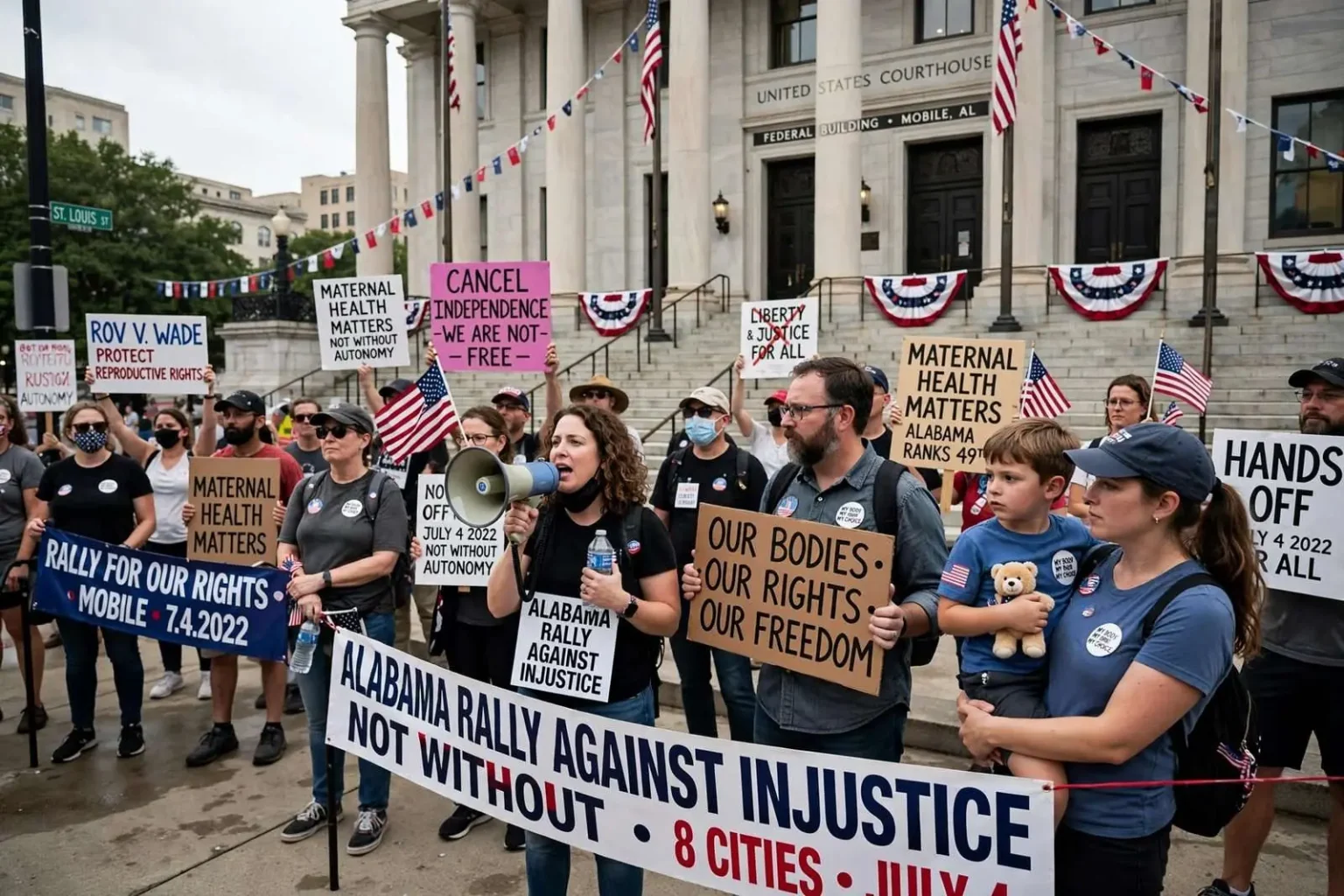
MOBILE, Ala. — As many across the Gulf Coast marked Independence Day with cookouts and fireworks, a group of Mobile residents used the holiday to protest the Supreme Court’s recent decision to overturn Roe v. Wade, gathering at the federal courthouse in downtown Mobile to make their opposition visible on a day built around national identity. The gathering was one of eight “Rally for Our Rights” events held across Alabama on July 4 under the banner of the Alabama Rally Against Injustice, a coordinated effort that tied the holiday itself to the organizers’ argument.
The timing was deliberate. July 4 celebrates a declaration that all people are endowed with unalienable rights, and the organizers chose that anniversary to argue that a newly struck-down federal abortion right represented a retreat from that promise. In Mobile, demonstrators assembled on the plaza and sidewalk outside the federal courthouse, a building that houses the region’s federal courts and has long served as the conventional stage for demonstrations aimed at the justice system and the federal government.
“We’re here to cancel Independence Day because women in America today, with recent decisions of Roe v. Wade, we are not free,” said Kalla Etheredge, one of the organizers. Her framing — rejecting the holiday’s celebration in favor of a vigil-like protest — captured the tone of the crowd, which included signs, chants and speakers who linked the ruling to broader questions of equality and personal liberty.
The legal landscape behind the rally
Alabama’s new abortion law took effect June 24, the same day the high court struck down the federal right to abortion recognized in Roe v. Wade for nearly half a century. That synchronization was not accidental: the state had enacted one of the nation’s most restrictive abortion statutes years earlier, but it had been blocked from enforcement while litigation worked its way through the courts. The Supreme Court’s decision in the Mississippi case that came before it removed the federal constitutional floor, and Alabama’s law moved immediately from dormant to operative.
For abortion opponents in Alabama, the effective date marked the culmination of a long legislative campaign. For opponents of the law, it meant that the state had gone overnight from a regulated-access environment to among the strictest in the country, with no exceptions widely available. That abruptness is what brought residents to the courthouse steps within days of the ruling — and, on July 4, kept them there. Alabama now sits alongside a handful of states with near-total bans, a status that has made it a focal point for both sides of the national debate.
The federal courthouse setting also carried symbolic weight. Abortion law nationwide now returns to the states, but the legal fights continue in federal courtrooms over issues ranging from state constitution claims to travel and interstate commerce questions. Demonstrating at a federal building rather than the state courthouse in downtown Mobile made the target of the protest the national decision itself, not merely the state law that followed it.
The people in the crowd
Participant Robert Faust said any society that values liberty must respect a person’s autonomy over their own body. His argument echoed a theme that ran through the afternoon: the protest framed abortion access not as a single-issue concern but as part of a wider American argument about freedom, one that the organizers insisted was being narrowed. For participants, the courthouse gathering was a chance to say publicly what opinion polls and dinner-table arguments had been expressing privately since the ruling was handed down.
For some, the motivation was personal. Lauren Starr, who attended with her young son, said the cause is about more than abortion. “It’s also about saving the lives that already exist,” she said — a reference to concerns about maternal health care, poverty and the support systems available to mothers and children in Alabama, a state that has for years ranked near the bottom of national measures of maternal health and child well-being.
That broader framing shaped the event’s rhetoric. Speakers and attendees connected the ruling to Alabama’s material realities: rural hospital closures that have reduced maternity care across the Black Belt and south Alabama, the state’s standing in infant and maternal mortality, and the economic pressures on families with young children. Whether one agrees with the comparisons or not, the message from the Mobile crowd was that the decision’s consequences would be measured in more than clinic access.
Mobile’s history of courthouse demonstrations
Demonstrations outside the federal courthouse on St. Louis Street join a long Mobile tradition of public protest at government buildings, from civil rights-era marches to more recent gatherings over national political events. The city’s downtown core — Government Street, St. Louis Street, Bienville Square and the streets around Government Plaza — has hosted rallies large and small for generations, and residents are accustomed to seeing crowds with signs gathered on the sidewalks on significant days.
What distinguished the July 4 event was its coordination. Eight simultaneous rallies across Alabama, from the Shoals to the Gulf Coast, required organizing networks capable of spreading a single message statewide on a holiday. The Alabama Rally Against Injustice, the umbrella name for the effort, signaled that the organizers intended the day’s events to be read together — a statewide statement rather than scattered local expressions of frustration.
Holiday rallies also draw a different mix of participants than weekday protests. With work schedules paused, the Mobile event brought families as well as activists, and the presence of children — Starr’s young son among them — underscored the generational framing that organizers emphasized. Speeches leaned on the language of the Declaration of Independence itself, turning the holiday’s own texts into the basis of the objection.
What organizers say comes next
Organizers said local demonstrations will continue as they press elected officials on the issue. That commitment points toward a sustained campaign rather than a one-day event: rallies outside government buildings, pressure on city councils and the Legislature, registration and voting drives aimed at the state offices that control Alabama’s abortion laws, and continued visibility on issues the organizers consider connected to reproductive freedom.
The practical levers in Alabama are limited by the political landscape. The Legislature that passed the state’s near-total ban holds veto-proof supermajorities, and statewide offices are dominated by abortion opponents, meaning the near-term policy debate is largely settled at the state level. That reality pushes advocacy toward longer horizons — elections, public opinion, and support networks that operate without waiting for policy change — and toward the federal courts, where challenges to state restrictions continue to move even after Roe.
For the organizers, though, the immediate measure of success was simpler: a visible crowd in a visible place on the most symbolically loaded day on the calendar. A rally on July 4 guarantees attention precisely because it inverts the holiday’s usual script. Passersby who came downtown for fireworks and festivities encountered instead a demonstration connecting the Declaration’s promises to a right that had just been removed from federal constitutional protection.
What the moment means for Mobile
The Mobile rally sits inside a larger national picture. Since the Supreme Court’s decision, state laws now govern abortion access in dramatically different ways across state lines, and Gulf South states including Alabama, Louisiana and Mississippi have moved quickly to enforce bans or near-bans. That regional uniformity makes travel for abortion care a longer journey for residents of the central Gulf Coast, and it has pushed nonprofit networks, clinics in other states and local volunteers into roles once played by providers closer to home.
It has also made public demonstration a recurring feature of civic life in cities like Mobile. Whether the issue draws supporters or opponents to the courthouse steps, the post-Roe era has ensured that the question will remain visibly contested in public spaces — at rallies, at church services, at school board meetings and at the ballot box. The July 4 gathering announced that Mobile’s chapter of that argument had begun, and that the people who organized it intend to keep showing up.
As the crowd dispersed and the holiday’s fireworks began elsewhere in the city, the message left behind on the courthouse plaza was the one the organizers had set out to deliver: that for them, Independence Day 2022 was not a celebration but a call to action. The demonstrations, they said, will continue — and the federal courthouse, as it has so many times in Mobile’s history, will remain the place where the community’s biggest arguments play out in public.
The Mobile rally also sits within a week of extraordinary legal movement. In the days after the Supreme Courts ruling, trigger laws across the South took effect in sequence, clinics in Baton Rouge, Jackson and Huntsville suspended abortion services almost immediately, and plaintiffs filed fresh challenges seeking to block some of the new restrictions under state constitutions. Each of those legal threads will be argued in courtrooms much like the federal building where the Mobile crowd gathered, and the organizers made clear they see public pressure and litigation as parallel tracks of the same campaign rather than alternatives.