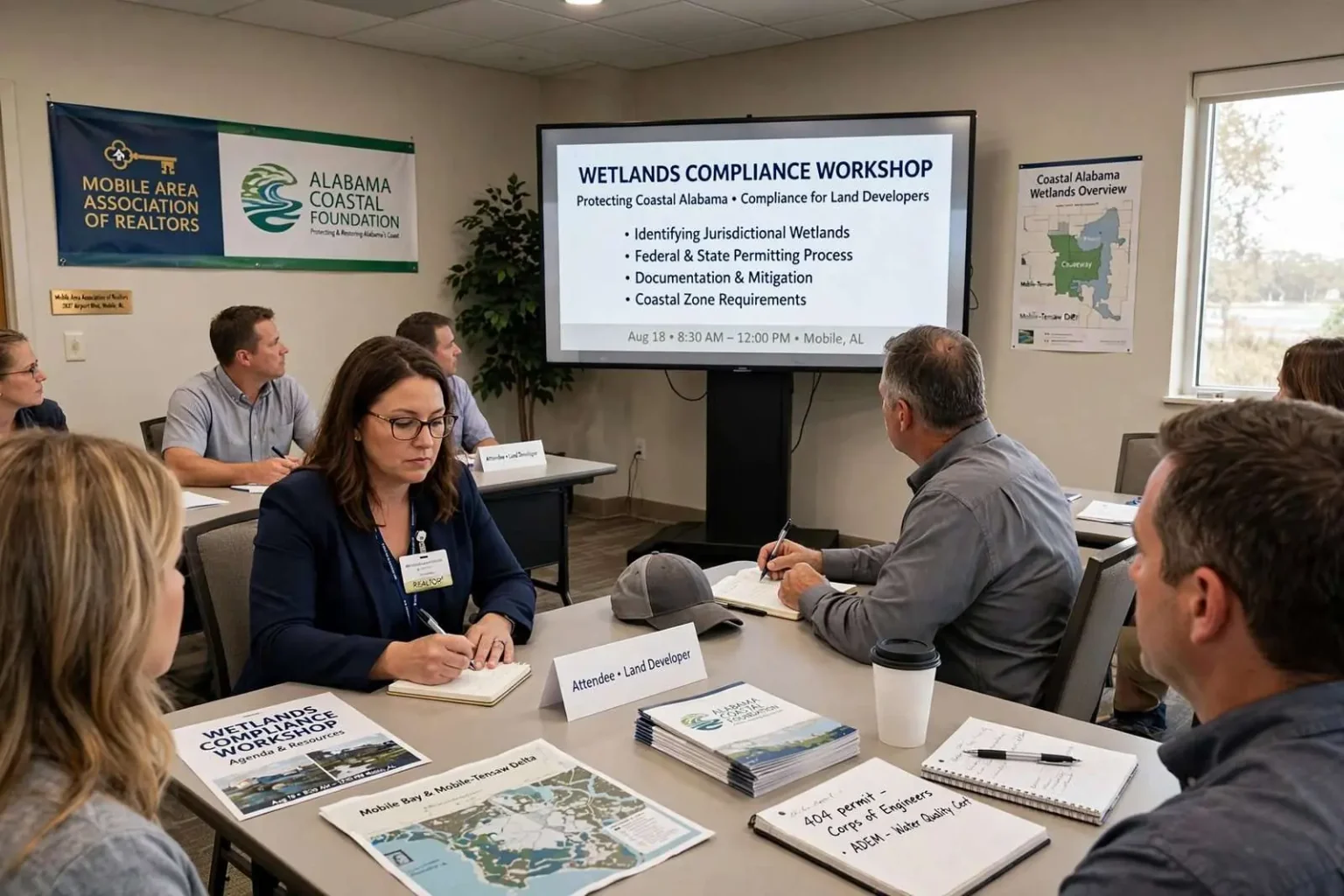
Local real estate professionals will have the chance to brush up on wetlands and land development regulations Tuesday during a workshop hosted by the Mobile Area Association of Realtors. The bi-annual Wetlands Compliance Workshop, presented by the Alabama Coastal Foundation, runs from 8:30 a.m. to noon on Aug. 18 at the Mobile Area Association of Realtors office at 2827 Airport Boulevard in Mobile. The half-day format is intended to give attendees a practical, working overview of the rules that govern building and land disturbance in and around the coastal areas of Mobile and Baldwin counties.
The workshop is designed to give real estate professionals and developers grounding in the legal and environmental logistics involved in land development, including how wetlands regulations factor into project planning and compliance. That covers the sequence a developer or agent typically faces: identifying whether a parcel contains jurisdictional wetlands, understanding which state and federal agencies have a say in what can be built, and knowing what documentation is required before land can be cleared, filled, or subdivided. For agents who list property in the coastal zone, those questions come up routinely, and a misstep early in a transaction can derail a sale or a project timeline.
Wetlands questions in south Alabama are not an occasional edge case. The region sits at the outlet of the Mobile-Tensaw Delta, one of the largest wetland systems in the country, and the shorelines of Mobile Bay, the Causeway corridor, and the tidal creeks that feed the bay are laced with marsh, swamp, and fringe wetlands that fall under federal protection. Even parcels that look like ordinary upland pine forest from the road can contain hydric soils or drainage ways that trigger regulatory review once a surveyor and an environmental consultant walk the site.
Who Regulates Wetlands in Coastal Alabama
At the federal level, the primary framework is Section 404 of the Clean Water Act, administered by the U.S. Army Corps of Engineers through its Mobile District. Work that places fill material into waters of the United States, including many wetlands, requires a permit, and the district offers a range of options from general permits for routine, limited-impact projects to individual permits that involve a full public review. The Environmental Protection Agency sets overarching policy, and the U.S. Fish and Wildlife Service and the National Marine Fisheries Service weigh in where threatened or endangered species and essential fish habitat are involved.
On the state side, the Alabama Department of Environmental Management administers water quality certification and related programs, and the Alabama Department of Conservation and Natural Resources manages coastal resources through its State Lands and Coastal Section. Alabama operates a federally approved Coastal Zone Management Program, which means projects in the coastal area must be consistent with state coastal policies in addition to federal permitting requirements. Local governments add their own layer through zoning, floodplain ordinances, and building codes, and in the counties around Mobile Bay, flood zone determinations frequently travel hand in hand with wetland determinations on the same parcel.
Attendees can earn continuing education credits for taking part, which is a practical draw for agents whose licenses require regular coursework. Real estate licensees in Alabama must complete continuing education during each renewal cycle, and courses that tie directly to the day-to-day realities of coastal transactions tend to fill a need that generic classroom offerings do not. A workshop like this one lets an agent spend a morning on material they will actually use the next time a buyer asks whether a low spot behind a proposed home site can be filled, or a seller asks why an appraisal and a lender are suddenly asking for a wetland delineation.
The cost to attend is $40, and space is limited, with seats offered on a first-come, first-served basis. According to the listing, registration closed Aug. 4. The modest registration fee and the limited seating reflect the format: a room-sized session built around questions and site-specific examples rather than a large-scale seminar. Agents and developers who missed the registration window are being pointed toward future sessions rather than walk-in attendance, since the association and the foundation have committed to offering the workshop on a repeating schedule.
The Mobile Area Association of Realtors, headquartered on Airport Boulevard, serves members across Mobile County and plays a regular role in hosting professional development, government affairs briefings, and continuing education for the local industry. Pairing that audience with an environmental organization is a deliberate fit for this market. In a county where new subdivisions, commercial sites, and waterfront projects keep pressing toward the margins of the delta and the bay, the association’s members are often the first people a property owner talks to about what can and cannot be done with a piece of land.
About the Alabama Coastal Foundation
The Alabama Coastal Foundation, which partners with the Realtors association to offer the workshop twice a year, focuses broadly on protecting and restoring the coastal environment along Mobile Bay and the surrounding region. The organization is known in the community for citizen-oriented programs that engage volunteers in oyster restoration, coastal cleanup efforts, and environmental education, and its work with professional groups extends that mission into the industries whose decisions most directly shape the shoreline. By teaching the people who broker and develop land how the regulatory system actually works, the foundation aims to reduce the kind of inadvertent violations that harm wetlands and create costly legal exposure for property owners.
The bi-annual cadence matters for the local industry because the regulatory landscape is not static. Permitting rules, mitigation requirements, and flood map updates change over time, and the professionals who stay current are better positioned to advise clients accurately. Real estate practitioners who understand the permitting process in advance can flag wetland issues during due diligence instead of after a contract is signed, which protects buyers, sellers, and lenders alike.
Wetlands compliance has become an increasingly important topic for developers and real estate agents working in Coastal Alabama, where projects often intersect with protected marsh and wetland areas. The growth pressures are easy to see along the corridor from downtown Mobile across the causeway into Spanish Fort and Daphne, and along the developing stretches of western Mobile County. As easily developed upland parcels get used up, new projects increasingly move onto land that borders tidal marsh, bottomland hardwood swamp, or the floodplains of the delta’s tributaries, and each of those settings carries its own permitting considerations.
For a developer, the practical consequences of wetland rules show up in cost and time. A project that needs an individual permit rather than a general permit can face a review process measured in many months, plus engineering studies, public notices, and possible mitigation obligations to offset unavoidable impacts. Mitigation in this region typically involves purchasing credits from an approved mitigation bank that preserves or restores wetlands elsewhere in the same watershed, and credit costs can add materially to a project budget. None of that is a reason to avoid a site, but it is the kind of thing an experienced developer wants to know before purchase rather than after, and it is exactly the knowledge a workshop like this is built to spread.
For real estate agents, the stakes show up in disclosure and deal flow. A listing where a portion of the parcel is jurisdictional wetland affects where a home can be sited, whether a septic system can be approved, how much usable yard a buyer actually gets, and how a lender and insurer view the property. Agents who can recognize the warning signs, such as hydric soils, standing water, drainage patterns, and known mapped wetlands, can direct clients to the right consultants early and keep transactions from collapsing in the final weeks before closing.
What Attendees Can Expect to Take Away
Sessions of this kind generally walk through the mechanics of the permitting process step by step: how a wetland delineation is performed and documented, how the Corps decides which permit pathway applies, what information must accompany an application, and what role state agencies and local governments play along the way. Attendees also typically hear about the consequences of noncompliance, which can include stop-work orders, restoration requirements, and civil penalties, along with practical guidance on how to keep a small project, such as a single-family home site or a boat launch, safely inside the rules.
The emphasis on real-world application is what separates a compliance workshop from a general environmental lecture. Agents and developers leave with checklists they can apply to the next parcel on their desk: when to order a delineation, when to call the Corps before grading, when a floodplain permit is needed in addition to anything else, and how to explain all of it to a client in plain language. In a market as water-dominated as Mobile’s, that fluency is becoming a baseline professional skill rather than a specialty.
The workshop also arrives at a moment when coastal resilience is drawing more attention across the Gulf region. Wetlands are widely recognized for the services they provide, absorbing storm surge, filtering runoff, and supporting the fisheries and wildlife that underpin the area’s tourism and seafood economy. As communities around Mobile Bay weigh how to accommodate growth while protecting those natural defenses, the intersection of development and environmental regulation is only going to get more crowded, and the professionals who work at that intersection benefit from regular, structured exposure to both sides of it.
Those interested in future sessions of the workshop are encouraged to contact the Alabama Coastal Foundation directly for more information. The foundation can provide details on the next scheduled session, registration requirements, and the continuing education credit arrangement, and the Realtors association likewise publishes its professional development calendar for members. Because the workshop is offered twice a year and consistently draws interest from both the real estate and development communities, early registration remains the surest way to secure a seat.
For the broader community, the partnership behind the workshop is a small but practical example of how environmental protection gets done in Coastal Alabama, not through confrontation at a public hearing after the bulldozers arrive, but through education before ground is ever broken. Every agent who can spot a wetland issue during a showing, and every developer who knows which permit to seek before buying land, represents a project less likely to end in violation notices, lost wetlands, or a stalled investment. The $40 registration fee and a Tuesday morning, by that measure, are a modest price for a smoother path between the region’s growth and the marshes and bayous that make it worth living next to.