Mobile Recycling Centers Reopen Following Hurricane Sally Disruption
Mobile's recycling drop-off centers on Museum Drive and Pinehill Drive have reopened with regular hours after Hurricane Sally damage.
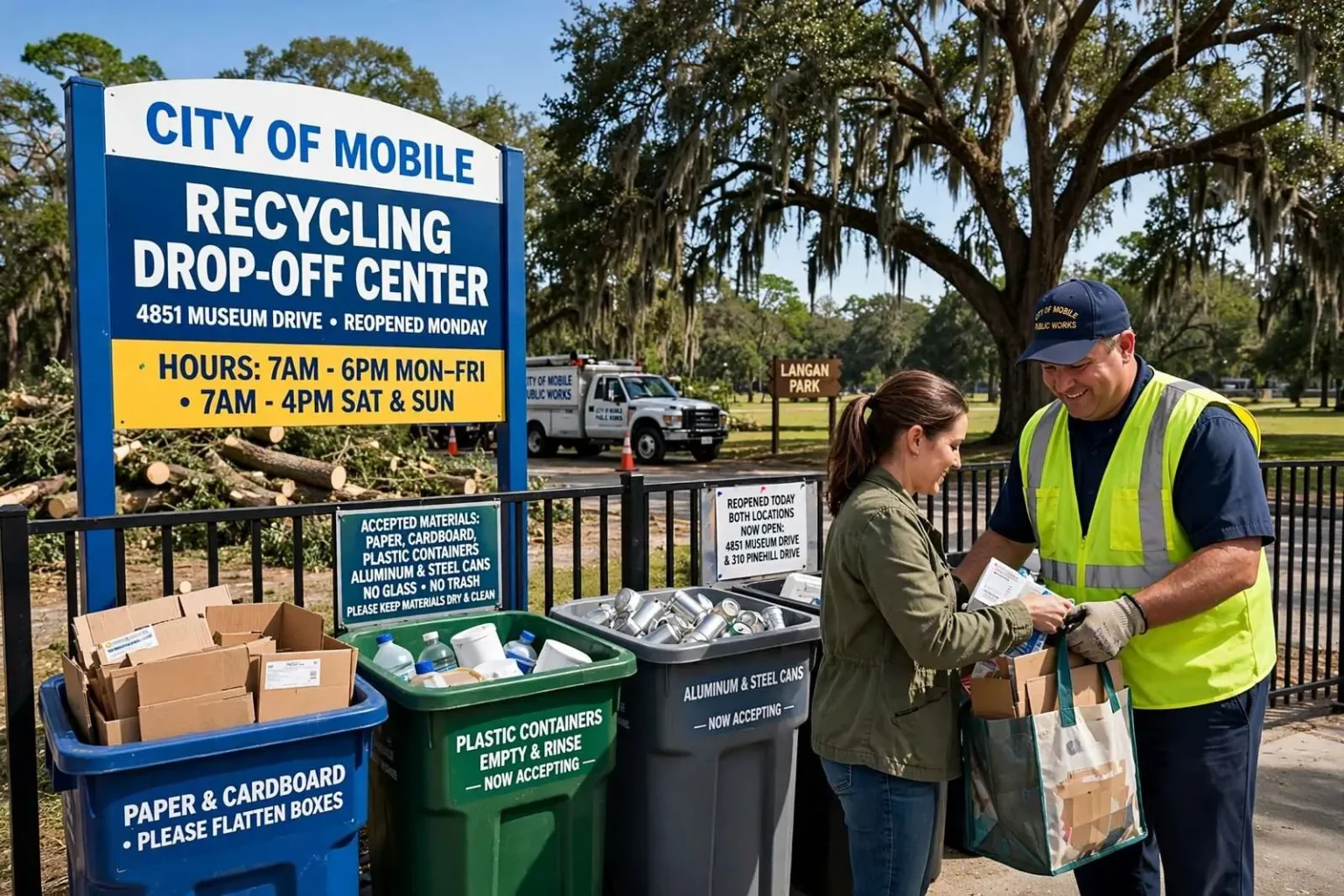
Mobile’s public recycling drop-off centers are back in operation after damage from Hurricane Sally forced their closure, the City of Mobile announced. Both locations — 4851 Museum Drive and 310 Pinehill Drive — reopened Monday, giving residents their first opportunity in weeks to drop off recyclable materials at the city’s public facilities. Hours are 7 a.m. to 6 p.m. Monday through Friday, and 7 a.m. to 4 p.m. on Saturdays and Sundays, returning the centers to their normal schedule.
The reopening marked another step in the city’s recovery from Hurricane Sally, the Category 2 storm that came ashore near Gulf Shores in September 2020 and raked the Mobile area with damaging winds, torrential rain, and a stubborn storm surge along Mobile Bay. While Mobile avoided the catastrophic wind damage experienced along the Baldwin County coast, the storm downed trees and power lines across the city, littered neighborhoods with weeks of debris, and disrupted normal city services — including the operations of the public recycling drop-off centers.
Residents who use the two facilities had been left without a public drop-off option since the storm. The Museum Drive site, located near the Mobile Museum of Art in Langan Park, and the Pinehill Drive site, serving neighborhoods in the city’s western sections, both sustained damage or were unreachable in the days after the storm as crews prioritized life-safety work, road clearing, and debris collection. The city’s announcement that both locations reopened Monday was welcome news to households that had been stockpiling recyclables in garages and carports while regular curbside routines remained strained by the recovery effort.
The Centers and What They Accept
The two drop-off centers are the backbone of Mobile’s public recycling program, providing convenient sites where residents can bring paper, cardboard, plastic containers, and aluminum and steel cans. The Museum Drive location at 4851 Museum Drive sits within Langan Park, one of the city’s largest and most visited green spaces, making it a natural stop for residents on the city’s western side. The Pinehill Drive location at 310 Pinehill Drive serves another residential corridor, giving the program coverage on both sides of the city’s core.
Operating hours for both sites are 7 a.m. to 6 p.m. Monday through Friday and 7 a.m. to 4 p.m. on Saturdays and Sundays, a schedule designed to accommodate commuters as well as those who run errands on weekends. The extended weekday hours allow residents to stop by before or after work, while weekend coverage serves families and those who consolidate their recycling trips into a single outing. City officials encouraged residents to check posted signage at the sites for guidance on accepted materials and to sort their loads before arriving to keep the lines moving.
The reopening matters for a practical reason as well: with the storm’s debris collection still underway across much of the city in the weeks after Sally, disposal capacity was at a premium. Every load of cardboard, cans, and bottles diverted to the recycling centers is material that does not have to be hauled, sorted, or landfilled through the city’s storm recovery channels, easing pressure on the overall waste stream during an already demanding period for Public Works crews.
Life After Hurricane Sally
Hurricane Sally came ashore on the morning of September 16, 2020, near Gulf Shores, with winds of 105 mph and a slow forward speed that compounded its rainfall totals. Communities along Mobile Bay and across Baldwin County endured days without power, and the storm’s winds snapped hundreds of trees across Mobile’s historic neighborhoods and modern subdivisions alike. The city’s recovery unfolded over months, with debris hauls, fence and roof repairs, and the gradual restoration of everyday services.
Recycling programs are among the quiet casualties of major storms. When a hurricane strikes, staffing shifts to emergency operations, collection equipment is reassigned, and facilities themselves can be damaged by wind, flooding, or power loss. Across the Gulf Coast after Sally, curbside recycling was suspended or curtailed in numerous jurisdictions, and restarting those programs became one of the markers of a community’s return to normalcy. Mobile’s reopening of both drop-off centers on the same day signaled that the city’s recovery had reached a meaningful milestone.
City officials thanked residents for their patience during the closure and reminded the public that the centers exist to serve every household in the city, not just the neighborhoods nearest to the two sites. As debris collection winds down and curbside service stabilizes, the drop-off centers are expected to return to their pre-storm role as a convenient, free option for residents who want to keep recyclables out of the landfill — a small but visible sign that, month by month, Mobile is putting Hurricane Sally behind it.
Why Recycling Drop-Off Matters in Mobile
Drop-off recycling plays a larger role in Gulf Coast cities like Mobile than it does in some larger metropolitan areas, because it offers a low-cost way for residents to participate without the logistics of curbside collection. Households that live in apartments, residents whose curbside service lapsed, and those who accumulate larger volumes of cardboard than a bin can hold all rely on the centers at 4851 Museum Drive and 310 Pinehill Drive. The sites are staffed and monitored, and their consistent hours make it easy to build a recycling habit into a weekly routine.
The environmental case for the program is straightforward. Recycling aluminum and steel cans saves the energy that would otherwise be spent producing new metal, recycling cardboard and paper reduces pressure on the region’s forests and landfills, and keeping plastics out of the waste stream prevents them from ending up in area waterways that drain into Mobile Bay. For a coastal city, that last point carries weight — storm drains and bayous throughout Mobile flow toward the bay, and cleaner waste handling upstream means cleaner water downstream.
The closure caused by Hurricane Sally illustrated how much residents had come to depend on the service. In the weeks the centers sat dark, recyclable material piled up in homes across the city, and some of it inevitably found its way into the regular trash. City officials have noted that restorm restarts of programs like this one are part of a broader effort to make sure temporary disruptions do not permanently erode community habits that took years to build.
Tips for Using the Centers
Residents planning a trip to either location can make the visit faster with a little preparation. Cardboard should be broken down flat to save space in the collection containers. Cans and bottles should be emptied and, where practical, rinsed to keep the sites clean and to reduce odors in the Gulf Coast heat. Paper should be kept dry, which can be a challenge in a rainy climate, so storing recyclables indoors or in a covered bin until drop-off day helps preserve their value.
The centers’ hours — 7 a.m. to 6 p.m. weekdays and 7 a.m. to 4 p.m. weekends — mean that early morning visits often find the shortest lines, particularly at the Museum Drive site, which sees steady traffic from park visitors as well as recyclers. Residents with oversized loads of storm-related cardboard, such as flattened boxes from deliveries or repairs, may want to make multiple trips or visit during off-peak hours to keep the drop-off areas from backing up.
The reopening of both facilities on the same Monday put Mobile’s recycling program back on its feet alongside the rest of the city’s returning services. For the residents who have been waiting, the message from the city is simple: the centers are open again, the hours are back to normal, and every bin of cardboard, cans, and bottles dropped off is a small contribution to a city that is steadily rebuilding — and doing what it can to keep its share of the Gulf Coast clean along the way.
The Storm That Shut the City Down
Understanding the closure requires understanding what Sally did to Mobile. The storm spent days crawling across the warm waters of the Gulf, and its slow motion meant prolonged hours of tropical-storm and hurricane-force conditions for coastal communities rather than a brief blow-through. Rainfall totals across the region were measured in the double digits in some locations, flooding streets and overwhelming drainage systems, while wind gusts toppled oak trees that had stood for generations across Mobile’s neighborhoods.
City crews faced an enormous task: clearing arterial roads of fallen trees and power lines, restoring traffic signals, reopening drainage, and beginning the monumental job of collecting storm debris from every corner of the city. In that environment, ancillary services like the recycling drop-off centers had to wait. The facilities’ entrances and collection areas were themselves cluttered with storm damage, and the staff who normally operate them were deployed to emergency duties.
The phased return of city services followed the recovery’s rhythm. Garbage and trash collection resumed on adjusted schedules first, followed by bulk pickup and debris operations. The reopening of the recycling drop-off centers Monday represented the next rung on the ladder — the point at which the city could spare the staffing and equipment to operate the sites and residents could once again count on them being open.
Patience and Persistence
City officials acknowledged the frustration many residents felt during the closure, particularly those who had made recycling a regular part of their routine for years. But the recovery period also demonstrated the resilience of the community. Neighborhood groups organized cleanup days, volunteers helped elderly neighbors clear their yards, and households across Mobile adapted their routines while the city worked through the backlog the hurricane created.
The experience of Hurricane Sally also prompted conversations across coastal Alabama about preparedness — not just for the storm itself, but for the weeks that follow. Families learned the value of keeping supplies on hand, of documenting damage for insurance, and of planning for services they take for granted being unavailable. Municipal departments, for their part, refined their recovery checklists, and the return of quality-of-life services like the recycling centers is part of those plans.
With both centers open again — 4851 Museum Drive and 310 Pinehill Drive, 7 a.m. to 6 p.m. on weekdays and 7 a.m. to 4 p.m. on weekends — Mobile’s recycling program is once more doing what it was designed to do. The City of Mobile’s announcement closed a chapter that opened when Sally’s winds swept across the city, and it gave residents a concrete reminder that recovery is measured not just in repaired roofs and cleared roads, but in the everyday services that make a city feel like itself again.