Mobile Reroutes Parking for 3,000 Educators as Tropical Storm Bertha Approaches
<p>Mobile rerouted parking for the 3,000-educator MEGA Conference at the Convention Center, closing its garage and shifting attendees to free Cruise Terminal parking with shuttle service as Tropical Storm Bertha approached.</p>
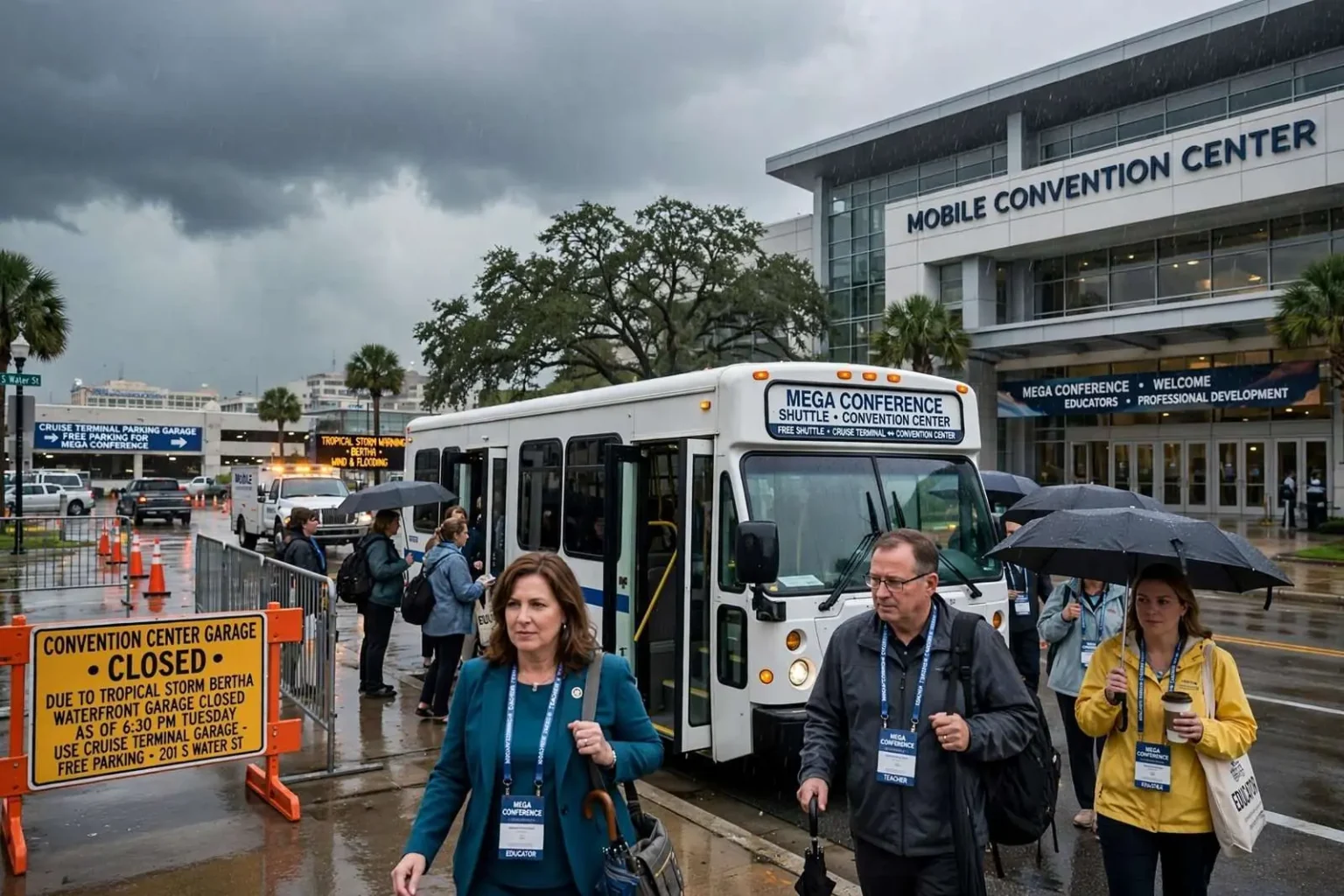
With more than 3,000 educators in town for a week-long professional development conference, the City of Mobile rearranged parking plans this week to work around Tropical Storm Bertha’s approach. The MEGA Conference, held at the Mobile Convention Center, drew the large crowd of teachers and school staff even as the tropical storm warning covering Mobile threatened flooding and gusty winds through midnight Wednesday.
The logistics exercise put the city’s storm-response playbook on display for a national audience of visiting educators, showing how a downtown that sits on the waterfront handles the routine challenges of hurricane season on the northern Gulf Coast.
A Garage Closed, a Plan Redirected
City officials closed the Convention Center’s parking garage as of 6:30 p.m. Tuesday as a precaution. Waterfront garages are among the first facilities exposed when a tropical system pushes water into the downtown streets and storm surge builds against the riverfront, and closing one before conditions deteriorate is a standard step — better to move cars early than to have drivers racing a rising tide.
Conference attendees were redirected instead to the Cruise Terminal Parking Garage at 201 South Water Street, where parking was offered free of charge for the duration of the closure. The Cruise Terminal garage sits within walking distance of the Convention Center along the same riverfront stretch, making it the natural alternate for an event that could not afford a complicated detour.
A complimentary shuttle ran between the Cruise Terminal garage and the Convention Center from 6:45 a.m. to 5 p.m. to keep attendees moving between the two sites without needing to walk through deteriorating weather. The shuttle window covered the full span of the conference day, letting teachers arrive early for sessions and leave without crossing a downtown already being lashed by the storm’s outer bands.
A Backup Plan Behind the Backup Plan
If the Cruise Terminal garage filled to capacity, attendees were told to use the U.S. Army Corps of Engineers Parking Deck at 109 St. Joseph Street, next to Regions Arena, as a backup option. Parking there ran $5 for up to 12 hours, with the same complimentary shuttle service extended to cover that location as well.
Layering a second overflow site into the plan reflected the size of the crowd. Three thousand attendees drive into a downtown at roughly the same hours each morning, and parking capacity around a convention center shrinks quickly when one of its largest garages goes offline. Building redundancy into the announcement spared conference organizers the scramble of solving the problem after it appeared.
The $5 rate at the Corps deck — charged even as the primary alternate went free — gave attendees a predictable cost if they had to use the backup, while the shuttle extension meant nobody parked at the far site would have to find their own way back to the Convention Center.
Tracking Bertha
At the time the parking changes were announced, the National Hurricane Center placed Bertha’s center about 105 miles south-southeast of Mobile, tracking west at 6 mph. A storm moving that slowly gives forecasters a longer window to refine predictions, but it also means a longer period of onshore flow pushing water toward the coast — one of the factors that keeps tropical storm warnings in effect even for systems that never organize into hurricanes.
The National Weather Service forecast 1 to 3 inches of rain for the area, concentrated mainly along Alabama’s coast, as the tropical storm warning remained in effect for Mobile through midnight Wednesday. Rainfall totals in that range are routine for the Gulf Coast but still capable of flooding low-lying streets, particularly when they fall in bands that repeat over the same areas, and gusty winds accompany those bands through the duration of the warning.
Bertha formed early in the Atlantic hurricane season, which runs from June through the end of November, and early-season storms that form in the Gulf or nearby Atlantic tend to move quickly ashore — but their approach still demands the same preparation as a stronger system. For a city like Mobile, which sits at the head of Mobile Bay and watches both river flooding and storm surge, the habits are well rehearsed.
The Convention Center’s Place in Storm Planning
The Mobile Convention Center anchors the downtown riverfront and hosts a steady calendar of conferences, trade shows and civic events that fill hotels and restaurants across downtown. Its operations staff plan every large event with weather contingencies in mind, because the building sits directly on the Mobile River waterfront where flooding risks are highest.
Closing the facility’s garage ahead of the weather is the visible tip of that planning. Behind it sit decisions about scheduling, food service, transportation contracts and communication with attendees — coordinated with the city, the conference organizers and the venue’s own staff. When those pieces line up, an event survives a storm week with little more than a parking inconvenience.
That resilience matters economically as much as practically. Convention business measures a city by whether events return year after year, and the way a destination handles a disrupted week — communicating early, offering alternatives, keeping attendees informed — travels through the meetings industry by word of mouth as surely as any sales pitch.
3,000 Educators Weather the Storm
The MEGA Conference brings together teachers, administrators and school support staff for professional development sessions spanning instructional practice, technology, leadership and student services. For the educators attending, the week represents hours of required training packed into an intensive schedule — and many had traveled from across the state to take part.
The parking adjustments allowed the conference to continue largely uninterrupted even as the storm pushed through the region, giving thousands of visiting educators a way to reach the Convention Center without navigating flooded or wind-affected areas near the downtown waterfront. Sessions proceeded on schedule, and the storm became a shared experience rather than a canceled one. Organizers credited the city’s early coordination for keeping the week’s training goals intact despite the weather.
What a Tropical Storm Warning Means
A tropical storm warning, issued by the National Hurricane Center, means that tropical storm conditions — sustained winds of 39 mph or higher — are expected somewhere within the warning area, generally within 36 hours. It is one notch below a hurricane warning, but for a city hosting an event, the practical effects are nearly the same: outdoor activities end, loose materials get secured, and transportation plans change.
The wind itself is only half the concern. Tropical systems rotating ashore along the Gulf push water into bays and rivers, and Mobile’s downtown sits at the point where the Mobile River meets Mobile Bay — geography that makes the waterfront district’s garages and low streets the first places to watch. Add rain bands that can drop several inches in a few hours and the warning becomes a full-stack test of drainage, traffic management and public communication.
Residents along the Alabama coast are accustomed to the rhythm. Schools and businesses monitor the same forecast the city does, and a storm like Bertha — short-lived, quick-moving, but disruptive — is the kind that tests systems without breaking them. The city’s parking shuffle this week is exactly the sort of routine adaptation that years of Gulf Coast storm seasons have made standard.
How Downtown Absorbed the Disruption
For a week in which downtown Mobile’s normal parking patterns were upended, the effect on the ground was remarkably contained. Visitors who would have parked under the Convention Center found free parking a short walk or shuttle ride away, and the garage closure happened in the evening, after most attendees had already left for their hotels.
Local businesses along the route felt the storm differently. Restaurants and bars in the district depend on conference crowds, and storm warnings thin out evening foot traffic as attendees head back to hotels early. Still, the week’s gatherings continued indoors, and the city’s early, clear communication — free parking, defined shuttle hours, a named backup location — kept confusion to a minimum.
The episode also offered a quiet demonstration for the educators attending the conference: a city modeling preparation, adaptation and communication in real time. Teachers spend their careers telling students to plan ahead, and this week downtown Mobile did the same — moving cars before the water rose, opening shuttles before the rain arrived, and keeping three thousand professionals focused on their work while a tropical storm passed offshore to the south.
By the time the warning expired at midnight Wednesday, the storm had moved on and the conference had weathered its only real disruption: a change of parking lot. For Mobile, whose hurricane seasons rarely pass without at least one such test, it was a week handled as routine — which is precisely the point.