
Mobile Senior Centers Reopen at Limited Capacity With New Health Protocols
Connie Hudson and Parkway senior centers in Mobile reopen fitness areas April 19 by reservation with masks and health checklists under new state guidance.
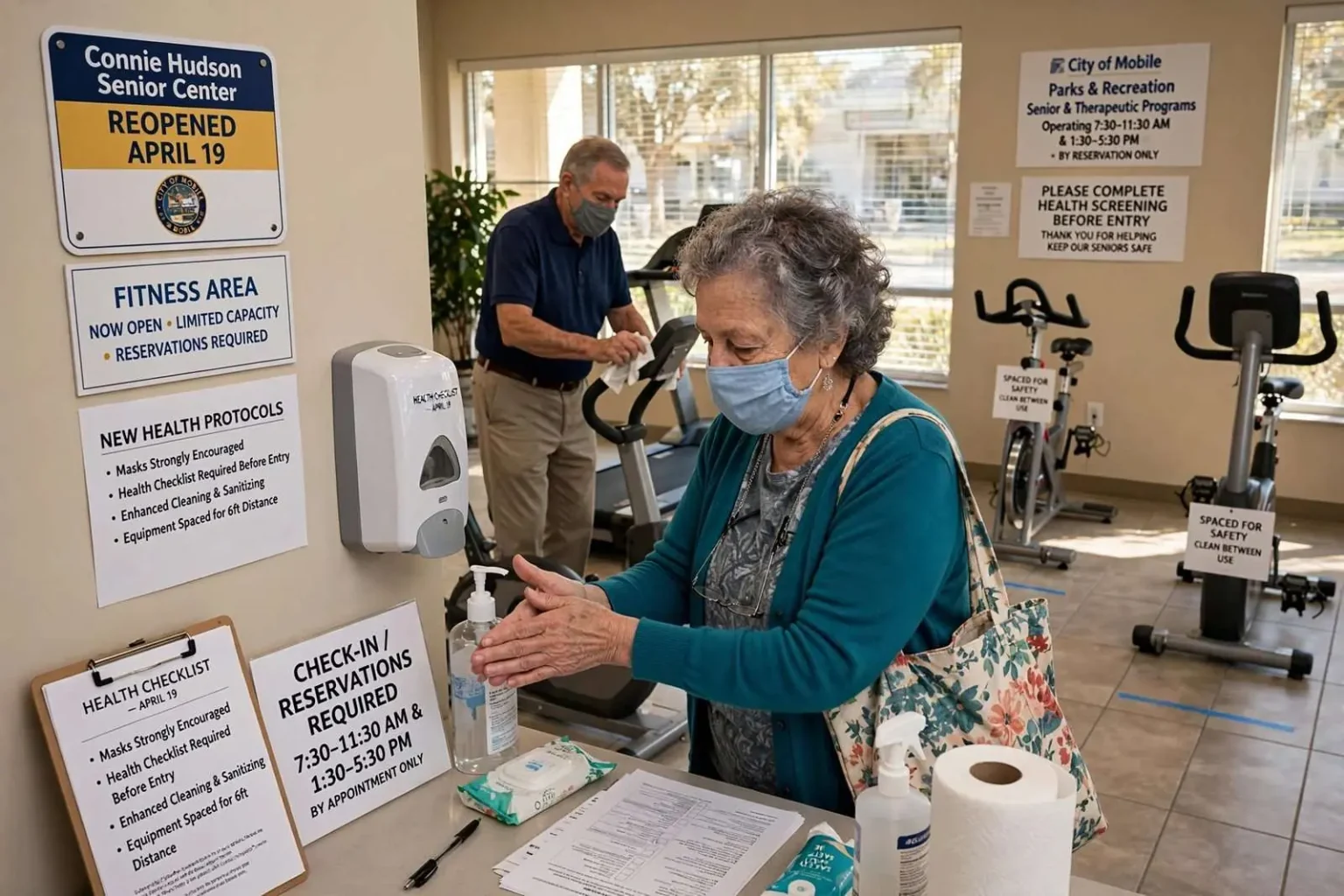
Mobile’s seniors can return to the city’s senior centers starting April 19, as Mobile Parks and Recreation reopens the Connie Hudson and Parkway centers at limited capacity under new state guidance. The reopening marks the first step back inside buildings that have been largely closed to in-person gatherings since the pandemic upended programming for older adults across the city more than a year ago.
Acting on direction from Gov. Kay Ivey’s office and the Alabama Department of Senior Services, the centers will initially open their fitness areas only. Everything else — the craft rooms, game tables, group classes and communal meals that normally fill the buildings — remains on hold until health conditions and capacity allow. Staff and participants will follow new COVID-19 protocols: masks are strongly encouraged, everyone completes a health checklist before entry, and enhanced sanitation and hygiene practices apply throughout the buildings. Hand sanitizing stations, more frequent cleaning of high-touch surfaces and spacing between equipment are part of the routine that greets anyone who walks in the door.
The limited capacity is the trade-off that makes any reopening possible. Fewer people are allowed in each space at one time, and the city is using reservations to keep headcounts predictable rather than turning participants away at the door.
Balancing safety and connection
“We realize the changes at our senior centers may limit the number of participants we can have at one time, but they are in place to provide a safer experience for everyone,” said Ashley-Nicole Flowers, supervisor of senior and therapeutic programs. “We are balancing the health and safety of our participants with our capacity and resources.”
Flowers’ point captures the dilemma that senior centers across Alabama have faced throughout the pandemic. Older adults are among the groups most vulnerable to severe illness from COVID-19, which is precisely why the centers closed early and stayed closed longer than many other public facilities. At the same time, the isolation that came with those closures carried its own cost — lost exercise routines, lost social contact and lost access to the daily structure that many participants count on. Health officials have repeatedly warned that prolonged isolation among seniors can worsen both physical and mental health, which is why the state’s guidance moved toward cautious reopening rather than indefinite shutdown.
The fitness areas were chosen as the first phase because they can be controlled: equipment can be spaced and cleaned between users, the activities are largely individual rather than group-based, and attendance can be capped and scheduled. Participants should expect to see fewer machines in use at any one time and more time between sessions as staff disinfect.
Drive-thru and virtual programming continue
While the buildings open in a limited way, the programs that carried Mobile’s seniors through the closures are not going away. Drive-thru and virtual programming continues unchanged during the phased reopening, meaning meal distributions, check-ins and online activities keep running exactly as they have. City staff have urged participants who are not yet comfortable returning indoors, or who have health concerns, to keep using those options without interruption.
The hybrid approach reflects how senior services across the state have adapted. The Alabama Department of Senior Services, which coordinates programs for older adults through local Area Agencies on Aging, shifted meal delivery, wellness checks and virtual activities to the front of its work during the pandemic, and many of those formats have proven durable. For homebound seniors especially, the drive-thru meal and activity lines have remained a lifeline that will outlast the reopening process itself.
Reservations are the key detail for anyone planning a visit. Both centers operate by reservation only, and spots are limited, so participants are encouraged to call ahead rather than assume space will be available on a given morning or afternoon.
Where and when to go
The Connie Hudson Senior Center is at 3201 Hillcrest Road in west Mobile, a facility named for the longtime Mobile County commissioner and former city councilwoman whose public career has been closely tied to parks and quality-of-life projects in the western part of the city. The Parkway Senior Center is at 1600 Boykin Boulevard, serving neighborhoods along the Boykin corridor in the central-eastern part of Mobile. Between them, the two sites anchor the city’s senior programming on both sides of town, giving participants a choice of location close to home.
Both operate 7:30–11:30 a.m. and 1:30–5:30 p.m., by reservation only. The split schedule allows staff to clean thoroughly between the morning and afternoon sessions, and it mirrors the half-day structure many senior centers adopted during the pandemic to limit how long any group of participants remains in a building. Questions can go to 251-602-4963 or [email protected], and staff can help participants who have not used the reservation system before.
City officials have asked for patience as the phased process unfolds. Capacity limits may change as state guidance changes, and the program mix — which areas of the centers open next, which classes resume, whether group meals return — will be announced step by step rather than all at once. Participants with questions about a specific activity should contact the centers directly rather than assuming a program has resumed.
What the health checklist involves
The health checklist required before entry is a short screening, completed each visit, that asks about symptoms and possible exposure. It is the same basic tool businesses, schools and government facilities across Alabama adopted during the pandemic, designed to catch the most common signs of illness before someone spends a morning in a shared space. Anyone feeling unwell is asked to stay home — a request that city staff framed as the single most effective thing a participant can do to protect the rest of the group.
Masks remain strongly encouraged but not required under the current guidance, a posture that matches the state’s broader move at the time away from broad mandates and toward individual responsibility combined with sensible precautions. For a population at higher risk, though, many participants and their families have continued to treat masking and distancing as defaults. Staff have emphasized that every precaution listed is voluntary to the extent state rules allow, but that the safest visit is one where everyone uses them.
Enhanced sanitation applies throughout the buildings, not just in the fitness areas. Staff have added cleaning cycles on doorknobs, handrails, restrooms and any shared equipment, and they are keeping groups separated so that a potential exposure does not automatically touch every corner of a center.
The bigger picture for Mobile’s seniors
The reopening arrives as cities across Alabama take similar steps with their own senior facilities, guided by the same state-level direction that Mobile followed. The Alabama Department of Senior Services has framed the process as a partnership: local departments know their participants and their buildings, and the state provides the health guidance and support that lets them open safely. For Mobile Parks and Recreation, which operates an unusually broad network of community and senior centers, the senior centers’ return is one more sign of the department’s gradual path back to full operations.
For participants, the practical advice is simple. Call ahead, reserve a spot, complete the checklist, and expect a different experience than the one the centers offered before the pandemic. The city’s message, in Flowers’ words, is that the changes exist to provide a safer experience for everyone — and that the fastest way back to normal is to keep the reopening phases healthy.
Seniors and caregivers who want updates on future phases can use the same contact channels, 251-602-4963 and [email protected], as the schedule of programs continues to evolve.
Why senior centers matter so much in Mobile
Senior centers occupy an unusual place in the civic life of a city like Mobile. For many participants they are not simply recreation sites but the fixed point of the week — the morning gym session, the card game, the lunch crowd, the class that gets them out of the house and among friends. Researchers who study aging consistently find that regular social engagement is tied to better health outcomes for older adults, from lower rates of depression to better management of chronic conditions. That is why public health officials have treated senior center closures as a necessary but genuinely harmful measure, and why cities worked hard to replace them with alternatives rather than let the services lapse.
Mobile’s response to that challenge leaned on formats that could work without indoor gatherings. Drive-thru events kept meals moving to seniors who depended on them, and virtual programming — everything from exercise sessions broadcast online to remote activities and telephone check-ins — kept the connection alive for participants with internet access or even just a phone. Staff at the senior centers became, in effect, outreach workers, tracking who had not been heard from and making sure the most isolated participants were not forgotten. Those efforts are the “drive-thru and virtual programming” that continues unchanged even as the buildings reopen.
The Connie Hudson and Parkway centers also serve as information hubs for the wider network of senior services in the area — nutrition programs, benefit counseling, caregiver support and referrals to the agencies that handle Medicare questions and home-delivered meals. Reopening even their fitness areas restores a doorway to all of that, which is why the city has advertised the reopening date prominently rather than letting word of mouth do the work alone.
How the reservation system works
Reservations are the mechanism that makes limited capacity enforceable. Instead of an open-door model where a dozen people might show up at once, participants reserve a time slot and staff know exactly who is in the building and when. That serves two purposes: it keeps occupancy under the state guidance thresholds, and it creates a record that makes contact tracing far easier if an exposure ever occurs. Participants who reserve and then cannot attend are encouraged to cancel so the slot can go to someone on the waiting list.
The two-session daily schedule — 7:30 to 11:30 in the morning and 1:30 to 5:30 in the afternoon — doubles the number of participants a center can serve in a day without ever increasing the number inside at once. The midday gap is deliberately left open for cleaning, and staff use it to reset the fitness areas, restock sanitation supplies and review the checklist results from the morning session. Anyone planning a first visit back should budget a few extra minutes for the screening process on arrival.
City staff have also asked families to help spread the word. Many of the center’s participants rely on adult children or neighbors for transportation and scheduling, and reservations made by phone at 251-602-4963 or by email at [email protected] can be handled by a caregiver on a participant’s behalf. For seniors without internet access, the phone line remains the simplest path to a spot, and staff would rather answer a question than have someone stay away because they were unsure of the rules.
The city has not announced a timeline for the next phase of reopening. As with every step so far, the sequence depends on health conditions and state guidance, and updates will come through the Parks and Recreation Department as they are finalized.


