Mobile Theatre Guild, Joe Jefferson Players Celebrate Standout Year in Community Theater
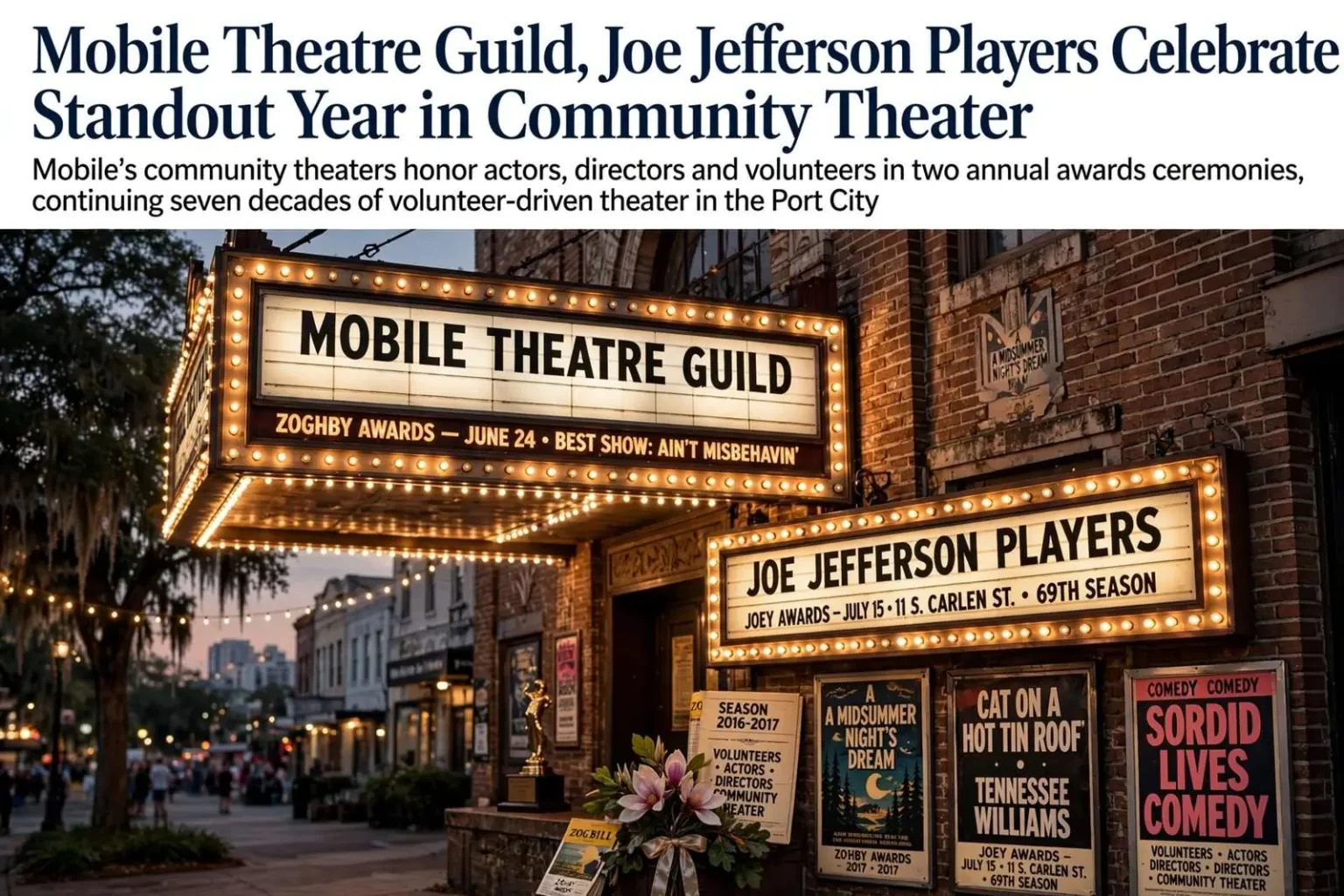
Mobile Theatre Guild handed out its Zoghby Awards in June, and Joe Jefferson Players is set to close its 69th season with the Joey Awards on July 15, continuing Mobile's summer tradition of honoring community theater talent.
Mobile’s community theater scene wrapped up another season of packed houses and honors, with two of the city’s longest-running playhouses handing out their top awards to actors, directors and volunteers who kept local stages busy over the past year. The ceremonies are the annual high point of a craft that runs almost entirely on volunteers in Mobile, where community theater has flourished for more than seven decades alongside the touring productions and professional companies that pass through downtown venues. The awards nights are part celebration and part tradition, and they offer a snapshot of how deeply theater is woven into the cultural life of the Port City.
A Season of Top Honors at Mobile Theatre Guild
Mobile Theatre Guild held its annual Zoghby Awards on June 24, recognizing standout performances and productions from its season. The guild, one of the oldest continuously operating community theaters in the region, draws its casts and crews from across the Mobile area, and its end-of-season awards evening has become a fixture of the local arts calendar. This year’s honors spanned musical and non-musical categories, newcomer recognition and lifetime contributions, reflecting the range of talent the guild’s volunteers bring to the stage.
“Ain’t Misbehavin'” was named Best Show, capping a season in which the guild’s productions filled seats across its calendar. Ravyn Otis took home Best Actress in a non-musical role, while Ebony Le’She Jarmon won Best Actress in a musical. Gayle Andrews was honored as Best New Actress, a category the guild uses to spotlight performers making their first impressions on the Playhouse stage.
On the men’s side, Gene Murrell was named Best Actor (Non-Musical) and Aron Meadows won Best Actor (Musical), with Robert Young recognized as Best New Actor. The pairing of veteran winners with first-year honorees is typical of community theater seasons, where experienced performers share the stage and backstage duties with residents trying theater for the first time. For the guild, the balance is part of the mission: keeping a pipeline of local talent moving through auditions, rehearsals and performances year after year.
Meadows also picked up a directing honor for his work on “Ain’t Misbehavin’,” a double recognition that underscored how central he was to the production the membership ultimately named the season’s best. In community theater, directing is itself a volunteer job, demanding months of evening rehearsals on top of day jobs, and the guild’s awards treat it with the same weight as the acting categories.
Directors and Namesake Awards
Meadows was one of several directors saluted for guiding individual productions during the season. Cory Olson was recognized for directing “A Midsummer Night’s Dream,” Chris Hill for “Archie and Mehitabel,” Lesley Roberts for “Cat on a Hot Tin Roof,” and Kyle Myers and Chris Hill together for “Sordid Lives.” The slate of shows — a Shakespeare classic, a musical revue, a Tennessee Williams drama and a contemporary comedy — illustrates the range the guild attempts each season, balancing familiar crowd-pleasers with more demanding material.
Several of the guild’s namesake awards, which honor contributions beyond the stage, also changed hands this year. Joann Oliveria received the Leslie Leslie Award, Yvonne Matthews and Her Band won the Nibbles Award, Kyle Myers was given the Jerry Carre Award, and Susan Vinson took home the Danny Conway Award. These honors acknowledge work that audiences rarely see: set construction, orchestration, costuming, fundraising and the countless hours of administration that keep a volunteer playhouse running.
Longtime volunteer Barney March received a special award recognizing his years of dedication to Mobile Theatre Guild. In an organization where every ticket sold and every set piece built depends on unpaid labor, service measured in years rather than productions carries particular weight, and the special award is the membership’s way of saying so.
Joe Jefferson Players Prepares for the Joey Awards
Across town, Joe Jefferson Players is preparing for its own night of recognition. The troupe will host its 2016-2017 Joey Awards on July 15 at its playhouse at 11 S. Carlen St. in Mobile, marking the close of JJP’s 69th season of community theater. The ceremony is open to the public, with doors opening at 6 p.m. for a potluck-style, bring-your-own-beverage gathering ahead of the 7 p.m. awards program — a casual format that has long distinguished the Joey Awards from more formal galas and keeps them accessible to members, families and curious first-time visitors alike.
Timothy Guy, Cory Olson and Lesley Roberts will serve as hosts for the evening, and local media personality Gene Murrell is set to livestream the event for those who can’t attend in person. The livestream is a relatively recent addition for an organization of JJP’s vintage, reflecting the way even the city’s most tradition-bound playhouses have adapted their outreach to audiences who follow community news online. Olson and Roberts, both honored at the guild’s Zoghby ceremony a few weeks earlier, appear on both organizations’ slates of working volunteers — a reminder of how small and interconnected Mobile’s theater community remains.
Joe Jefferson Players takes its name from the nineteenth-century actor Joe Jefferson, whose association with the Mobile area has made him a fixture of local theater lore, and the organization has spent nearly seven decades staging full seasons of plays and musicals in Midtown. For many Mobile families, the Carlen Street playhouse is where children first encounter live theater, whether through main-stage productions or youth programs, and generations of local actors credit the group with their start.
The two ceremonies cap off what has become a familiar rhythm for Mobile’s theater community: individual playhouses close out their seasons each summer with awards shows honoring the actors, directors and behind-the-scenes volunteers who make their productions possible. The summer timing allows the groups to celebrate, restock their playhouses and begin auditioning for the fall before the school-year calendar pulls volunteers in different directions.
A Wider Circle of Local Stages
Beyond Mobile Theatre Guild and Joe Jefferson Players, the region is home to several other community theater groups that stage productions throughout the year, giving local performers, directors and technical volunteers regular opportunities to hone their craft outside the professional stage. From church and school drama programs to independent companies that mount shows in borrowed spaces, the Gulf Coast’s volunteer theater ecosystem supplies the experience base from which every playhouse casts its seasons. That depth is one reason Mobile has sustained multiple full-season playhouses for decades, a level of activity few cities of comparable size can claim.
The Walk of Fame That Never Was
The idea of expanding recognition for the arts in Mobile isn’t new. In 2013, a proposal for a Walk of Fame along the Saenger Theatre’s downtown block gained real traction, with a committee that included representatives from city government, business and the arts community, along with an architect’s preliminary plan and cost estimates from city engineers. The concept drew on a familiar model — the star-studded sidewalks made famous in Hollywood — and aimed to give Mobile a permanent, public tribute to the performers and arts institutions that built its reputation on the Gulf Coast.
The effort stalled after leadership changes at both the Saenger and in city administration, and the project never moved forward. The Saenger, the 1927 movie palace on Joachim Street that anchors the Saenger Theatre block, remains one of downtown’s most visible cultural landmarks, hosting touring Broadway shows, concerts and comedians, but the proposed walk of honors around it exists only in the committee’s plans and drawings. For advocates of arts recognition, the episode has become a cautionary tale about how easily momentum can evaporate when key backers move on.
A Case for an Area-Wide Awards Show
Some in the local arts community have floated the idea of a broader, area-wide theater awards event that would recognize standout performances across all of Mobile’s community playhouses rather than within a single organization, similar in spirit to how New York’s Tony Awards draw on a large nominating and voting body to evaluate productions across many venues each season. Under such a model, judges or members from each participating theater would see productions across the city and nominate the season’s best work collectively, rather than each troupe celebrating only what appeared on its own stage.
Any such effort locally would likely need a smaller, more streamlined structure, but supporters argue it could raise the profile of community theater across the region and drive more public attention to each troupe’s upcoming season. A combined ceremony would give the city a single marquee night for local theater, generate coverage that individual playhouses struggle to earn on their own, and perhaps most importantly, introduce audiences loyal to one group to the work being done at the others. Skeptics note that coordinating judges across competing organizations poses real logistical challenges, from scheduling to standards of evaluation, which is one reason the idea has remained a conversation rather than a program.
Joe Jefferson Players’ new executive director, Jason McKenzie, has expressed enthusiasm for the concept as the organization looks ahead to its next season. With a new leader at JJP and a fresh round of seasons taking shape at the guild and other companies, supporters see an opening to revisit the idea while energy around the current award seasons is still high.
Whether or not a combined, area-wide awards event ever materializes, this summer’s Zoghby and Joey Awards continue a decades-long local tradition of honoring the volunteers who keep Mobile’s stages lit. For the winners, the recognition is personal; for the playhouses, it is the engine that keeps volunteers returning — because in community theater, the awards aren’t just trophies. They are how a city says thank you to the people who build the sets, sew the costumes, run the lights and step into the spotlight, show after show, year after year.
Residents who want to follow the local theater calendar can expect auditions and season announcements to pick up in late summer, with both major playhouses opening new slates in the fall. The Joey Awards on July 15 remain open to the public for those who want a first-hand look at the community behind Mobile’s stages.