Mobile Unveils $6 Million Plan to Ease Traffic on Busy Dauphin Street Corridor
Mobile is planning a $6 million Dauphin Street redesign between Sage Avenue and Springhill Medical Center, with new signals, turn lanes and median openings.
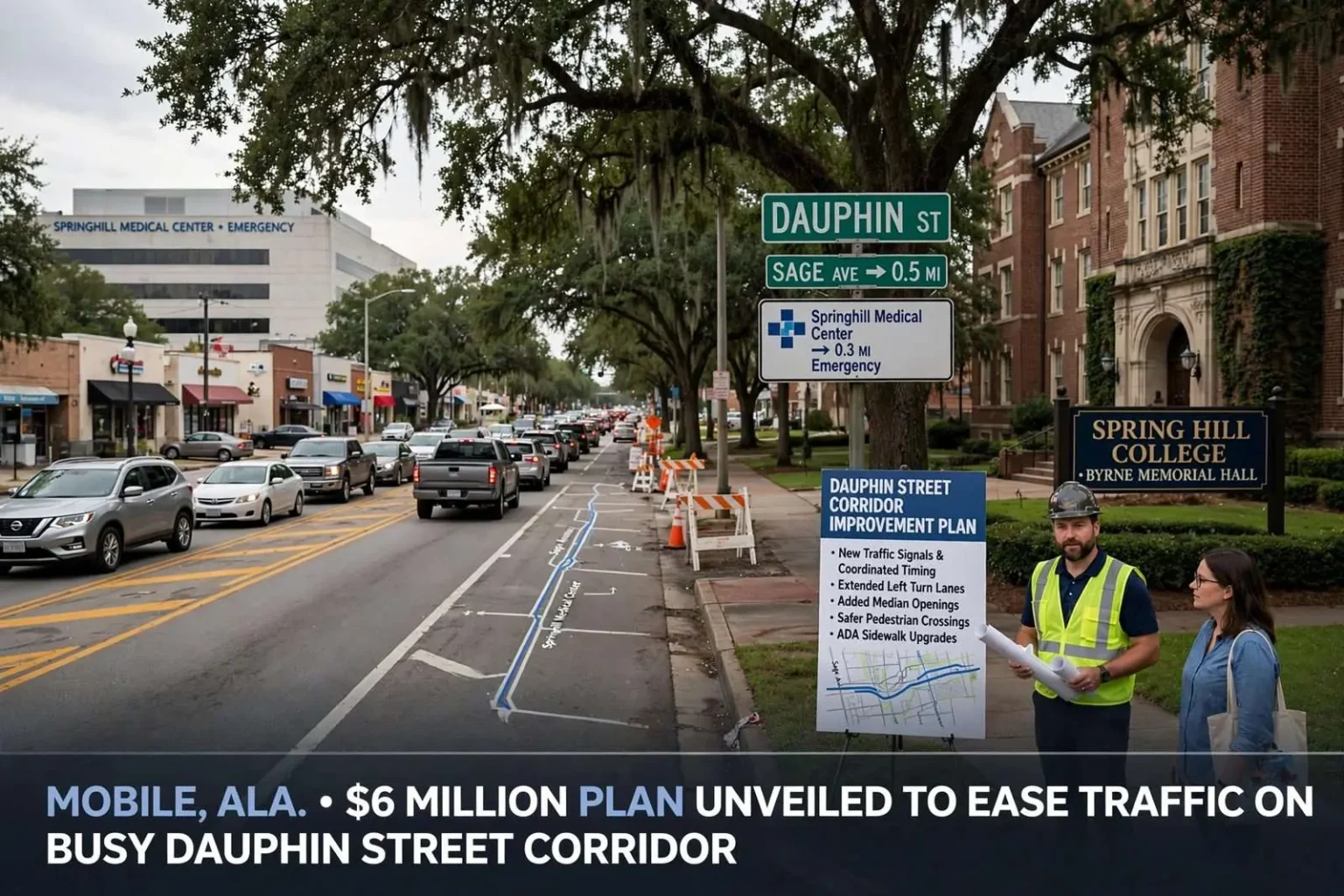
MOBILE, Ala. — The City of Mobile is laying out plans for a roughly $6 million overhaul of a congested stretch of Dauphin Street, and it wants residents to weigh in before work begins. City officials hosted a public information meeting on the project at Spring Hill College’s Byrne Memorial Hall, drawing neighbors, commuters and business owners from one of the busiest corridors on the city’s western side. The meeting marked the point where months of engineering study meet the people who drive the road every day — an exchange city planners say makes projects better and smoother before the first cone goes out.
The redesign targets traffic flow between Sage Avenue and Springhill Medical Center near I-65 West, a segment of Dauphin Street that funnels commuters, college traffic and hospital visitors through some of the densest congestion in west Mobile. Planned improvements include new traffic signals, extended turn lanes and added median openings — a package aimed at the specific failures that make the corridor maddening at rush hour: left turns stacking up behind waiting cars, signal timings out of step with traffic volumes, and mid-block movements that choke through lanes.
Dauphin Street stretches from downtown Mobile’s entertainment district west through Midtown and into the Spring Hill area, making it one of the city’s most traveled east-west arteries. The stretch between Sage Avenue and the hospital sits at the corridor’s western end, where residential streets, the college and the medical center’s campus all discharge traffic onto the same roadway. Anyone who has timed a hospital visit or a class commute badly knows the bottleneck well; the city’s engineers do too, and the project is their answer.
Federal Dollars, Hospital Access
Most of the project will be paid for with federal aid, supplemented by local funds. The arrangement is standard for corridor projects of this scale, drawing on the federal-aid highway programs that flow through state transportation agencies to cities for improvements on locally significant routes. For Mobile, the federal share means a $6 million overhaul costs the city a fraction of that amount — stretching local dollars while addressing a corridor that serves the entire western half of the city.
City Engineer Nick Amberger said the corridor has been under study for some time, and that improving efficiency matters both for businesses along the route and for patients racing to the hospital. Springhill Medical Center anchors the western end of the project area, and its emergency department and medical offices generate a steady stream of traffic for which minutes matter. Amberger’s framing captured the corridor’s dual character: it is both a commercial address for the businesses that line it and, for many drivers, the last stretch of road between them and medical care.
The public meeting at Byrne Memorial Hall put those stakes on display for the neighbors who live with the road daily. Planners were on hand with visual renderings of the proposed modifications, gathering public input to complement the engineering work already done. Residents examined the drawings, asked about specific intersections and access points, and flagged concerns from driveway access during construction to pedestrian safety near the college — the kind of ground-level knowledge that turns a technically sound design into a workable one.
What the Redesign Changes
The improvement package reads like a catalog of modern corridor engineering applied to an old roadway. New traffic signals replace or upgrade intersections where timing and visibility have fallen behind the corridor’s traffic volumes, bringing coordinated signal timing that moves platoons of cars through successive lights rather than stopping them one after another. Extended turn lanes give left-turning drivers a place to wait out of the through lanes — the single biggest relief for corridors like Dauphin Street, where a single turning car can back up traffic for blocks during peak hours. Added median openings are calibrated to keep access to businesses and side streets while channeling turns to safer, engineered locations.
Each element reflects the study work Amberger referenced. Corridor studies count cars, time signals and map crash patterns to find where the road’s geometry fights its traffic. On a stretch that carries commuter surges each morning and evening, hospital traffic around the clock and college traffic on the class schedule, the mismatches accumulate at predictable points — and the renderings displayed at the meeting showed the specific spots the redesign targets.
The $6 million price tag reflects more than asphalt and signals. Utility relocations, drainage work, ADA-compliant sidewalk and curb ramps, and signal hardware all ride along with corridor projects, and federal-aid requirements bring design and review processes that add months before construction can begin. The timeline — construction possibly starting as early as next year — tracks that pipeline from public meeting through final design, right-of-way confirmation and bid letting.
What It Means for the Neighborhoods Along the Route
For the Spring Hill and west Mobile neighborhoods that border the corridor, the project promises shorter, more predictable trips — and a construction period to get through first. The city says it will work to limit traffic impacts and delays for residents, businesses and drivers while the project is underway. That commitment typically means phased construction that keeps at least one lane open in each direction, work scheduled away from peak commuting and hospital visitation hours where possible, and advance notice to businesses and residents before segments in front of their driveways are under construction.
The businesses along the stretch have a particular stake. Corridor construction can choke access to shops and offices whose customers arrive by car, and the city’s planners used the public meeting to hear those concerns directly. The message from officials was that the inconvenience is temporary and the payoff permanent: a corridor that moves traffic efficiently is a corridor where customers can actually arrive.
The hospital access question drew particular attention. Springhill Medical Center’s emergency traffic cannot be rerouted around construction without cost, and the design’s signal and turn-lane improvements are partly aimed at keeping that access reliable — during construction and after it. Emergency responders and hospital officials were among the stakeholders consulted as the design took shape, according to the project’s public materials.
A Corridor with Deep Roots
Dauphin Street is one of the oldest named roadways in Mobile, traced from the French colonial grid of the downtown to the residential reaches of Spring Hill, where the street climbs the low ridges that ring the city’s western side. Spring Hill College, whose Byrne Memorial Hall hosted the project meeting, has anchored the area since the college was founded in 1830 as the first institution of higher learning in Alabama, and its campus generates a daily rhythm of traffic that the surrounding streets have absorbed for generations. Springhill Medical Center, a few blocks west along the corridor, added a modern medical destination to a stretch that once carried little more than neighborhood traffic and the streetcar lines of early-20th-century Mobile.
The corridor’s congestion is, in a sense, a product of the city’s own growth — westward expansion that filled in the neighborhoods between Midtown and the I-65 interchange, turning a quiet residential avenue into a commuter artery without rebuilding it to match. The segment near I-65 West sits where local traffic meets the highway’s flow, and the interchange area’s volumes press onto Dauphin Street at every rush hour. The $6 million redesign is the city’s attempt to bring the roadway’s engineering up to the traffic it actually carries.
Public meetings like the one at Byrne Memorial Hall are the formal mechanism for that kind of catch-up work. Federal-aid projects require public involvement as part of their process, but city officials have increasingly treated the sessions as genuine design input rather than ritual — and the renderings brought to Spring Hill showed designs still open to adjustment based on what residents said.
Looking Down the Road
With construction possibly beginning as early as next year, the corridor’s drivers have a runway to prepare: a winter and spring of final design and bidding before the orange barrels arrive. The city’s pledge to limit traffic impacts and delays will be tested in the details — the sequencing of intersections, the handling of turn-lane construction, the management of hospital access — and residents who attended the meeting will be watching.
When the work is done, the stretch of Dauphin Street between Sage Avenue and Springhill Medical Center is expected to move measurably better: signals timed to the corridor’s reality, turn lanes that keep through traffic flowing, and median openings that preserve access without inviting chaos. For a $6 million investment weighted heavily with federal dollars, the project represents the kind of targeted infrastructure work that pays dividends daily — for the businesses along the route, for the patients and staff of the medical center, and for every west Mobile driver who has ever sat through one more signal cycle on the way home.
Residents who missed the meeting but want to weigh in can contact the city’s engineering department, which will incorporate public comment into the design as the project advances toward construction. The road that carries so much of west Mobile’s daily life is about to get its most significant upgrade in a generation — and thanks to the meeting at Spring Hill College, the neighborhood got its say before the work begins.