Mobile Unveils Kiosks at Government Plaza to Help Small Businesses Get DBE Certified
Mobile's Office of Supplier Diversity has launched two kiosks at Government Plaza to help small, minority, women- and veteran-owned businesses get DBE.
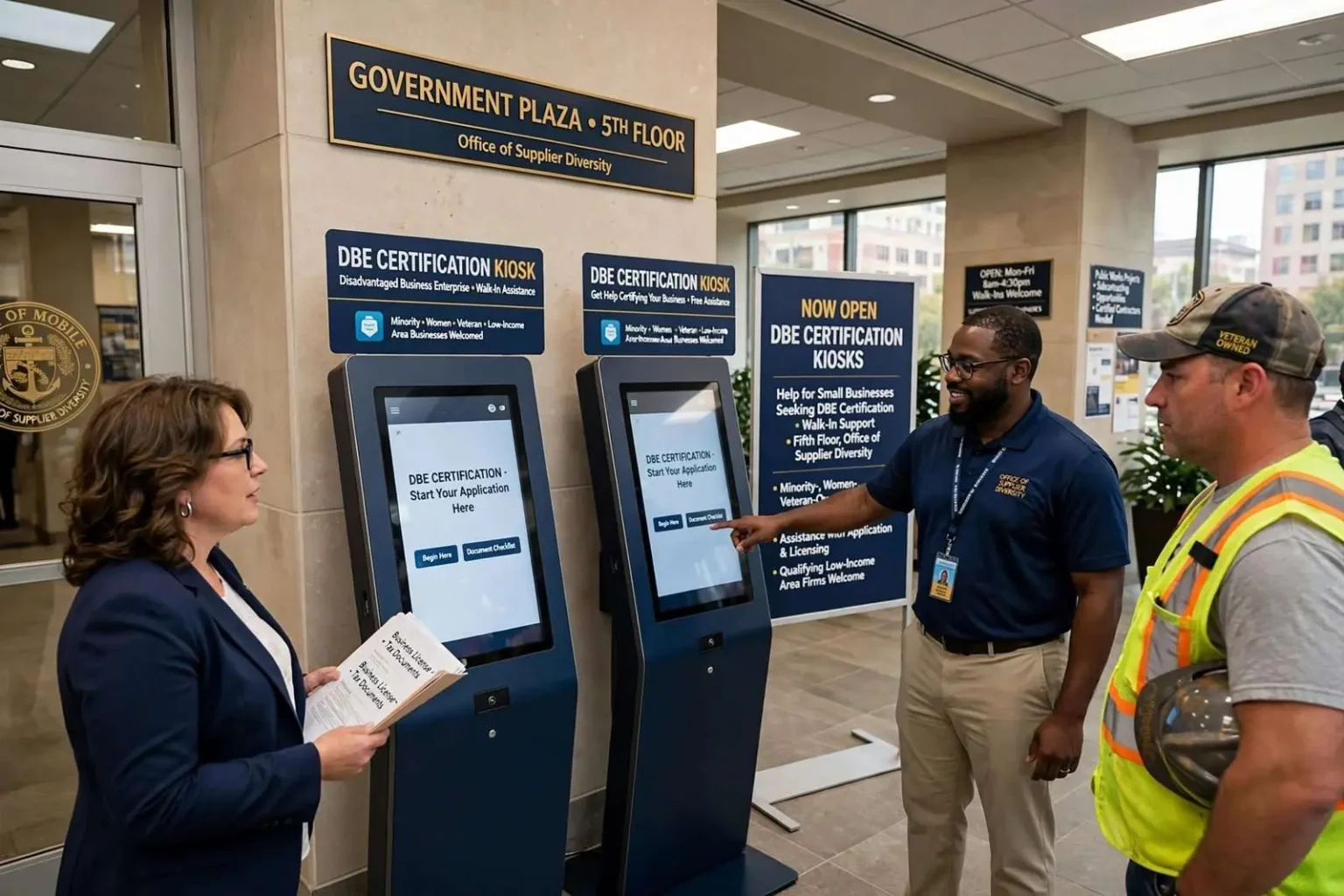
The City of Mobile has installed two new in-person kiosks at Government Plaza designed to help minority-, women- and veteran-owned businesses — as well as businesses in qualifying low-income areas — become certified Disadvantaged Business Enterprises. The kiosks, located on the fifth floor of Government Plaza, were unveiled by the city’s Office of Supplier Diversity as a walk-in point of entry for business owners who want to compete for public contracts but have found the certification process daunting.
City leaders say the initiative will benefit Mobile’s economy by expanding the pool of certified contractors available for public projects. “We have a need for contractors whether it be roofers, electrical, concrete, anything that has to do with maintenance… painters especially,” said Archnique Kidd, the city’s Supplier Diversity Manager. “That helps to get those contractors in and make sure they get the proper licensing.”
What DBE certification is
A Disadvantaged Business Enterprise certification is a federal designation, rooted in the U.S. Department of Transportation’s DBE program, that qualifies a business to count toward participation goals on government-funded projects. To qualify, a firm must be at least 51 percent owned and controlled by one or more socially and economically disadvantaged individuals — a category that includes women, minorities and, in many local programs, service-disabled veterans — and its owners must meet federal personal net worth limits and demonstrate genuine management control of the business.
Certification matters because public agencies routinely set participation goals on construction and professional services contracts, requiring prime contractors to subcontract a share of the work to certified firms. A roofing company, an electrical contractor or a painting crew that holds DBE certification can be counted toward those goals; an equally qualified firm without the certification often never gets the call. In that sense, certification functions as the entry ticket to a pipeline of public work that can transform a small business’s revenue.
The process itself has historically been the obstacle. Applicants gather tax returns, financial statements, ownership documents, licenses and proof of control over day-to-day operations, then submit to an eligibility review that can take weeks. For a two-person painting company or a family concrete crew, assembling that paperwork without help can be the point where a worthy application stalls — which is exactly the problem a staffed kiosk on the fifth floor of Government Plaza is designed to solve.
Why the city built the kiosks
Government Plaza, the landmark shared city-county building in downtown Mobile, houses the offices where much of this work happens, and placing the kiosks on its fifth floor puts business owners steps away from the Office of Supplier Diversity staff who review certifications and field questions. Rather than requiring applicants to navigate the process online or by mail, the kiosks create an in-person path: walk in, get help assembling documents, ask questions of the people who will actually evaluate the file.
For the Office of Supplier Diversity, the kiosks are the latest tool in a mission that reaches beyond paperwork. The office works to grow the number of minority-, women- and veteran-owned firms doing business with the city, connect those firms with prime contractors, and make sure vendors understand licensing requirements before they bid. Kidd’s description of the need — roofers, electrical, concrete, maintenance trades, painters especially — reads as a practical inventory of the subcontracting categories that show up on public projects again and again.
The economics behind the effort are straightforward. Mobile spends public money on streets, buildings, parks and utilities, and every public project is an opportunity for local dollars to circulate through local firms. When the pool of certified subcontractors is thin, participation goals go unmet, money flows to out-of-town firms, and small local businesses miss the chance to build track records that lead to bigger contracts. Expanding that pool keeps more of the city’s infrastructure spending in Mobile.
The kiosks arrived at a moment when Mobile’s building boom made the need visible. Projects across the city — public and private — have bid out work in every trade, and contractors routinely report difficulty finding enough qualified subs to cover their schedules. A larger roster of certified firms helps primes meet participation requirements, helps the city demonstrate that its contracting reflects the whole community, and helps owners of small firms who have the skills but not yet the credentials.
The push also carries the weight of history. Minority- and women-owned firms have long been underrepresented in government contracting across the South, facing barriers that range from access to capital and bonding to the informal networks through which contracts have traditionally been awarded. Supplier diversity programs, including the federal DBE framework, exist precisely to counteract those barriers — not by lowering standards, but by making sure qualified firms know about opportunities, get certified, and get a fair shot at the work.
Who qualifies and how to start
The kiosks serve a broad cross-section of Mobile’s small business community. Minority-owned businesses, women-owned businesses and veteran-owned businesses all fall within the target population, and so do firms located in qualifying low-income areas — a recognition that geography, as much as ownership, shapes who has historically had access to public contracts. A painter working out of a neighborhood shop, a veteran-run landscaping crew, a woman-owned janitorial service: all are the kinds of firms the city hopes will walk up to a kiosk.
The process typically starts with the basics. Business owners need their entity registration, tax identification, applicable state or municipal licenses, and documentation of ownership. From there, the eligibility review examines control — who signs the contracts, who manages the crews, who makes the financial decisions — because certification depends on the disadvantaged owner genuinely running the firm, not lending a name to it. Staff at the kiosks can walk applicants through each requirement and connect them with licensing help where a trade license is missing.
Kidd’s emphasis on “proper licensing” is a practical point worth underlining. Certification and licensing are separate hurdles, and a firm that arrives at a kiosk missing the trade license its work requires leaves with a to-do list rather than a certification. By pairing the two conversations — certification and licensure — in one place, the city hopes to shorten the distance between a qualified tradesperson and a public contract that fits their skills.
What it means for Mobile’s contractors
For established prime contractors, a deeper certified pool changes how they build bids. Participation goals are easiest to meet when there are more certified firms to hire, and relationships formed through the Supplier Diversity office can turn a goal on paper into working relationships on job sites. For the certified firms themselves, the first subcontract on a public project is often the beginning of a track record — performance documentation, references and bonding capacity that open doors to larger private work.
For the wider community, the kiosks represent a modest piece of equipment with an ambitious goal behind it: a city where the firms that help build Mobile’s streets and buildings look more like Mobile itself. Business owners interested in DBE certification can visit the kiosks on the fifth floor of Government Plaza, where the Office of Supplier Diversity can begin the process in person.
The kiosk model itself reflects how governments have rethought access over the past decade. Earlier generations of certification assistance meant office hours, appointments and, often, a daytime visit that required a business owner to close the shop. Self-service terminals staffed by knowledgeable employees split the difference: owners keep control of their own applications while getting expert help on the spot, and the city captures applications it would otherwise never see.
Mobile’s effort fits within a broader Gulf Coast push. Ports, transit agencies, airports and municipalities across the region all administer or participate in disadvantaged business programs, and regional cooperation on certification — recognizing certifications across jurisdictions where allowed — has been a recurring goal of small business advocates. Every public body that simplifies its own process raises the odds that a certified firm in Mobile also competes for work in Baldwin County, along the Gulf and across state lines.
For the business owners the program targets, the advice from suppliers-diversity offices tends to be consistent: start before the bid you want. Certification takes time, and primes assemble their subcontractor lists while preparing bids, not after winning. A firm that completes certification now positions itself for the next cycle of public projects, from routine maintenance contracts to the larger construction packages that Mobile’s growth keeps producing.
The two kiosks on the fifth floor of Government Plaza will not, by themselves, balance the contracting ledger. But as an entry point — a place where a painter, a roofer, an electrician or a veteran-owned crew can walk in with questions and leave with a plan — they target the exact bottleneck that Supplier Diversity Manager Archnique Kidd described: getting those contractors in, and making sure they get the proper licensing. Each new certified firm adds one more name to the list of businesses that can say they helped build the city.