Mobile Warehouse Opens as Emergency Cold Weather Shelter for People Experiencing Homelessness
An 8,000-square-foot warehouse near Ladd-Peebles Stadium opens as an emergency shelter for homeless residents as temperatures drop toward freezing.
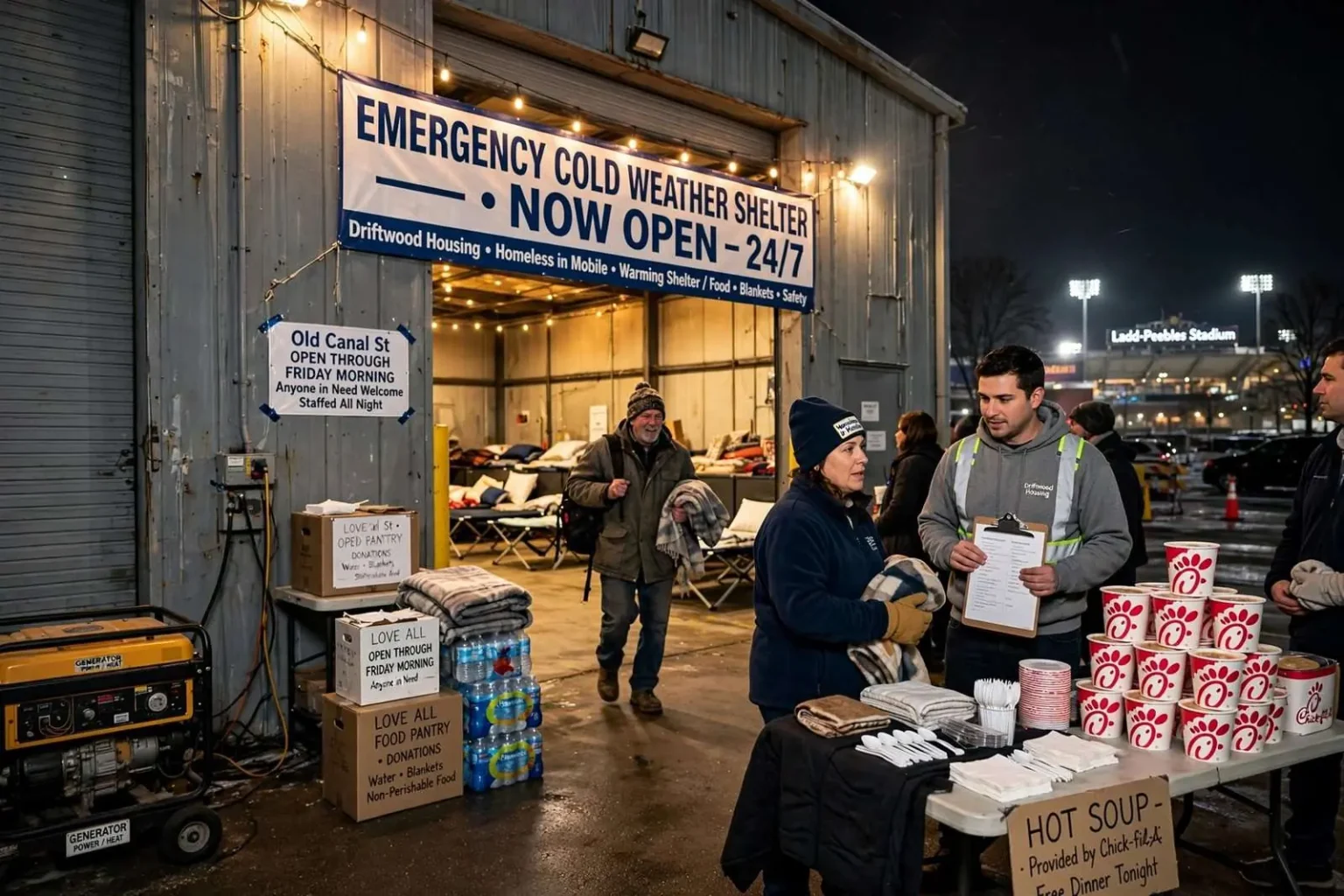
An 8,000-square-foot warehouse on Old Canal Street near Ladd-Peebles Stadium has been converted into an emergency cold weather shelter, offering people experiencing homelessness a warm place to sleep as temperatures drop toward freezing. The shelter, operated by Driftwood Housing and the Homeless in Mobile group, opened Tuesday and was slated to remain open through Friday morning — a window covering the coldest nights of the forecast.
The facility is equipped with a generator, blankets, and food, and the operation came together quickly as the forecast turned. The Love All Food Pantry donated additional food and water, and Chick-fil-A provided soup for the first night’s dinner, giving organizers the supplies to feed every guest who came in from the cold.
“If you know someone who is on the street… you can bring them here,” said Dale Pfeiffer, co-founder of Homeless in Mobile. “We’ll be here all night long, and we have other individuals that are managing the facility, so they can bring them out.”
Eleven people stayed at the shelter Tuesday night, the first night of operation. Volunteers planned a potluck for Wednesday and Thursday evenings, turning the warehouse’s common space into a shared meal while temperatures outside fell toward freezing. Pfeiffer said the warehouse is intended to serve as temporary housing for people experiencing homelessness in the near future, beyond the immediate cold snap — a step beyond a one-time emergency opening and toward a standing resource for the city.
Community Effort Fills a Gap as Temperatures Plunge
The shelter represents a rapid community response to a forecast calling for near-freezing overnight lows. Mobile does not experience sustained hard freezes often, but when overnight lows approach freezing, exposure becomes a life-threatening risk for people living outdoors, particularly older adults and people with chronic health conditions. Hypothermia can develop in temperatures well above freezing when wind and dampness are factors, and unsheltered residents sleeping outdoors have no way to warm up once the cold settles in.
With established shelters often at capacity, the warehouse provides surge capacity during the most dangerous conditions. Mobile’s existing shelter system serves many people year-round, but emergency capacity is the crucial variable on a cold night: a shelter that is full at 6 p.m. cannot absorb the additional people who seek warmth as the temperature drops. The Old Canal Street warehouse adds beds precisely on the nights when the alternative is a parking lot or a park bench.
Organizers emphasized that anyone in need is welcome, and the facility is staffed around the clock while open. The 8,000-square-foot space allows for separate sleeping areas, storage for personal belongings, and room for the cots, blankets and food supplies that make an overnight stay survivable. The generator on site ensures heat and lights remain on even if severe weather disrupts power in the surrounding area.
The Organizations Behind the Shelter
Driftwood Housing and the Homeless in Mobile group partnered to open the facility, combining housing-focused resources with the grassroots outreach that Homeless in Mobile has built through its street-level work in the city. Pfeiffer’s organization operates largely through volunteer networks and social media coordination, and its co-founder said the warehouse model emerged from the recognition that Mobile needed surge capacity when cold fronts push through.
The donations that stocked the shelter’s first night illustrate how the operation functions. The Love All Food Pantry contributed additional food and water to supplement the shelter’s supplies, and Chick-fil-A provided soup for the first night’s dinner. Local businesses and food ministries have long played that role in Mobile’s homeless response, filling immediate needs faster than formal systems can, and the first night’s dinner came together through exactly those networks.
Volunteers planned a potluck for Wednesday and Thursday evenings, turning the shelter’s operation into a community effort in both directions — people experiencing homelessness receiving meals and warmth, and neighborhood residents contributing dishes, time and blankets. For the eleven people who stayed Tuesday night, the meal was as practical as the cots: a hot dinner is part of the body’s ability to hold warmth through a cold night.
Why Cold Weather Kills
The urgency behind cold weather shelters comes from the physiology of exposure. Hypothermia sets in when the body loses heat faster than it can produce it, and wind and dampness accelerate that loss dramatically. A night in the 30s with wind and wet ground can be as dangerous to an unsheltered person as far colder temperatures would be indoors, and chronic conditions, medications and exhaustion all lower the threshold. Emergency rooms and street outreach teams see the consequences every winter: hypothermia cases, frostbite and amputations among people who could not find a warm place to sleep.
Mobile’s winters are mild by national standards, which makes the city’s cold-weather infrastructure thinner than northern cities’. When a hard freeze does arrive, the small number of beds can be overwhelmed in a single night. That gap is what the Old Canal Street warehouse is designed to bridge — a building large enough to scale up quickly, in a location accessible to the areas where unsheltered residents congregate, activated by organizations that already know the people who need it.
A Location Near Ladd-Peebles
The warehouse sits on Old Canal Street near Ladd-Peebles Stadium, in the corridor between Mobile’s downtown and the city’s western neighborhoods. The location matters: it is close to the areas where many people experiencing homelessness already spend their days, and accessible to the outreach workers and volunteers who coordinate with them. The building’s size gave organizers room to configure sleeping quarters, a food service area and storage within a single secure space.
Pfeiffer said the warehouse is intended to serve as temporary housing for the homeless in the near future beyond the immediate cold snap — a longer-term use that would take the facility from an emergency activation to a standing part of the city’s safety net. Transitional housing of that kind bridges the distance between a shelter cot and permanent supportive housing, giving residents a stable address while they work toward income, documents and permanent placement.
The shelter’s opening also reflects how homeless outreach actually works in Mobile. Street outreach workers and volunteers know by name many of the people sleeping outside, and when a cold shelter opens, the fastest way to fill it is a car ride: outreach teams go to the camps, underpasses and parking lots where people stay, explain what is available, and offer a ride to the warehouse. Pfeiffer’s message to the public — “If you know someone who is on the street… you can bring them here” — extends that invitation to everyone, making every resident a potential outreach worker on the coldest nights.
“We’ll be here all night long, and we have other individuals that are managing the facility, so they can bring them out,” Pfeiffer said. The around-the-clock staffing means the shelter does not turn people away because they arrive at 2 a.m., and it means families or friends who locate someone on the street can deliver them to warmth at any hour.
How to Help or Get Help
Organizers stressed that anyone in need is welcome at the shelter, and they encouraged the public to spread the word to anyone they know who is sleeping outdoors. People who encounter someone on the street during a cold night can bring them directly to the warehouse on Old Canal Street, where staff are present all night long to receive them. The facility’s hours were slated to run through Friday morning, covering the coldest nights of the forecast window.
For more information, Pfeiffer can be reached via Facebook, where Homeless in Mobile coordinates its volunteer sign-ups, donation requests and real-time updates during weather activations. The organization’s social media presence has become a de facto dispatch system for the city’s grassroots homeless response — spreading word of cold shelters, collecting blanket and food donations, and connecting individuals with the services available to them.
Donations of blankets, warm clothing, food and bottled water are the most consistently needed items during cold weather activations, and the Love All Food Pantry’s contribution demonstrated the scale of need an 8,000-square-foot facility can absorb. Financial contributions to the organizations operating the shelter help cover the generator fuel, heating costs and supplies that keep the facility running through a cold snap and toward its planned use as temporary housing.
The Broader Picture of Homelessness in Mobile
The warehouse opening fits into a larger conversation about homelessness in Mobile County. The city’s unsheltered population includes people displaced by job loss, medical bills, disability and the tight local housing market, and the gap between shelter capacity and need becomes visible every time the weather turns dangerous. Emergency activations like this one are the visible tip of that gap; the longer-term work — permanent supportive housing, rental assistance, and coordinated intake across agencies — happens year-round and depends on the same organizations now staffing the warehouse.
Cold weather shelters also serve an outreach function beyond a single night. Every person who comes in from the cold is a person connected to services: outreach volunteers learn names, needs and obstacles, and the trust built over a hot meal and a warm night often becomes the first step toward housing. The eleven people who stayed Tuesday night are, in that sense, the beginning of a caseload, not just a headcount for one cold snap.
For now, the measure of the shelter is simpler: eleven people slept warm Tuesday night who otherwise would not have, and the volunteers planned potlucks, staffed the building and kept the generator running to make sure that number grew as the cold held. Anyone in need of shelter, or anyone who knows someone who is, can find the warehouse on Old Canal Street near Ladd-Peebles Stadium, staffed all night long for as long as the cold lasts.