
Mobile Weighs Trust in Police as Michael Moore Shooting Probe Continues Amid National Unrest
As federal investigators continue examining Mobile police's fatal shooting of Michael Moore, residents are weighing how last week's police shootings in Baton Rouge, St. Paul and Dallas should shape the push for greater trust between officers and the community.
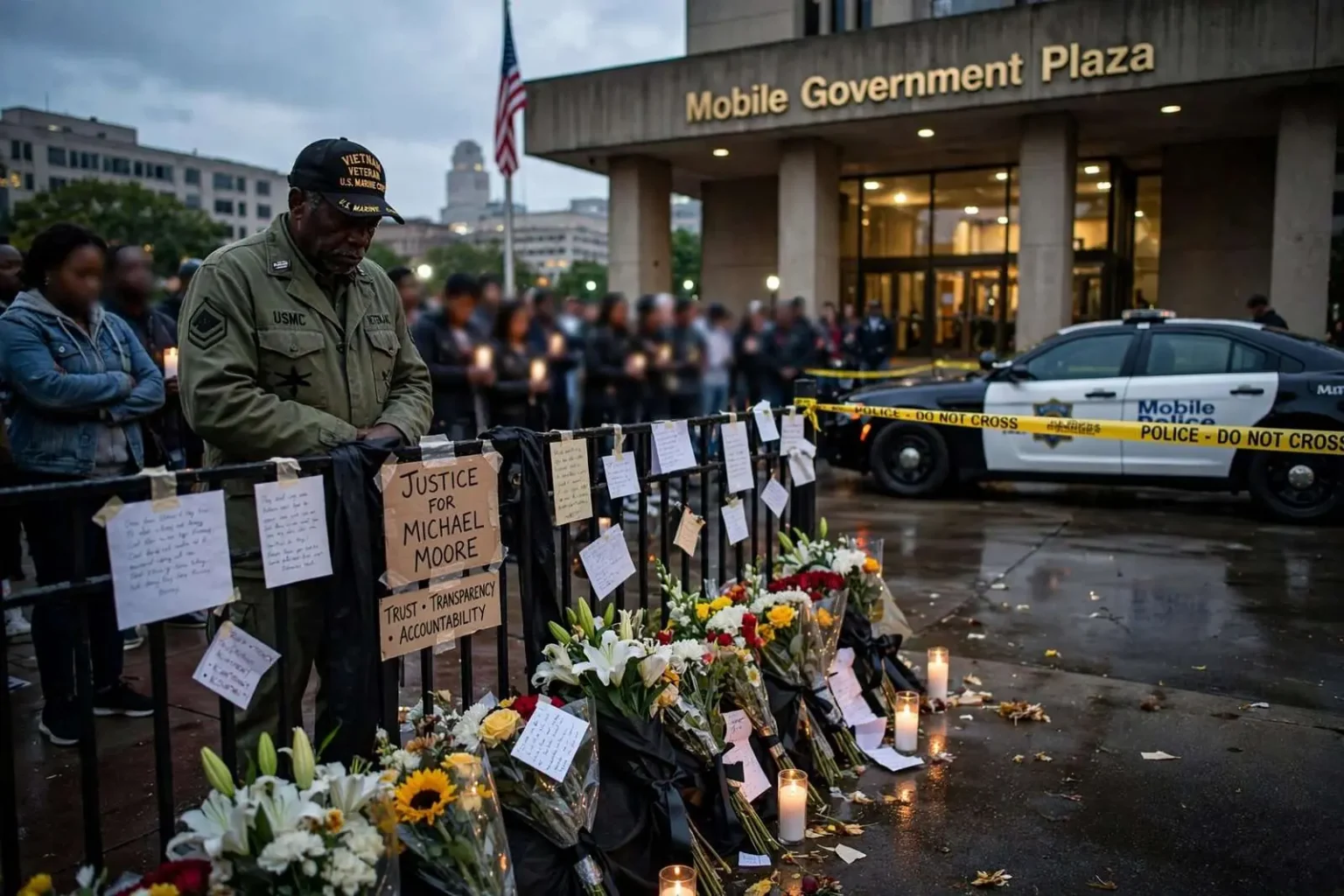
A string of deadly police shootings across the country last week has renewed a local conversation in Mobile about trust between law enforcement and the communities officers serve, even as federal investigators continue examining the case of Michael Moore, a Mobile man killed in an encounter with city police.
Within a 72-hour span, the nation absorbed the deaths of seven people connected to policing: two black men killed by officers in separate incidents in Baton Rouge, Louisiana, and St. Paul, Minnesota, and five Dallas police officers gunned down by a lone attacker who told negotiators he wanted to kill white officers in retaliation.
The back-to-back tragedies, arriving just days after the Fourth of July, have left community leaders in Mobile and elsewhere searching for a way to process grief on multiple sides of an increasingly raw national debate.
What has made the loss in Dallas especially difficult for many observers to reconcile is that the department there was widely regarded as one of the more progressive law enforcement agencies in the country. Its leadership had invested in initiatives specifically designed to build bridges with residents in high-poverty neighborhoods, a reputation that has only sharpened the national debate over whether community policing reforms are sufficient on their own or must be paired with deeper accountability measures to restore public trust.
In Mobile, that debate has a local anchor. The U.S. Attorney’s Office and the FBI are continuing to investigate the shooting of Michael Moore by Mobile police, a case that has drawn sustained attention from residents who want answers about what happened and why. Federal authorities have not announced a timetable for concluding the inquiry.
The Mobile Police Department has spent the past several years shifting its approach to high-crime areas, moving away from large-scale roadblocks and sweeps toward more targeted policing strategies paired with programs aimed at building relationships in neighborhoods that have historically had strained relations with officers. Department leadership has pointed to that shift as evidence of a broader effort to reform how officers engage with the community, even as the Moore case tests public confidence in that effort.
Community members who have followed the case say the national wave of violence has made local patience, and local scrutiny, more urgent at the same time. Advocates for police reform argue that incidents like the Moore shooting cannot be dismissed as isolated, while others caution against assuming systemic failure before an investigation is complete.
That tension has echoes in Mobile’s own history. Community members who came of age during the civil rights era and the more militant currents of the late 1960s and early 1970s say they recognize elements of that period in the frustration expressed by younger residents today, particularly a wariness that promises of equal treatment under the law will not be kept. Longtime observers of Mobile’s civic life say that recognizing those historical parallels, without excusing violence in any direction, is part of what will be required to move the city forward.
One of those longtime observers is a Mobile man who served in the Marine Corps during the Vietnam era and, after enlisting, was drawn into a secret group of black servicemen known as the Mau Mau, named after the Kenyan independence fighters of the 1950s and ’60s. Forged partly in the jungles of Vietnam, the group held an explicit hostility toward whites and dismissed nonviolence as a waste of time, believing American society would never grant full equality to black citizens without being forced to.
He has said it was ultimately the pull of family and faith, along with distance from that military-era environment, that changed the course of his life. Reflecting on the current moment, he has said he sees echoes of that same anger and the same loss of faith in the country’s stated ideals building among young Black residents today, which he considers a warning sign worth heeding rather than dismissing.
President Barack Obama, addressing the nation after the Dallas ambush, called the attack on officers indefensible while also acknowledging the deeper pattern that had set off protests in Baton Rouge and St. Paul. He described the disproportionate number of black men killed in encounters with police as a problem the whole country, not just black or Hispanic communities, needs to own and address.
Officials with the Mobile Police Department have said they welcome scrutiny of the Moore investigation and have pledged cooperation with federal investigators. Community leaders, meanwhile, are urging residents to give the U.S. Attorney’s Office and the FBI room to complete their work while continuing to press for transparency.
For now, the case remains open, and no findings have been released publicly.
The national shootings
The two men killed by police that week were Alton Sterling, who was shot July 5 outside a convenience store in Baton Rouge, and Philando Castile, who was shot July 6 during a traffic stop in Falcon Heights, a suburb of St. Paul. The five Dallas officers were killed on the night of July 7 by a gunman who opened fire as a peaceful downtown protest march was ending.


