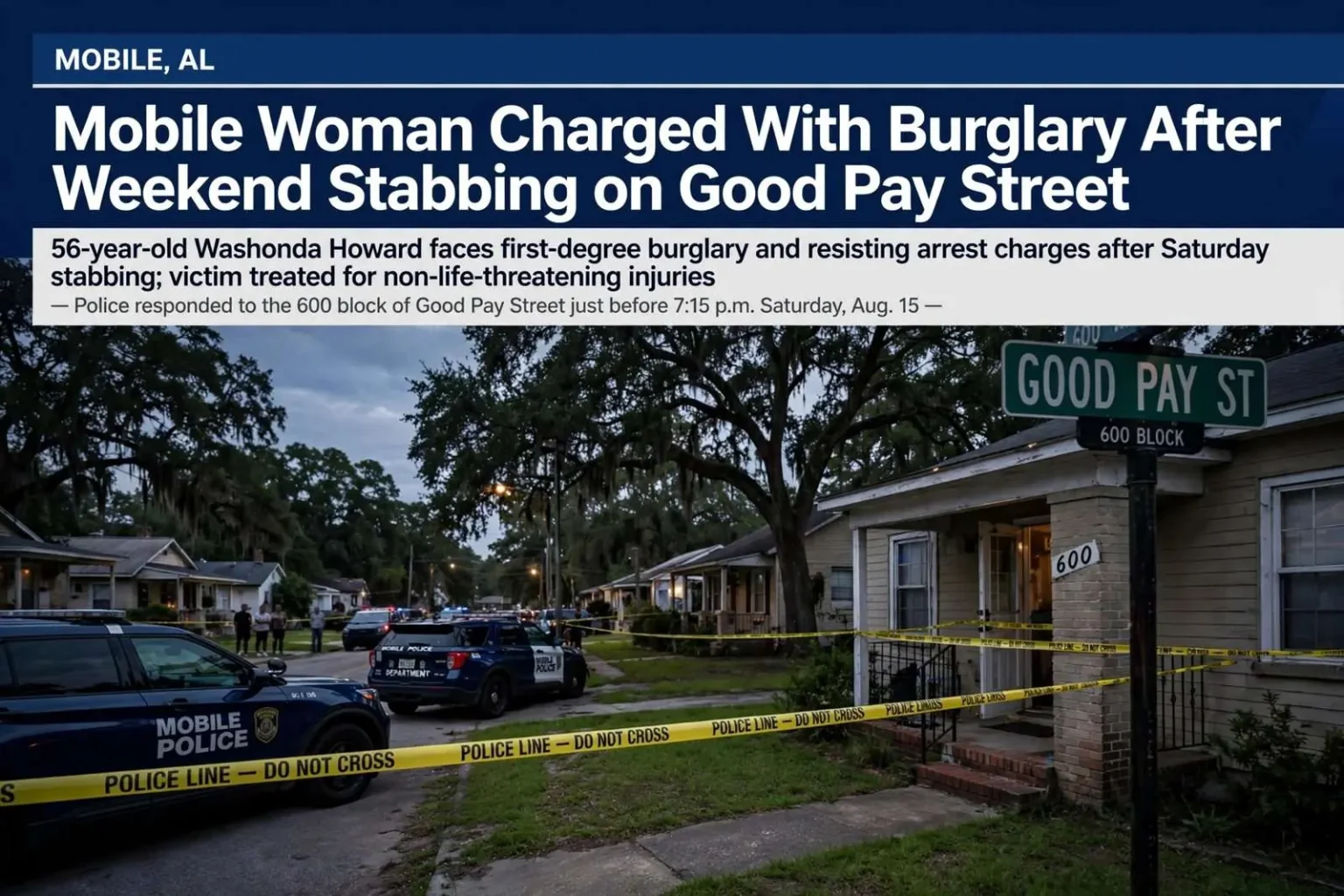
A Mobile woman is facing burglary and resisting arrest charges after police say she stabbed another woman during a confrontation over the weekend. According to the Mobile Police Department, officers were called to the 600 block of Good Pay Street just before 7:15 p.m. Saturday, Aug. 15, in response to a stabbing. When officers arrived, they found a woman with non-life-threatening injuries.
Police said the victim knew the woman accused of cutting her, and that the stabbing occurred during a fight between the two. Investigators allege the suspect, identified as 56-year-old Washonda Howard, broke into the victim’s home before the altercation, leading to a first-degree burglary charge. Howard is also accused of resisting arrest, though police have not detailed how she allegedly resisted. She was taken into custody and booked into Mobile County Metro Jail.
The Mobile Police Department has not released additional details about the relationship between the two women or the circumstances that led to the fight. Detectives continue to work the case, and charges could be adjusted as investigators piece together what happened inside the home in the minutes before officers arrived. This story may be updated as more information becomes available.
For neighbors on Good Pay Street, the episode was a jarring one for a residential block. Stabbings are uncommon in most Mobile neighborhoods, and a violent incident on a summer Saturday evening draws immediate attention — patrol cars on the street, tape across a doorway, and questions from residents who saw the response but not the events behind it.
What the charges mean
First-degree burglary is a serious felony under Alabama law. The charge generally applies when a person unlawfully enters a building with the intent to commit a crime inside, and the offense rises to first degree when the building is a dwelling, when someone is present inside, or when the intruder is armed or causes injury. The allegation that Howard broke into the victim’s home before the altercation is what elevates the case from a simple assault to burglary.
Because the charge involves an occupied dwelling, a first-degree burglary conviction in Alabama carries a potential sentence measured in decades, not years. That severity reflects the law’s judgment that a person’s home is entitled to the strongest protection on the books — an intruder who enters a residence where someone is present commits one of the most heavily punished property-adjacent crimes in the state.
The resisting arrest count is a separate, typically misdemeanor charge. It alleges that Howard physically interfered with officers as they took her into custody. Police have not described the alleged resistance, and such details often emerge later — in arrest affidavits, court filings or testimony — rather than in the initial release.
The police response
The timeline of the response began with the 911 call shortly before 7:15 p.m. Dispatch sent officers to the 600 block of Good Pay Street, where they located the injured woman. Medics treated her injuries, which police described as non-life-threatening, and the victim was able to tell officers what had happened — including, according to the department, that she knew the person who cut her.
Identifying a suspect quickly in cases where the parties know each other is common, and the arrest followed within the same weekend. Howard was booked into Mobile County Metro Jail on the two charges. The jail, located downtown, processes most of the arrests made by MPD and other municipal agencies in the county, holding defendants ahead of initial court appearances.
From there, the case moves into the court system. An initial appearance before a district court judge typically comes first, where bond is set and the defendant is advised of the charges. Preliminary hearings and grand jury review follow in felony cases — the grand jury decides whether the evidence supports formally indicting Howard on the burglary count. Throughout, the police department’s public account remains limited to what investigators have confirmed.
How Mobile police handle domestic-adjacent violence
Although police have not described the relationship between the two women, the case carries the markers of violence between people who know each other — a fact that matters both to investigators and to advocates. Violence between acquaintances, family members or intimate partners follows different investigative paths than stranger violence, and it connects to a wider public health problem: a large share of assaults nationwide are committed by someone the victim knows.
Mobile police, like departments across the country, coordinate with victim advocates and support services in cases where the parties know one another. Protective orders, safety planning and follow-up checks are standard tools. The department’s decision to withhold details about the relationship is consistent with that approach — releasing them could complicate the investigation or expose details the parties have not made public.
The non-life-threatening nature of the victim’s injuries is the episode’s one unqualified relief. Stabbings turn fatal quickly, and the difference between a hospital stay and a homicide investigation often comes down to minutes of medical care. That the victim survived means detectives can build the case with her account — the single most important piece of evidence in an incident with no independent witnesses reported.
The neighborhood context
Good Pay Street sits in central Mobile, part of the grid of residential streets where most of the city’s population lives well away from the downtown entertainment district. Incidents like Saturday’s stabbing are the sort that rarely make headlines beyond a short police-blotter account, yet they shape how residents feel about their blocks — doors locked a little earlier, porch conversations about who was taken away and why.
Police departments nationwide have leaned on community cooperation in exactly these cases: tips, doorbell camera footage and witness accounts often determine whether a case moves forward. Mobile is no exception, and MPD routinely asks anyone with information about an incident to come forward. On a residential block where the two women apparently knew each other, investigators will be working from a small circle of people likely to know what preceded the fight.
The case now sits where most such cases sit: with detectives, a case file and a court calendar. The charges are serious, the victim’s injuries were not, and the full story of what happened inside a home on Good Pay Street on Aug. 15 will come out — if it comes out at all — one hearing at a time.
The booking process at Mobile County Metro Jail documents each arrest in detail — the charges listed, the bond amounts set, and the identity of the arresting agency. Those records are public, which is how arrest reports like Howard’s become the basis for news accounts. What the records do not include is the story behind the arrest: the arguments, the history between the parties, the moment a fight became a stabbing. That context arrives, when it arrives, through court proceedings.
Defense attorneys in burglary cases typically focus on the entry itself — whether it was unlawful, whether intent to commit a crime inside can be proven, and whether the statements tying a suspect to the scene were obtained properly. Prosecutors, for their part, will weigh the victim’s account, any physical evidence collected from the home, and the circumstances of the arrest. Cases built on an admission-laden scene and an identified suspect tend to move efficiently through the system, but every step still takes weeks or months.
The 600 block of Good Pay Street will not see the case play out on its sidewalks. From the arrest forward, the matter belongs to the courthouse — arraignment dates, filing deadlines, plea negotiations or trial dates that unfold on schedules most residents never see. The neighborhood’s part ends with what witnesses tell detectives and what the record shows about a Saturday evening that went badly wrong.
Staying informed as the case develops
Police said the investigation is ongoing in the sense that all such cases are: details not yet released may still be confirmed, and initial accounts are always subject to revision. Local news outlets typically track felony cases like this one through key milestones — indictment, bond modification, plea or trial — and updates become more substantial once court filings become public.
For residents wondering what to make of the initial account, the limited details are normal. An arrest announcement is a snapshot: who was booked, on what charges, and the bare outline of the allegation. Departments withhold more when releasing it could compromise the case, and when the facts are still being verified. The Aug. 15 stabbing report will fill in over time, and this story may be updated as more information becomes available.
What is known now is enough to sketch the outline: a fight between two women who knew each other, a home that police say was broken into before the fight, a victim whose wounds were not life-threatening, and a 56-year-old Mobile woman facing first-degree burglary and resisting arrest charges in the Mobile County Metro Jail. The rest — the relationship, the circumstances, the outcome — belongs to the process that started with a 911 call on a Saturday evening and will end in a Mobile courtroom.