Mobile woman shares her story of survival to urge others facing domestic violence to get help
A Mobile woman shared her domestic violence survival story to encourage others to seek help, and listed local resources including Penelope House and The.
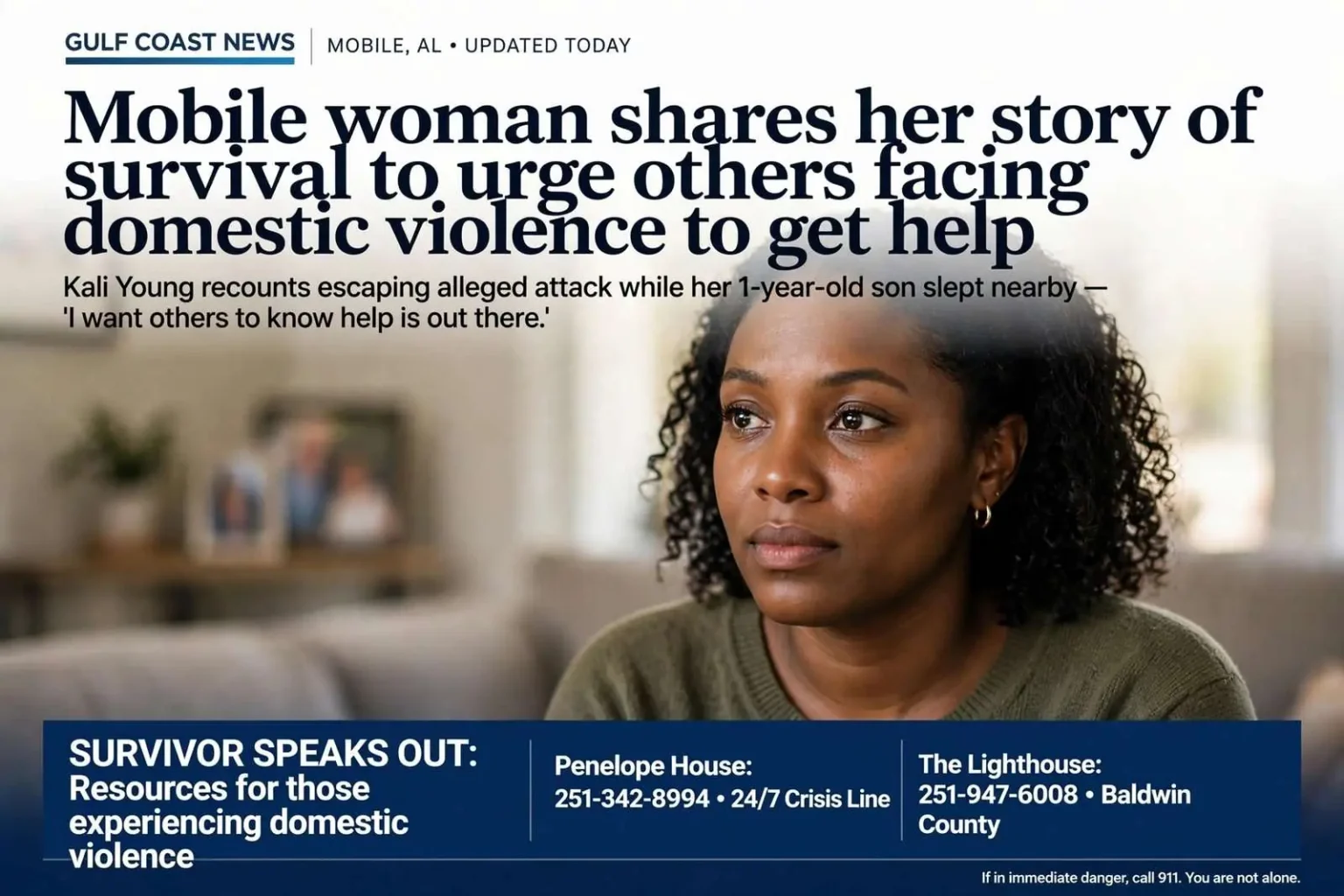
A Mobile woman is sharing her experience surviving an alleged domestic violence attack, hoping her story will encourage others to seek help. Kali Young recounted the night she says she had to fight for her life, with her 1-year-old son asleep in the next room — a detail she says is both the most terrifying part of the memory and the reason she decided to speak publicly about what happened to her.
Young described being grabbed by the neck and struck during the alleged attack. Strangulation is among the most serious warning signs recognized by domestic violence experts and prosecutors alike: victims who are strangled by a partner face dramatically elevated risks of being killed by that same partner later, which is why the offense carries its own enhanced charge in Alabama law. What can look, to an outside observer, like “just a fight” is treated by medical and legal professionals as a documented step on a well-known escalation curve.
What Young says saved her was quick thinking under pressure. She said she was able to text her boss on a work cellphone to call police — a reminder that help does not always come through the obvious channel. For victims whose phones are taken, monitored or out of reach, reaching anyone who can call 911 on their behalf can be the difference that ends an attack. Advocates note that employers, neighbors and friends who unexpectedly receive a plea for help should always take it seriously and make the call rather than assume it is a mistake.
Lance Lucas was booked into the Mobile Metro Jail after the incident and charged with third-degree domestic violence, domestic violence by strangulation and resisting arrest, according to authorities. The strangulation charge reflects Alabama’s enhanced penalty for that specific act, and the resisting arrest count stems from the response that followed the emergency call. The allegations against him have not been proven in court, and he is presumed innocent until prosecuted under the law.
Going Public
Young’s post about the attack was shared nearly 2,000 times, a reach that extended her story far beyond her own circle of friends within days. She said messages from other women revealed similar experiences — private accounts, sent in response, that echoed the details of her own night. The response illustrated what domestic violence advocates say they see constantly: abuse thrives in silence, and survivors who speak up often discover they are speaking for dozens of others who have not yet found their own moment to do so.
The decision to go public is never simple. Survivors weigh embarrassment, fear of retaliation, worry about family and coworkers finding out, and the pain of reliving the worst night of their lives every time the story is retold. Young said she chose openness deliberately, believing that if even one frightened woman sees her story and calls for help, the exposure is worth the cost. That calculus is one advocates encourage more survivors to consider on their own timetable — with no obligation to share publicly and full control over what is told.
The case also points to the pattern behind the pattern. Records reviewed by the news outlet showed Lucas has multiple prior domestic violence charges, some involving strangulation, dating to 2015. That history is depressingly familiar to advocates and prosecutors in Mobile County: the men and women who end up charged in the most serious domestic violence cases frequently arrive at that moment with a paper trail of earlier charges, dismissed cases and plea agreements stretching back years. Researchers who study intimate partner violence have long noted that strangulation in particular is a repeat behavior, and that offenders with strangulation histories pose the highest danger to their partners.
For the courts, that history is both an investigative tool and a hard problem. Prior charges can support enhanced prosecution, inform bail arguments and guide protective-order decisions, but they also depend on victims willing to press forward through a process that can take months. Domestic violence dockets in Alabama’s circuit courts remain among the busiest in the state’s criminal system, and Mobile County’s specialized handling of these cases — including victim advocates embedded with prosecutors — exists precisely because cases built on the testimony of frightened, recovering victims require more support than ordinary prosecutions.
The allegations against Lucas have not been tested in court. He is presumed innocent of every charge, and the outcome of the case will be decided by the prosecution’s evidence and the judicial process, not by public opinion. What the record shows regardless of outcome is the escalation pattern that domestic violence professionals describe: charges dating back years, repeated involvement of law enforcement, and a progression that ended, in Young’s account, with a fight for her life while her toddler slept in the next room.
Where to Get Help on the Gulf Coast
Young said she wants others who are afraid to reach out. “If you are going through this and you’re scared, I get it, but get help — there are resources out there,” she said. Her emphasis on fear is deliberate. Shame and terror keep many victims in dangerous situations long after the first violent night, and advocates say the most common sentence they hear is some version of “I thought I could handle it myself.”
The good news for Mobile-area survivors is that the region’s support network is real and reachable. If you or someone you know is a victim of domestic violence, local resources include The Penelope House at 251-342-8994 and The Lighthouse at 251-947-6008. Penelope House has served Mobile County for decades as the region’s primary shelter and advocacy organization, offering emergency housing, court advocacy, support groups and a 24-hour crisis line. The Lighthouse serves Baldwin County from its base in Robertsdale, providing shelter, counseling and support services to survivors across the Eastern Shore and the bay communities.
Both organizations operate around the clock, take calls from victims, from friends and family members worried about someone, and from professionals who encounter abuse in the course of their work. Callers do not need to be ready to leave a relationship to ask for help — advocates can talk through safety planning, legal options and available services at whatever pace the caller sets. In an immediate emergency, 911 remains the first call, and Alabama law gives police authority to arrest for domestic violence based on probable cause without a warrant when they witness evidence of an attack.
Young’s message, distilled from her own worst night, is the one the region’s advocates repeat daily: the fear that keeps a victim silent is real, but it is not permanent, and the first phone call changes everything. Survivors on the Gulf Coast who reach out find shelter beds, court advocates, counseling and — as Young discovered after her post spread — a community of others who made it to the other side.
Understanding why strangulation carries its own charge requires understanding what it does. Medical literature on strangulation shows that victims can suffer serious internal injury — damage to the throat, interrupted blood flow to the brain, delayed swelling — with little or no visible marking on the skin. That invisibility once made the crime nearly impossible to prosecute, which is why Alabama and most other states rewrote their statutes to treat strangulation as a distinct felony rather than a footnote to an assault charge. Hospitals in the Mobile area now train emergency staff to screen for it specifically, and photographs taken in the hours after an attack often matter enormously to the case that follows.
The work of Penelope House and similar organizations extends well past the crisis call. Shelter residents receive help with protective orders, transportation, children’s school transfers and the slow logistics of starting over; outreach programs follow survivors into the months after they leave; and prevention education reaches schools, churches and workplaces across the two counties. The organizations run largely on a mix of federal grants, state funding and local donations, and their crisis lines ring at every hour of the night — most often, advocates say, in the hours just after an attack, when a survivor is finally alone and deciding what to do next.
Friends and family members often ask what they should do when they suspect abuse but have not been told directly. Advocates’ advice is consistent: say what you have noticed without judgment, make it clear you will help without conditions, and offer the crisis line numbers rather than demanding the victim act on your timetable. Leaving an abusive relationship is statistically the most dangerous phase for a victim, which is why pressure without support can backfire. The caller’s job is to keep the door open, not to shove anyone through it.
For Young, the aftermath of that night is still unfolding — the case moves through the courts on its own schedule, and recovery is its own long project. But the response to her post has already given her story a second life as a message: nearly 2,000 shares, hundreds of private messages, and at least a few women who saw themselves in her account and picked up the phone. That, she said, is why she told it. The next reader who is scared and alone tonight should know the same thing she now tells everyone who asks: the fear is real, and so is the help.