Mobile Writers Join National Novel Writing Month Push
Mobile writers are taking on National Novel Writing Month this November, aiming to draft 50,000-word novels with help from a local writers meetup group.
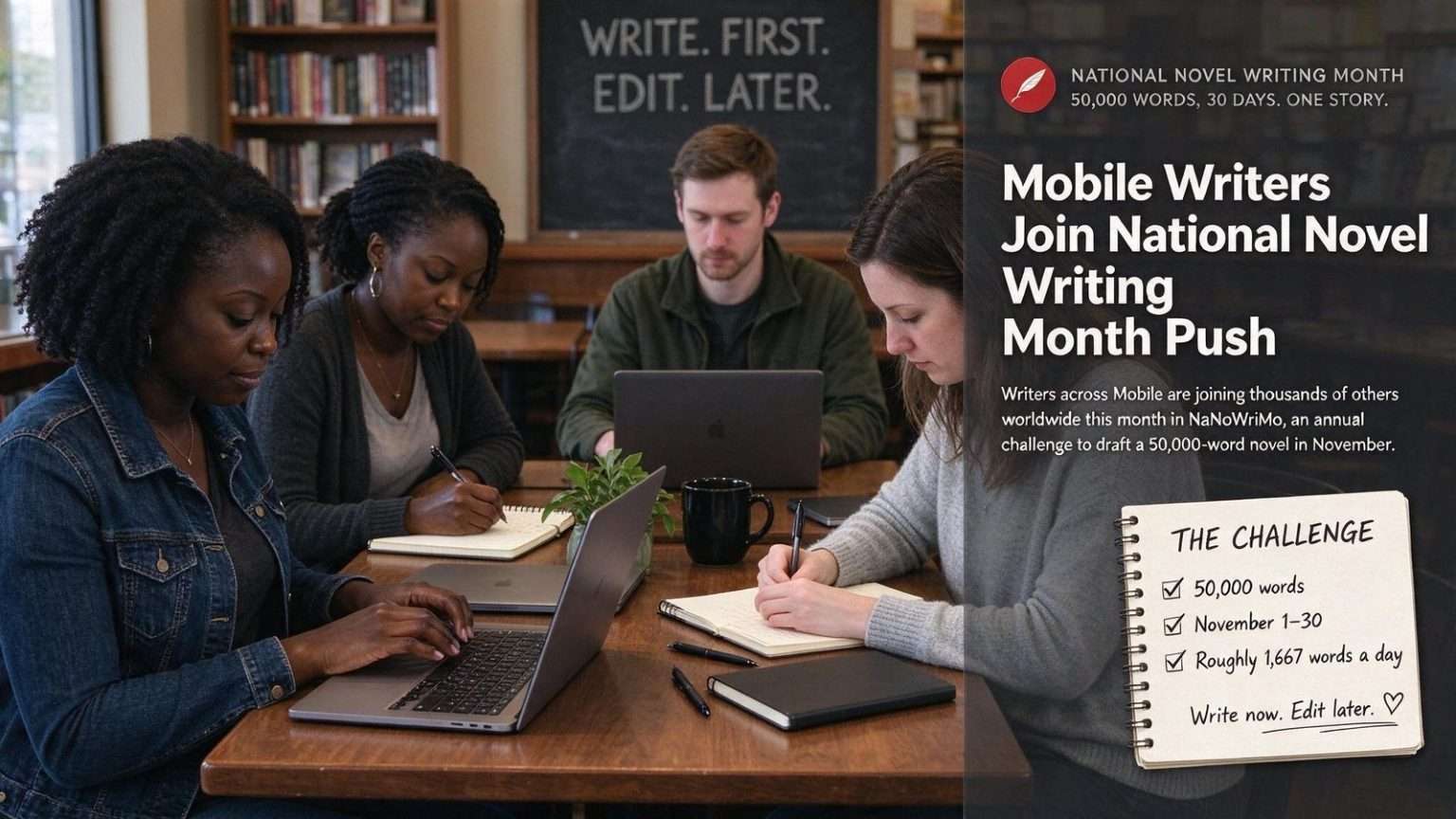
Writers across Mobile are joining thousands of others worldwide this month in National Novel Writing Month, known as NaNoWriMo, an annual challenge to draft a 50,000-word novel between November 1 and midnight on November 30. The challenge, which began Monday, asks participants to produce roughly 1,667 words a day to hit the target by the end of the month.
For most participants, that daily figure is the heart of the experience. It turns an abstract, intimidating ambition — “someday I’ll write a book” — into a concrete, countable task that fits into lunch breaks, early mornings and evenings after the kids are in bed. Falling behind by a day or two is normal; the challenge’s built-in pacing gives writers room to recover, and the shared deadline keeps the pressure gently on through Thanksgiving and the last frantic week.
A challenge built on output, not polish
Organizers behind the program describe it as an exercise built around output rather than polish, encouraging participants to silence their inner editor and simply get a full draft on the page. The idea is that many people who have thought about writing a novel never start because they get caught up trying to make every sentence perfect the first time through. Chapter one gets rewritten half a dozen times, momentum dies, and the manuscript stalls at twenty pages.
NaNoWriMo’s founders designed the event to break exactly that pattern. By demanding quantity within a fixed month, the challenge forces writers to push through the doubts, dead ends and dull stretches that inevitably appear in a long work. A scene that does not work is noted and left behind; a character who wanders off course is allowed to wander. Revision, in this philosophy, is a separate project for December and beyond — and a writer can only revise something that actually exists.
The approach has produced real results. Novels drafted during past NaNoWriMo challenges have gone on to mainstream publication after revision, and the event’s alumni include authors whose books became bestsellers. Organizers are careful to note that the overwhelming majority of November drafts will never be published — and say that is beside the point. The challenge’s deeper goal is to prove to participants that they can complete a long creative project, a milestone many describe as life-changing even when the manuscript stays in a drawer.
Local writers gathering for support
To help participants stay motivated through the monthlong sprint, a Mobile-based NaNoWriMo group is organizing weekly meetups where writers can compare notes on their progress, talk through plot problems and keep each other accountable. The time and location of the sessions were still being finalized, and organizers said turnout and interest from local writers would help shape the schedule.
These in-person gatherings, known in NaNoWriMo circles as write-ins, are a tradition of the event. Participants bring laptops or notebooks to a library, coffee shop or community room and write in companionable silence, punctuated by word-count check-ins and occasional plotting arguments. Veterans of past challenges say the format works because it removes the isolation that kills so many solo writing projects — it is much harder to skip a writing session when a dozen other people are expecting to see you there.
Anyone interested in joining the Mobile group can search for “National Novel Writing Month: Mobile AL Meetups” on Facebook to connect with other participants in the area. The group’s page serves as the coordination point for the local writing community, where members post meetup times, swap encouragement during the mid-month slump and organize shared sprints against the clock.
The social layer of NaNoWriMo has proven to be one of its most durable features. The event’s official forums and regional groups let writers in the same city compare word counts, trade critiques of opening chapters and commiserate over day ten, the point veterans identify as the challenge’s classic danger zone — when the initial excitement has faded and the ending is still too far away to feel real. Local groups soften that stretch, and many participants say the friendships formed during a November challenge outlast the manuscripts.
Mobile’s writing community extends well beyond November. The city’s public library branches host author talks and writing workshops through the year, the University of South Alabama and other local institutions support creative writing programs, and the Gulf Coast’s literary scene — from independent bookstores to writing collectives — gives new writers plenty of places to keep going after the challenge ends.
Registering and tracking progress
Registration for the challenge itself remains open throughout November on NaNoWriMo’s website, where writers can log their word counts and connect with the wider community. The site’s tracking tools turn the month into a visible progression: a daily word count, a running total, and a chart showing how far a writer is ahead of or behind the pace needed to reach 50,000 words by the deadline.
The gamified element is more powerful than it might sound. Watching a graph climb past the halfway mark provides its own momentum, and the site’s community features let writers announce milestones — the first 10,000 words, the messy middle, the final sprint — to an audience of fellow participants who understand exactly what those moments feel like.
To be counted among the year’s official winners, participants need to reach the 50,000-word mark by the November 30 deadline, though organizers note that simply starting and building a writing habit is itself a meaningful goal for many who take part. “Winning” in NaNoWriMo carries no prize beyond the verification of the word count and the right to display the winner’s certificate — but the community treats it as a genuine achievement, and many writers frame the certificate or pin it above their desks as proof of what they can do.
Why 50,000 words matters
The 50,000-word target is not arbitrary. It falls within the range of many published novels, and it is long enough that a writer must confront the structural challenges of a real book — pacing across dozens of chapters, character arcs that sustain over months of story time, subplots that need paying off. A writer who reaches the finish line has, in the most literal sense, written a novel’s length of prose, even if the draft needs substantial work.
Participants are encouraged to start a fresh project on November 1 rather than continue an existing manuscript, on the theory that a blank page plus a fixed deadline produces the freewheeling draft the challenge is designed to elicit. Some writers plan extensively in October, outlining chapters and sketching characters; others, in the challenge’s own vocabulary, “fly by the seat of their pants” and discover the story as they type. Neither approach is officially favored — the only rule is the deadline.
For Mobile participants, the month ahead offers a rare combination: a global event with a hard deadline, a local group meeting weekly for accountability, and the quiet satisfaction of joining a writing tradition that has turned hundreds of thousands of people into novelists, whatever became of their drafts. The word counter starts now.
Tips from long-time participants
Veterans of past NaNoWriMo challenges tend to offer the same handful of survival strategies. Write every day, even if the words are bad — a 300-word day preserves the habit in a way that skipping entirely does not. End a session in the middle of a scene rather than at a natural stopping point, so the next session begins with momentum instead of a blank cursor. Keep a running notes file for research questions and continuity problems rather than stopping to solve them mid-draft.
Experienced participants also urge writers to protect their writing time the way they would any other appointment. The challenge’s daily arithmetic — 1,667 words — is forgiving in the first week and punishing by the third for anyone who falls behind, and the most common reason drafts die is not writer’s block but scheduling. An hour blocked out before work or after dinner, defended consistently, is worth more to a November draft than a heroic weekend binge followed by three silent days.
Finally, veterans remind newcomers that the inner editor will get loud around the midpoint, when the draft’s flaws become undeniable. The challenge’s answer is the same every year: keep writing. Flaws are fixable in December; a half-finished draft abandoned in week three is not.
The challenge’s wider footprint
NaNoWriMo began as a small gathering of friends in the San Francisco Bay Area and grew into a nonprofit event with participants in dozens of countries. Its impact on writing culture is easy to spot: the phrase “50,000 words in November” is now common shorthand among writers, and the event’s emphasis on community accountability has inspired spin-off challenges for poets, editors and bloggers throughout the year.
The organization has also used its scale to promote writing education, funding creative writing programs in classrooms and providing free curricula for young writers. Participants can join through school programs, adult challenges or simply as individuals with an idea and a deadline.
For the Mobile writers typing toward midnight on November 30, the mechanics are simple and the support is local. Registration is open on the NaNoWriMo website, the Facebook group “National Novel Writing Month: Mobile AL Meetups” connects local participants, and weekly meetups will give the community a place to gather as word counts climb. Whether a draft becomes a published book or a private milestone, the challenge’s core promise holds: in thirty days, a novel can go from an idea to a finished first draft.