Mobile’s ACCEL Charter School Graduates Its First Senior Class
ACCEL Day and Evening Academy, Alabama's first public charter school, graduated its inaugural class of 45 seniors in Mobile, capping a first year defined by academic gains, counseling support and hard-won lessons in running a brand-new school.
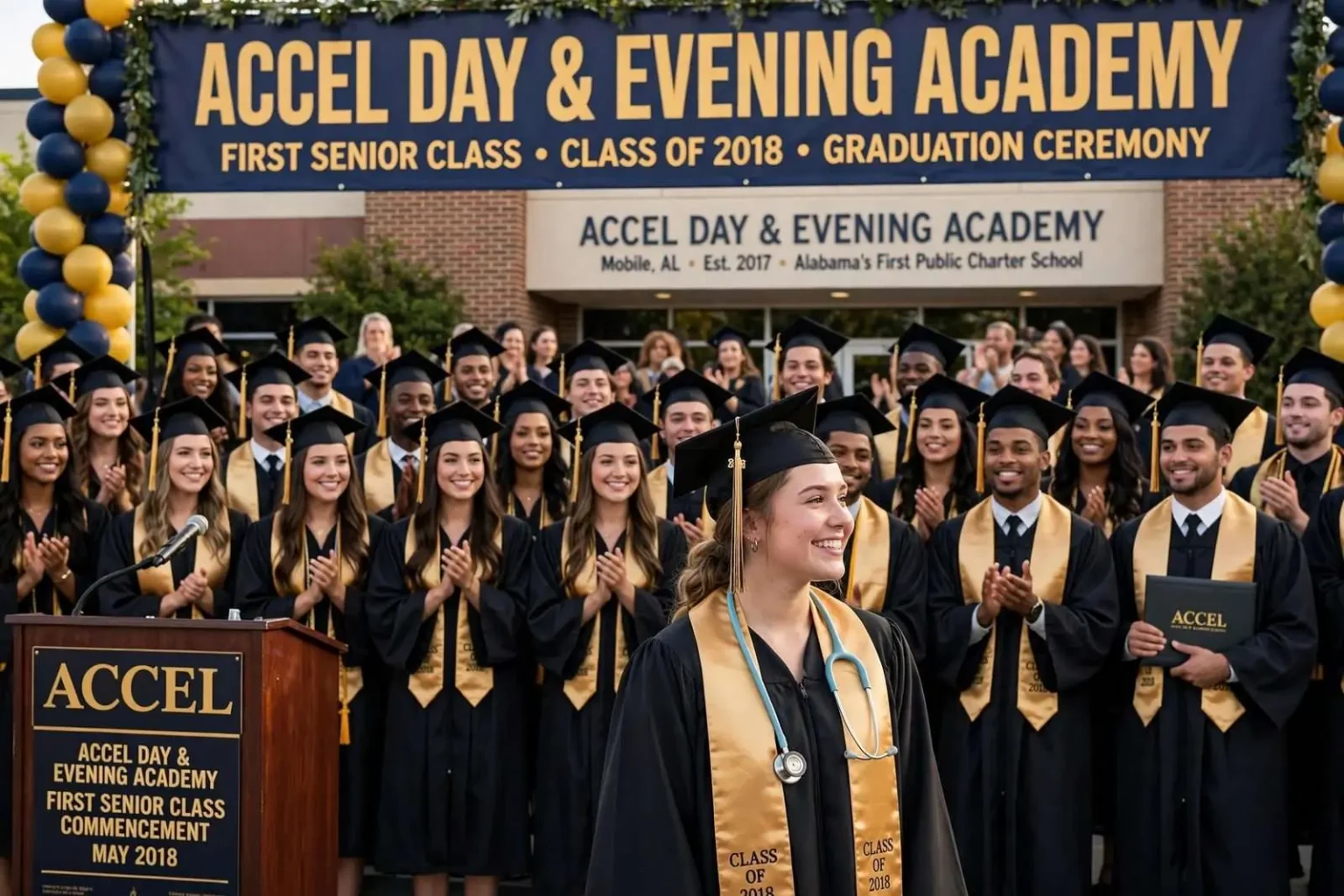
Forty-five students walked across the stage last month as the first graduating class of ACCEL Day and Evening Academy, marking a milestone for the school that opened in 2017 as Alabama’s first public charter school. The ceremony capped a turbulent, closely watched first year for a campus built specifically for teenagers who had fallen behind or dropped out of traditional high schools altogether.
Among the graduates was Kaitlyn Burgess, who left Davidson High School during her junior year after being diagnosed with epilepsy. She said the school did not have a full-time nurse on hand to administer emergency medicine, and after suffering two seizures on campus, she stopped attending. For two years, she said, she had no plan for what came next.
“I really just gave up. For two years I didn’t know what I was going to do,” Burgess said.
While working toward a GED, Burgess learned about ACCEL, a school backed by the Mobile Area Education Foundation that was designed to serve high school dropouts and other students considered at risk of not finishing school. She enrolled and, within a single year, completed both her 11th and 12th grade coursework by attending day school, night school and online classes simultaneously. She graduated with a diploma and has since accepted a $72,000 scholarship to Spring Hill College, where she plans to study nursing with an eye toward becoming a pediatric neurology nurse practitioner.
“In my opinion, the work was more difficult than a traditional public school, but they give you the tools you need to do it. Teachers were actually helping us, not just sitting us down with a worksheet,” Burgess said.
From Dropout to Diploma
ACCEL Superintendent Jeremiah Newell said the “at risk” label attached to the school’s mission is often misunderstood as targeting troubled students, when in reality it describes a wide range of circumstances that show up in every public school system.
“Every school, and particularly public schools, have ‘at risk’ kids. We have students who are homeless, students who are primary caretakers of their family, students who have families of their own, students facing chronic health issues — these are not unusual,” Newell said. “The difference is we’re saying, ‘We hope that you come’ and not, ‘You’re in our zone so we’ve got to do something with you.’ We’re trying to plan a school around those realities.”
Charter schools operate as public schools funded with public dollars, but they are run by nonprofit boards rather than elected school boards, and Alabama law requires that at least 20 percent of a charter school’s board be made up of parents of enrolled students. ACCEL’s students take the same state assessments and are held to the same academic standards as students in traditional public schools, and the school is bound by a contract with the Alabama Public Charter School Commission that spells out specific academic goals for the population it serves.
Of the 45 graduates in ACCEL’s inaugural class, 20 entered the school with junior-level credits and nine with sophomore-level credits, meaning many students compressed multiple years of coursework into a single year to reach graduation. Newell said building a sense of ownership among students helped offset the fact that many of them arrived without the traditional four-year cohort of classmates.
“So much went into supporting and building a strong school culture this year. Students didn’t feel like they lost something because they hadn’t been here for four years, it was much more a sense of pride for being the first,” Newell said. “These students really felt like they were trailblazers.”
The school’s name reflects its structure: in addition to a standard school-day schedule, ACCEL offers evening classes and online coursework for students who need extra time to catch up or cannot attend during a traditional 8 a.m. to 3 p.m. schedule. Academically, the school relies on competency-based learning, meaning students advance to new material once they demonstrate mastery of a concept rather than automatically progressing based on grade level.
How Competency-Based Learning Works
“Some ninth-grade students took an algebra I course the entire year because they came in with third, fourth and fifth grade-level math skills. They just couldn’t master it one semester,” Newell said. “Others did it in one semester, then took geometry the next semester and are looking forward to taking algebra II in August. These are both true ninth graders, but their paths are different.”
Newell said roughly 80 percent of instruction during ACCEL’s first year was focused on bringing students who were behind grade level up to where they needed to be, with the remaining 20 percent aimed at advancing students who were already on pace.
Carolyn Akers, chief executive officer of the Mobile Area Education Foundation, said the counseling support built into ACCEL’s model has been central to its early success. The school employs two full-time advocate counselors who function similarly to traditional school counselors, along with licensed therapeutic counselors who work with students on issues both inside and outside the classroom. Burgess said those counselors helped her personally and also guided her through the college application process, including financial aid and scholarship paperwork, as she applied to and was accepted by several colleges.
“I didn’t have the greatest home life, and just felt like I was having a rough time and needed someone to talk to,” Burgess said. “They found that immediately.”
Because ACCEL’s students enter at different academic levels and progress at different rates, the state has not yet calculated a traditional four-year graduation rate for the school, and the eventual calculation is expected to be more complex than for a typical high school. Even so, Newell pointed to internal assessment data as evidence of progress during the school’s debut year.
“Eighty-two percent of our students are on track at this point to move on to the next grade level, whereas 80 percent of those same students were off track when they came in,” Newell said. “Forty-one of the graduates this year left college and career ready and had benchmarked on the ACT or WorkKeys. That’s about 91 percent, which I think is really strong for a first year.”
Counseling Support and Graduation Metrics
The first year was not without setbacks. Akers said building a school from scratch came with what she called “a huge learning curve,” including one significant miscalculation: the cost of feeding roughly 200 students a day. Because ACCEL is housed in the former ITT Technical Institute building on Cottage Hill Road, the campus has no cafeteria, and meals have been brought in daily through partnerships with local businesses, including Clark’s Catering, Morrison’s Cafeteria, Foosackly’s and Little Caesars.
“I think that probably was our big misstep, and that’s why we own it,” Akers said. “We had to do what we had to do, and that included raising a lot of outside money to help soften that blow.”
Next year, the school plans to partner with a local school district’s Child Nutrition Program to bring down food costs, though without an on-site kitchen, ACCEL will continue to rely on outside meal preparation.
The school also saw notable student attrition in its first year. ACCEL opened with 240 students last August, and about 39 of them, or roughly 16 percent, left by the end of the first semester.
“We originally set a goal of having about 85 percent of our kids retained. I think we’re a little bit closer to 75 percent this year,” Newell said. “That’s OK considering it’s the first year, but as a school, we’d like to see that improve. It’s one of our main targets.”
Because Alabama school funding is based on enrollment from the first semester of the prior year, ACCEL’s lower fall enrollment could work in its favor this year even as the school aims to grow. Newell said administrators expect enrollment to top 300 students in the coming year, which will require the school to stretch funding calculated on a base of 240 students.
Accountability, Funding and Public Perception
Logan Searcy, who serves as the liaison between the Alabama State Department of Education and the charter school commission, said ACCEL delivered a strong first year despite the pressure that comes with being the state’s first charter school.
“It was a good year, and Mobile has a lot to be proud of,” Searcy said. “There’s a lot of pressure on them, and they’ve withstood it and done a great job.”
Searcy said ACCEL now faces a thorough evaluation and audit by the charter school commission this summer, in which a third party will review the school’s academics, operations, governance, culture, climate and financial stability, with the findings made public. She said many Alabamians do not realize charter schools face this level of scrutiny.
“They have all the same requirements as any other public school, plus they have to meet what they’ve agreed to do in their charter contract. It’s a second layer of accountability that traditional public schools don’t have,” Searcy said. “They have a five-year contract, and they can be closed down if they don’t meet those objectives.”
Charter schools remain a point of controversy in Alabama, where critics argue they divert funding from traditional public school systems. The state spends roughly $9,000 per student annually, meaning a system that loses 10 students to a charter school loses about $90,000 in funding. Newell said that framing overlooks the fact that charter school students are public school students as well, and noted that several of ACCEL’s students were dropouts for whom no school system was receiving any funding at all.
Newell said misconceptions about the school have often been shaped by broader political debate over charter schools rather than by ACCEL’s actual track record.
“Completely reductive” is how he described the mindset that charter schools are inherently bad and therefore ACCEL must be as well.
Akers, who has worked alongside public educators in Mobile County for decades, said that kind of rhetoric has been personally difficult to absorb, in part because it has come from former colleagues.
“I do think one of the biggest obstacles has been misinformation about what we’re trying to do here, and a lot of it has come from people I worked with side by side for a long time,” Akers said. “The charter school legislation, for us, was a vehicle we could use to try something different.”